Saturday, 25 October 2014

Three Tuns (Old Three Tuns Hotel), Moor Lane

Old Three Tuns Moor Lane Bolton


The Old Three Tuns can be seen boarded up in the distance on this 1973 photograph from the Bolton Library and Museums Service collection (copyright Bolton Council).

There were three pubs in Bolton by the name of the Three Tuns. One was on Bridge Street, one on Chapel Street, off Folds Road, and this one on Moor Lane opposite what is now the fire station.

Having multiple pubs with the same name wasn’t uncommon. Bolton had two Nags Heads – the Higher Nags and the Lower Nags– two Millstones, two pubs named the Hen and Chickens, two Dog and Partridges and there was a whole host of pubs named the  Bowling Green.  

The full name of this pub was the Old Three Tuns Hotel. Having ‘Old’ as a prefix usually denoted it was the original. Not so in this case. The Three Tuns on Chapel Street was in existence by 1800, the Old Three Tuns on Moor Lane followed a few years later in 1804.

The pub was a meeting place for the St John’s Lodge of the Freemasons. The lodge was formed in 1815 in Chowbent (or Atherton as it is now known). Unusually, it had its headquarters in a number of towns moving from Chowbent to Tyldesley and then to Halshaw Moor (now Farnworth) before basing itself at the Three Tuns in 1836. The lodge’s itchy feet were in evidence yet again when it upped sticks just two years later and it met at three more Bolton pubs before returning to the Three Tuns in 1842. It remained at the pub for the next 31 years. One of the oldest lodges in the country, St John’s Lodge number 348 still exists and meets these days at the Masonic Hall on Silverwell Street. [1]

The part of Moor Lane around the bottom end of Deane Road gave us two of  Bolton’s oldest sporting institutions. Bolton Wanderers were formed at Christ Church school and were headquartered at the nearby Britannia Inn before moving to Burnden Park in 1895. Meanwhile, in 1908, Bolton United Harriers were formed at the Three Tuns.

One of the pub's landlords who went on to greater things was Frank Whittle. He ran the pub in the early-sixties before the licensed trade took him off to a further seven pubs in various parts of the country. Frank ended up in Stowmarket, Suffolk, where he served as a local councillor and was the town’s mayor in 2007-08. [2]

The Three Tuns was a Magees pub for much of the twentieth century. It was then bought by Greenall Whitley as part of their takeover of Magees in 1958 and the pub lasted until 1973. Council plans for the southern limb of the inner relief road meant it was bought under a compulsory purchase order and demolished soon after it closed.  

[1] Lane's Masonic Records. Retrieved 25 October 2014.
[2] Leigh Journal. 14 May 2008. Retrieved 25 October 2014.




Friday, 24 October 2014

Jolly Waggoner, Deane Road


Jolly Waggoner Deane Road Bolton


The Jolly Waggoner, pictured around 1975. Image from the Bolton Library and Museum Services collection. Copyright Bolton Council.

The Jolly Waggoner was originally a shop at the gable end of Balshaw Street, which ran down the side of the pub.

In the early-1840s a local character named Joseph Atherton owned a donkey and cart and had a business selling cockles and mussels on the streets of Gate Pike, as the area at the bottom of Deane Brow was known. ‘Cockle Joe,’ as he was known, eventually moved to the top of Balshaw Street where he opened a shop and traded as a greengrocer and fishmonger. He was still known as ‘Cockle Joe’ even after expanding his product range and he was later joined in the business by his son Amos, nicknamed ‘Yam Cockle’.

An un-named beerhouse had previously been run by Richard Marsh in the 1840s from his small house in Balshaw Lane, but that had closed by 1853. The Farmers Arms closed in 1869 while the Split Crow beerhouse had also closed. In the early-1870s Cockle Joe sold his shop and on the addition of an extension the premises were converted into two separate businesses. These fronted the main road, then known as Pikes Lane but later re-named Deane Road. One of the businesses was a butcher’s shop while the rest of the premises, on the Balshaw Street side, became a beerhouse.

The licensed premises were originally known as the Red Herring Inn, perhaps as a nod to Cockle Joe, who by now had moved to the top of Gilnow Lane. 

In 1875, John Bennett became licensee. Bennett was a popular local figure, a jovial character who drove his lorry and three horses around Gate Pike and it was from Bennett that the pub took its new name – the Jolly Waggoner.

The pub was an early Magees outlet. Hazel Morgan was born at the pub in 1934 – her parents were managers there for 38 years. Her recollections of the pub are contained here on the Bolton Revisited site

One of Hazel’s anecdotes worth repeating concerned her bridesmaid, Midge, a chimpanzee belonging to Edgar and Phyllis Charlton who owned the pet shop at 148 Derby Street. Hazel’s husband, David Harrison, worked for the Charltons. One night, as Hazel and David slept at the Jolly Waggoner there was a screech of brakes from the street outside. Midge had escaped from the shop on Derby Street and had run down to Deane Road where she narrowly escaped being run over by a lorry. More recollections of Midge can be seen here and here

The Jolly Waggoner was among the first of a huge raft of Bolton beer houses to obtain full public house licenses at the start of the sixties. A large number of pubs successfully applied in 1961, but the year before, in 1960, the Jolly Waggoner was one of a small number that tested the water with an application.

By then it was a Greenall Whitley pub. The image at the top of the page was taken around 1975, according to the Bolton archive records. That would have been five years after Greenall’s had closed Magee’s brewery on Derby Street though it is possible that the photo was taken earlier than 1975.  An earlier image can be seen here in the Bolton News archives.The pub had long since expanded into the adjoining retail premises.

Greenall’s eventually got out of brewing and the licensed trade. Its tied estate was split up and by the time the Jolly Waggoner closed in 2006 it was owned by Hyperhold Ltd, a small operator of pubs and bars that has since gone out of business. 

The Jolly Waggoner was sold de-licensed. It initially became a cybercafé and business centre but is now in use as a restaurant.

The Jolly Waggoners pictured in 2012


Thursday, 23 October 2014

Split Crow, Pikes Lane


Fern Street runs off to the right on this April 2012 image (copyright Google Street View), Deane Road runs to the left. The boarded-up Jolly Waggoner can be seen in the distance, the Lilian Hamer home is in the foreground. The Split Crow was close to the corner with Fern  Street, roughly where the patch of grass is.

The Split Crow is one of those long-lost pubs that even failed to make it into any of Gordon Readyhough’s books, so brief was its existence. We have the early-twentieth century Methodist historian Hannah Cottrell to remind us that it ever existed.

In the early-twenties Mrs Cottrell set out to write a history of the Methodist church on Fern Street, off Deane Road. As an illustration  she sets out a vision of the area of Deane known as Gate Pike in the early-1840s immediately prior to the arrival of Methodism.

Gate Pike was a hamlet situated roughly halfway between the outskirts of Bolton and Deane church, at the foot of Deane Brow. It consisted of just three streets: Balshaw Street, Markland Street (later Gate Street) and Moss Street (later Fern Street). The area still exists around by the former Jolly Waggoners pub and the Lilian Hamer old people’s home.

Mrs Cottrell describes some of the characters who lived in the area at the time and the nicknames they were given. There was ‘Owd Woof’ who ran the corner shop at the top of Balshaw Street; Joseph Atherton – ‘Cockle Joe’ – who sold cockles and mussels from a wheelbarrow. ‘Cockle Joe’ was succeeded in the business by his son Amos, nicknamed ‘Yam Cockle’. A clogger named Aspinall was known as ‘Old Sootum’, the Heaton family were known as the ‘Yettons,’ ‘Saut Bob’ was the rag-and-bone man and ‘Owd Hardneck’ the army pensioner.

But as a Methodist it was the plethora of drinking establishments that Mrs Cottrell took aim at. Owd Woof sold beer at his shop; a man named Dick Marsh sold beer at his cottage at the top of Balshaw Street; there was the Farmer’s Arms, the Gibraltar Rock, the Cross Guns and the Split Crow, all within a short walk from each other.

For a small community of perhaps a few hundred people that is a lot of places to sell beer. The Methodists’ promotion of the abstinence from alcohol meant that as they expanded from their chapel at Ridgway Gates in the centre of Bolton, a small self-contained community such as Gate Pike where beer was widely available meant it was a target for the establishment of a Methodist presence. Indeed, the place was known to them as ‘Hell’s Mouth’.

“Swearing, drinking and gambling were excessively indulged in by many of the men whose wives and families were miserably neglected. Their running dogs, fighting cocks and pigeons received far more attention and consideration than did their little children.” [1]

The Split Crow was situated on land now occupied by the Lilian Hamer home. It was in the middle of a row of three houses on Pikes Lane, which later became Deane Road. Next door, on the corner of Moss Street (was William Worthington’s butchers shop where calves and sheep were slaughtered in the cellar.

The Methodists arrived in the area in the spring of 1843 when they rented a cottage, 34 Balshaw Street. The Split Crow was already in operation by then having sprung up in the aftermath of the 1830 Beerhouses Act.

The pub closed some time in the 1850s. By then the Methodists had moved from Balshaw Street to Moss Street (renamed Fern Street around 1869) where they built a small chapel in 1843. In a twist of irony they bought the Split Crow. It reverted back to a private residence and became the chapel-keeper’s house of the Wesleyan chapel.

In 1927 the Methodists moved to a new church a few yards away on Deane Road on land now occupied by Bolton Blinds. The old Fern Street Wesleyan church was converted into a cinema, the Plaza, and number 336 became part of the cinema complex. The Plaza became the Windsor in January 1937 and closed in 1962. [2]

The Lilian Hamer old people’s home was built on the site in 1973. That closed in 2009 and remains vacant. An attempt to sell the home for £325,000 failed in 2010.

[1] Gate Pike: The Story Of 80 Years’ Methodism, 1843-1923, by Hannah Cottrell (Mrs Albert Openshaw). Originally published by Tillotsons (Bolton) Ltd (1924). The book is a comprehensive history of the Wesleyan church up to that time and includes a history of the bottom part of Deane from Deane Brow and Gate Pike down to Chamber Hall closer to town.

[2] Cinema Treasures website. Retrieved 23 October 2014.

Sunday, 19 October 2014

African Chief, Moss Street


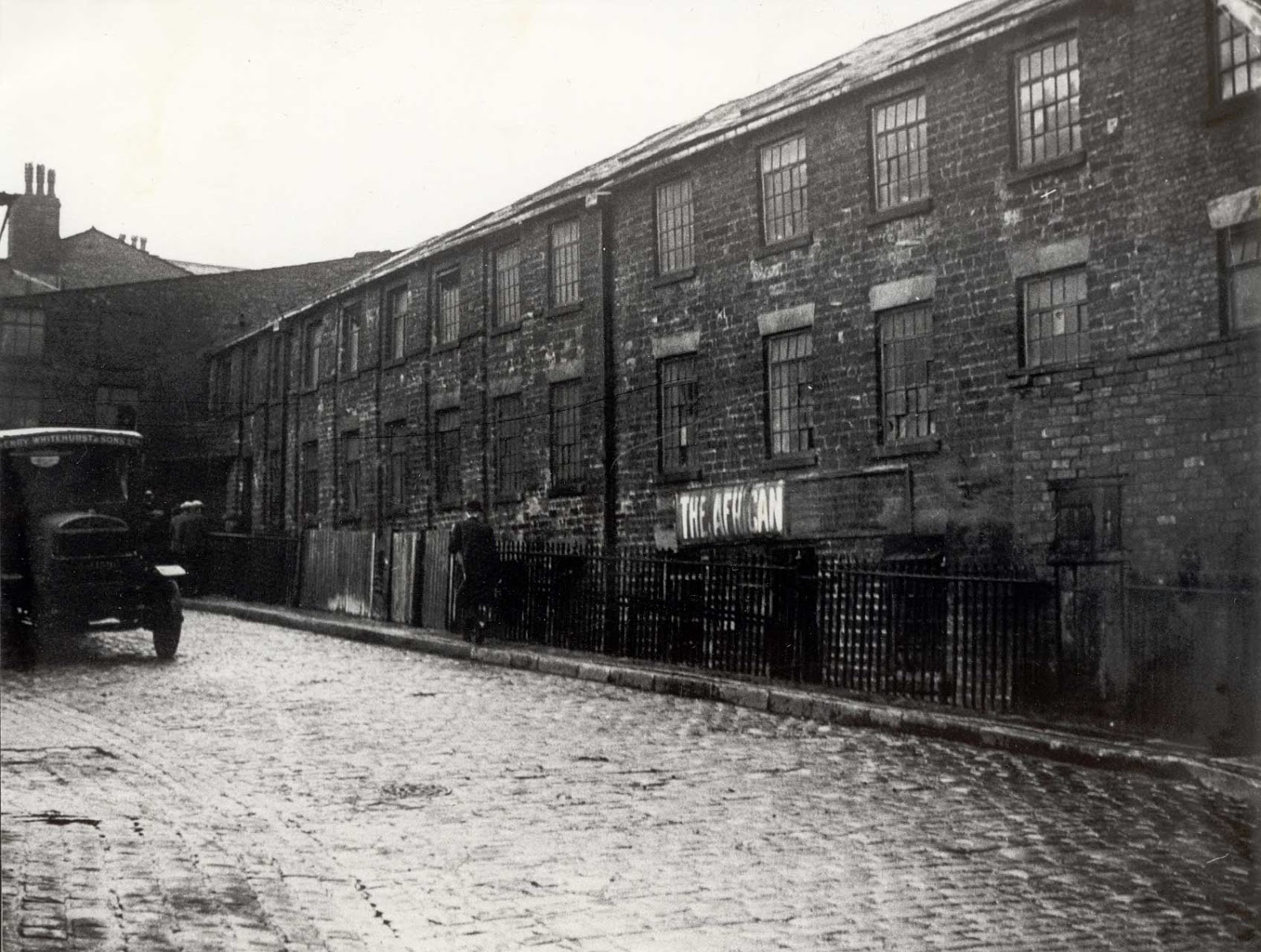
Here’s an interesting photo. It’s from the Bolton Libraries and Museum collection. (Copyright Bolton Council) but not much is known about the image.

‘The African’ – African what? It looks as though it may have been a pub sign, in which case it could have been the African Chief on Moss Street. The vehicle in the picture and the dress of the man walking up the street and the men further up all suggest it is later than the turn of the century so it would have been taken some years after the pub closed, which was in 1908.

The African Chief dated back to the 1860s when it was owned by Charles Seddon of the St George’s Hotel, St George’s Road. [1] By 1871 it was one of two beerhouses in Moss Street: one at number 4 owned by George Davison and one at number 5 owned by David Orrell. This latter establishment is more likely to have been the African Chief.

A number of Irish families lived in Moss Street in the 1880s and 1890s. In 1881, the Irish-born William Thompson and his wife Mary kept the pub. Another Irishman, Francis Lenaughan, would soon succeed him. Other Irish-born residents in the street included the Queenans and the Linehans. [2]

The African Chief became an Atkinson’s pub and in 1898 it came into the hands of the Manchester brewery Cornbrook’s after they took over Boardman’s brewery who had bought out Atkinson’s in 1895. Cornbrook’s obviously decided to sell the African Chief as it was owned by Hamer’s when its licence was refused in 1908.

So is the photo of the African Chief? It’s possible but by no means certain. A look at a map of the area in 1893 shows Moss Street coming to an end by Victoria Mills but all we really have to go off is an incomplete sign.

Moss Street was partly redeveloped in the twenties and Moss Street Baths were built in 1924 on the site of the former Richmond Terrace and Richmond Place. The baths remained open until 1987.

[1] Bolton Pubs 1800 – 2000, by Gordon Readyhough. Published by Neil Richardson (2000).
[2] About Laurence Queenan. Retrieved 20 October 2014.


Saturday, 18 October 2014

Red Lion, Crook Street


The Red Lion was situated at the Derby Street end of Crook Street, just four doors along from the Flying Horse.

The pub dated back to the 1840s, probably the latter end of that decade. It first appears in the 1849 licensing records when the licensee was James Nuttall.

The Red Lion was owned by William T Settle whose brewery was based near the Rose and Crown pub, off Turton Street. However, in the early days of its ownership the brewery was known as Booth’s. William T Settle was born out of wedlock to Robert Booth and Rachel Settle. The couple later married and had two more sons, Albert and Daniel. Meanwhile, William T Settle went to work in the Rose and Crown’s brewery as a 14-year-old and later took over the business. He expanded the tied estate and installed his brothers at two of its pubs, Daniel at the Rope and Anchor on Kay Street and Albert at the Red Lion.

One day, during a visit to the pub, William and Albert got into an argument during the course of which Albert remarked that the name of the brewery – Booth’s – didn’t correspond with William’s surname of Settle. William picked up a stool, smashed the window with the Booth’s brewery name on it and said “It will have Settle’s Ales on it tomorrow”. All the pubs were subsequently changed to Settle’s.

Settle’s remained in control of the Red Lion until 1951. The brewery and its pubs were then sold to Dutton’s of Blackburn.

The Red Lion last for just two more years before being closed in 1953. It remained standing for some years afterwards but it was demolished in the mid seventies.


This image of the slip road to Aldi looking towards the bottom of Derby Street was taken in May 2012 and is copyright Google Street View. The site of the Red Lion was on the left of the image roughly where the slip road starts. 

Tuesday, 14 October 2014

Grapes Hotel, Victoria Square

Grapes Hotel Victoria Square Bolton

The Grapes is on the right of this photograph taken from the clock tower of the Town Hall around 1900. Nearby shops included Hyde Brothers, T Hindle, the  British and Colonial Meat Company and Charles Bowker. Photograph from the Bolton Library and Museums Service collection. Copyright Bolton Council.

The Grapes was situated on Victoria Square, though when it opened in 1840 the square was actually the New Market Place

During the early part of the nineteenth century, like in so many of the old-established pubs in Bolton, this pub played host to numerous political discussion groups [1]. The politics discussed depended on how well-furbished the pub was. The Ship on Bradshawgate was quite plush and was frequented by the town’s businessmen, as was the Swan Hotel. The customers in those pubs were more likely to lean towards the Tory Party. The George and Dragon on Oxford Street played host to a Liberal debating society, while in the poorer part of Bolton, the Dog Inn – also known as the Talbot – on Brown Street was a meeting place for more left-wing radical politics. [2]

In the Grapes’ early days it was adjoined by a portable theatre which had been placed there before the pub opened. Parish’s fit-up travelling theatre performed Margaret’s Ghost there in February 1836. The California market was subsequently situated next to the pub. [3]

Gordon Readyhough describes the Grapes as “a typical town centre pub”. Entrances were in Victoria Square and in Exchange Street which still runs down by the side of the former site of the pub. [4]

The Grapes closed in 1960 and was demolished in the same year. Shops were built on the site. A Wimpy bar was on part of the site for many years. That was succeeded by Kingburger and now a café named Tiffany's In The Square.  

[1] Leisure In Bolton, 1750-1900, Robert Poole, 1982
[2] Malcolm Hardman’s book Classic Soil: Community, Aspiration, and Debate in the Bolton Region of Lancashire, 1819-1845 goes much deeper into the local politics of that time.
[3] Arthur Lloyd’s theatre history site.  Accessed 14 October 2014.
[4] Bolton Pubs 1800-2000, by Gordon Readyhough. Published by Neil Richardson (2000).

Sunday, 12 October 2014

Oscar's, The Wellsprings, Le Mans Crescent


An Oscar's gig guide from the spring of 1994. Members of Lost Boys are now in Glam 45.

Oscar’s opened in 1989 in the cellar of The Wellsprings, an office block built on the site of which a large stone building that once housed Bolton Central Library.

The old library building opened in 1893 but closed in 1932 when the library service moved to the newly-built Civic Centre across the road. It remains there to this day. Its former premises was the Victoria (Civic) Restaurant from 1948 to 1951 before housing National Insurance and local government offices until they moved to Elizabeth House when that was completed in 1971. It was subsequently used as the Bibliographic Services unit of the library until it was demolished in the mid-eighties. The Wellsprings was built in its place. [1]

Part of the entrance to Oscar’s was on the site of the Town Hall Hotel, a former pub that closed in 1933.

Oscar’s was initially a café bar but it soon gained a reputation as a live music venue and it had live acts on most nights of the week as the above leaflet shows. It’s hard to imagine a pub having so much live music on these days with only the Alma Inn or the Dog and Partridge coming close.

The pub was run by the same management team that ran Hawthorn's on Spa Road. 

Oscar's closed around 2004, supposedly when the lease ran out. Far from the premises being taken up by another pub lessee the premises were given over to a ladies-only gym.

A night-time view of The Wellsprings from March 1996 can be seen here.  

Another gig poster from the 1990s can be found here


[1] Bolton Town Centre, A Modern History. Part One: Deansgate, Victoria Square, Churchgate and Surrounding Areas, 1900-1998