Showing posts with label Crook Street. Show all posts

Saturday, 2 January 2016

Bridgeman Arms, Crook Street - Bridgeman Street


There were two pubs that went by the name of the Bridgeman Arms in the Bridgeman Street-Crook Street area. This about the first such pub which lasted from at least 1824 until the 1840s and was situated on Crook Street.

The pub was founded by Richard Makin who first appears as the landlord in the 1824 Bolton Directory. The previous Directory, for 1821/2, had no reference to the pub.

By 1830 the Bridgeman Arms was owned by Jeremiah Hardcastle who died in October of that year. A newspaper report says that he retired to bed one night only to be found dead in his bed at two o’clock the following morning. He died of an apoplectic fit and the verdict given at his inquest was: “Death by the visitation of God”. [1] By 1836 the pub was run by George Hutchinson.

Interestingly, the address of the Bridgeman Arms was given as Bradford Square which was the name given to the area around what is now Trinity Street prior to the construction of the Bolton to Manchester railway line. The railway opened in 1838.

Gordon Readyhough gives the pub’s date of closure as being around 1840 [2]. Certainly it was a landmark on census reports of 1841. [3]   By then it was being run by George’s wife Peggy Hutchinson and there is no indication as to what had happened to George. Its address according to the census was Bridgeman Street though it is listed as the first property after the junction with Crook Street. In those days Bridgeman Street continued across the railway line to link up with what is now known as Lower Bridgeman Street. In that case it may well have been at the junction of Crook Street and Bridgeman Street but backing in on to Bradford Square. That would put it in vicinity of the Albion Hotel on Bridgeman Street. 

Peggy Hutchinson was still running the pub according to the 1843 Directory but it seems to have closed shortly afterwards. However, it isn't beyond the realms of possibility that it changed its name to the Albion. 

The Bridgeman Arms name was subsequently used by a beerhouse that opened in the mid-1840s and was situated at 81 Bridgeman Street.

[1] Manchester Courier, 2 November 1830.
[2] Bolton Pubs 1800 – 2000, by Gordon Readyhough. Published by Neil Richardson (2000).
[3] Lancashire Online Parish Clerk project. Accessed 1 January 2016.

Map of Bolton 1824

An 1824 Map of Bolton. Bradford Square can be seen in the lower half of the picture.

Thursday, 10 December 2015

General Sir Robert Sale, Crook Street, Bolton


The first General Sir Robert Sale was situated on Crook Street in between the junctions with Ormrod Street and Blackhorse Street. The pub took its name from a British soldier in the garrison of Jalalabad during the First Afghan War (1839-1842). Known as “Fighting Bob”, General Sale was killed in action in 1844 during the First Anglo-Sikh War and was renowned for always being in the thick of any fighting.

In Bolton during the middle of the 18th century, a pub on Crook Street named after “Fighting Bob” would have been quite apt. The area bordered by Crook Street, Newport Street, Blackhorse Street and Ashburner Street was known as Newtown. There was an influx of Irish immigrants following the Great Famine of 1848-49 and it soon became the roughest part of an already rough town.

Thomas Lever ran a beerhouse in Great Moor Street in 1836, but he was on Newport Street by 1841 and by 1849 he was on Crook Street in the pub which was now named General Sir Robert Sale. Previously the property was a private residence.Two years later he was employing a brewer, Joseph Walton, who lived on the premises along with his wife and two children.

The Bolton Directories for 1853 and 1855 both have the pub’s address as 47 Crook Street. The Bowling Green, close to the junction with Ormrod Street was number 45. Even taking into account the fact that in those days streets weren’t always numbered odd on one side and evens on the other it still puts the General Sir Robert Sale quite close to the Bowling Green.

In 1854, Thomas Lever decided to apply for a full licence for the General Sir Robert Sale. It was one of 23 beerhouses that applied for licences to sell wine and spirits as well as beer. But the application was heard by the staunch teetotaller Robert Walsh and all 23 applications were thrown out. [See here for more details].

Thomas Lever was still at the pub on the 1861. By this time he was 73 and his wife Margaret was 66. According to Gordon Readyhough, the pub was demolished a few years later to make way for modifications to the railway line in the area. The Crook Street goods depot was expanded and properties in the vicinity, including the General Sir Robert Sale, were demolished. But instead of giving up Thomas Lever simply moved to 97 Newport Street and re-opened under the same name. [1]

Click here for the second General Sir Robert Sale.

A car park now stands on the original site of the General Sir Robert Sale, on the right of the image below taken in August 2015. (copyright Google Street View)

[1] Bolton Pubs 1800-2000, by Gordon Readyhough. Published by Neil Richardson (2000).


Saturday, 21 November 2015

Barley Mow, 140 Crook Street, Bolton


Crook Street goes off in the distance and Thynne Street goes across the middle of this August 2015 image (copyright Google Street View). When Sainsbury’s was built on the site of the old Hick, Hargreaves factory in 2003-04 it took out much of Burns Street. Only the junction with Bridgeman Street now exists. At the other end of the street at the junction with Crook Street was the site of the Barley Mow, roughly where the bushes are on this image.

The Barley Mow was situated at the Thynne Street corner of Crook Street, part of a triangle of land also bordered by Burns Street and which was later used as a bus station.

The pub dated back to the 1840s when the part of Crook Street around the Holy Trinity church was being developed. It is mentioned on the licensing list of 1849, but it isn’t on directories from that decade – 1843 or 1848.

The first recorded licensee was Robert Hamer. Robert was a joiner living in Hanover Square according to the 1841 census. A decade later he and his wife Sarah were at the Barlow Mow along with their son Henry. But by 1861 he had given up the pub trade and was living just around the corner in Burns Street and working as a joiner and undertaker.

The Barley Mow was licensed to sell beer and wine, but Gordon Readyhough tells us in Bolton Pubs 1800-2000 that by the 1890s the licensee was also brewing his own beer. That is likely to have been Isaac Gibbons who spent around twenty years at the Barlow Mow from late-1870s onwards. By 1901 he had moved to the Grapes on Blackburn Road.

The Barley Mow lasted until 1910 by which time it was being supplied by Wilson’s brewery of Newton Heath, Manchester. Later in the twentieth century Wilson’s were a major supplier of beers in Bolton. 

The premises were demolished soon afterwards and in time the rest of the buildings between Burns Street and Thynne Street were also pulled down. For some years from the 1940s up to the expansion of Moor Lane bus station in 1969 this parcel of land was used as a small bus station by operators such as Salford Corporation Transport and Lancashire United Transport. Salford’s number 8 bus to Manchester used this small station which consisted of no more than a few stone shelters.  A 1958 map of Bolton bus services shows that the number 12 to Manchester, the 41 to Worsley and Eccles, the 49 to Union Road Mills, the 51 to Little Lever and the 52 to Bury via Little Lever and Radcliffe all left from this bus station. When the buses moved to Moor Lane the land was used as storage by Thistlethwaites Tyres. When the news Sainsbury’s was built Thistlethwaites moved across Burns Street to occupy the whole parcel of land that once contained the Barley Mow.


 “John McDermott, 19, was indicted for stealing from the person of Robert McClenahan, a silver lever watch and three shillings in money on 28 June. Mr Marshall prosecuted and Mr Cottingham defended. The parties were drinking together on the day in question and at the Barley Mow on Crook Street, prosecutor fell asleep. He awoke at eleven o’clock at night, but the prisoner had then left, and the watch and money were gone. The prosecutor was drunk at the time, and admitted in cross-examination that it was probable he might have asked the prisoner to take care of the watch. Evidence as to the character of the witness was given and by direction of the Recorder a verdict of not guilty was at once returned. The Recorder, in discharging the prisoner, said that in this case the prosecutor was more to blame than the prisoner, and he ought to leave that court thoroughly ashamed of himself for his conduct.”

Bolton Evening News, 23 July 1869.

Saturday, 20 June 2015

Brunswick Hotel - Railway Shipping Inn - Bowling Green, 91 Crook Street


The Brunswick Hotel was situated at 91 Crook Street on the corner with Ormrod Street.

Like many beerhouses it began life as a shop. The 1841 census shows Wright Sutcliffe as a shopkeeper in Crook Street. Ten years later, in 1851, he is described as a provision dealer. However, Mr Sutcliffe was already a beerseller having appeared as such in the 1843 Bolton directory. A list of Great Bolton beerhouses for 1848 shows that Mr Sutcliffe was the landlord of the Bowling Green on Crook Street. This was the pub’s original name came from a nearby bowling green situated on the corner of Crook Street and Blackhorse Street.

Wright Sutcliffe also appears to have owned the Greengate Inn on Hammond Street. In 1854, he applied unsuccessfully to convert it from a beerhouse into a fully-licensed pub, but the application failed. He ran the Bowling Green until his death in March 1875 and was succeeded by his grandson, Wright Lever. He had been living at the pub in 1871 along with his wife Harriet, the first of his three wives and had previously lived in nearby Andrew Street.

The first thing Wright Lever did was to change the name of the pub from the Bowling Green to the Railway Shipping Hotel for the simple reason that the bowling green had long since been built over and Wright wanted to appeal to railway clerks from the nearby Great Moor Street station.

Wright Lever was at the pub in 1881 along with his second wife, Sarah Ann (nee Gerrard), her daughter Harriet from her first marriage and Sarah’s widowed mother Sarah Wardle. But by the early-1890s Wright Lever had given up the pub trade and was living at 142 Deane Road along with Sarah and grand-daughter Phyllis Elliott. Sarah died a few years later, but Wright Lever married for a third time. In 1901 he was 53 years old and still living at 142 Deane Road but with his third wife Louisa Ann (nee Smith), then aged just 19, and their five month-old son Wright. He died in 1930 aged 82.

The Railway Shipping Hotel was bought by local firm Atkinson’s whose Commission Street brewery was situated half a mile away from the pub. It received a full licence in 1888 following the closure of the Old Hen and Chickens, situated further down Deansgate from where the sole surviving Hen and Chickens (formerly the Higher Hen and Chickens) still stands.

By 1898, the pub was owned by Cornbrook’s of Manchester and it remained in their hands until it closed in 1955. It was renamed the Brunswick Hotel after the First World War. The licence was transferred to another of Cornbook’s Bolton pubs, the Bull’s Head (‘Bottom Bull’) on Bury Road.

The Brunswick remained standing until 1968 when it was demolished. The Trinity Street dual carriageway runs through the site of the pub.

Ormrod Street still exists, at least in part. It runs from Great Moor Street down the side of the Grosvenor Casino – the original Sainsbury’s. But part of the street running up towards Crook Street was closed off many years ago and is now as parking for residents of Hargreaves House.


Trinity Street pictured in September 2014 (copyright Google Street View). The walled car park on the left marked the end of Ormrod Street. The Brunswick stood on the far corner of the junction as we look.

Saturday, 18 October 2014

Red Lion, Crook Street


The Red Lion was situated at the Derby Street end of Crook Street, just four doors along from the Flying Horse.

The pub dated back to the 1840s, probably the latter end of that decade. It first appears in the 1849 licensing records when the licensee was James Nuttall.

The Red Lion was owned by William T Settle whose brewery was based near the Rose and Crown pub, off Turton Street. However, in the early days of its ownership the brewery was known as Booth’s. William T Settle was born out of wedlock to Robert Booth and Rachel Settle. The couple later married and had two more sons, Albert and Daniel. Meanwhile, William T Settle went to work in the Rose and Crown’s brewery as a 14-year-old and later took over the business. He expanded the tied estate and installed his brothers at two of its pubs, Daniel at the Rope and Anchor on Kay Street and Albert at the Red Lion.

One day, during a visit to the pub, William and Albert got into an argument during the course of which Albert remarked that the name of the brewery – Booth’s – didn’t correspond with William’s surname of Settle. William picked up a stool, smashed the window with the Booth’s brewery name on it and said “It will have Settle’s Ales on it tomorrow”. All the pubs were subsequently changed to Settle’s.

Settle’s remained in control of the Red Lion until 1951. The brewery and its pubs were then sold to Dutton’s of Blackburn.

The Red Lion last for just two more years before being closed in 1953. It remained standing for some years afterwards but it was demolished in the mid seventies.


This image of the slip road to Aldi looking towards the bottom of Derby Street was taken in May 2012 and is copyright Google Street View. The site of the Red Lion was on the left of the image roughly where the slip road starts. 

Tuesday, 9 September 2014

Painters Arms, Scandals, Mr D's, The Academy


Painters Arms Crook Street Bolton


The Painters Arms pictured in 1978. Although the pub’s address was Crook Street, for many years the main entrance was on Thynne Street.

The Painters Arms was at 148-150 Crook Street.  It is possible that the building was in use as a dwelling before it became a pub but it was certainly in use as licensed premises by 1871. In that year Worrall’s Directory named the licensee as Joseph Young.

The Painters occupied the corner of Crook Street and Thynne Street and while the layout of the streets around the pub changed over the years the building can be seen on old maps from the middle of the nineteenth century.

In those days Crook Street was still pretty much where it is today, though it went on for much longer beyond the Sweet Green. Burns Street, which was largely covered by the rebuilt Thistlethwaites Tyres in 2004-5, was already in existence, but the street that now forms the end of Thynne Street in front of Holy Trinity church and running past the Painters, was known as Bleakley Street and only ran as far as the junction with Bridgeman Street.

Behind the pub, just off Bleakley Street, was Horrocks Court, the entrance to which can still be seen today. Horrocks Court was a short thoroughfare just a few yards long. On the left-hand side were the rear of the Painters Arms and other buildings on that part of Crook Street; on the right-hand side were four small houses. Those houses were demolished after the first world war.

Thynne Street came into existence around the 1860s and was extended to run past the Painters in the 1930s. At that time a small bus station was built on the site of what is now Thistlethwaite's garage and was used by buses to Salford and Manchester (the number 8 service) up to the late-sixties.

Thynne Street, along with Matthew Street North, Matthew Street South, Bleakley Street, Burns Street, North Street and Moncrieffe Street, formed the catchment for custom at the Painters. But Thynne Street was re-developed in the early sixties. Houses standing on one side of the street were demolished to form the short dual carriageway that still exists today. Properties in Matthew Street North and South and also North Street were demolished and those streets were erased from the map.

The Painters was a Magee's pub in the early part of the twentieth century but was sold to Hamer’s Volunteer Brewery of Bromley Cross. Hamer’s were bought out by Dutton’s Brewery of Blackburn in 1951, while Dutton’s merged with Whitbread’s in 1954. [1] [2]

On 9 January 1941 the area close to the Painters Arms was hit by a bomb during a German air raid with a cafe on the corner of Burns Street taking a direct hit. The reminiscences of that night by Trev Barker, a night watchman, can be read here.  

In the Painters Arms became Scandal’s, a kind of disco-fun pub. Four years later it was renamed Mr D’s, a late-night gay disco aimed at clientele of the nearby Church Inn, which closed at 11pm . By 1994 it was known as The Academy as its owners chased the student population that had moved into the nearby Orlando Village development.

The Academy closed in 1999 and the building was boarded up for a while before becoming the Achari Indian restaurant.

In September 2014 a plan to convert the upper floor of the building into four flats was withdrawn by the applicant.

[1] Pubs Of Bolton 1800-2000, by Gordon Readyhough. Published by Neil Richardson (2000).
[2] Turton Local History group did some research into Hamer’s pubs in 2003 and 2004. Their work remained incomplete and appeals were made in the Bolton Evening News. However, the pubs they were able to identify makes for interesting reading. Click here for the list.

Below are two more recent views of the former Painters Arms. First is Crook Street pictured in March 2011 with the premises in use as the Achari Restaurant. The original entrance to the rear of the pub has been restored. At the bottom is a view from April 2009 (copyright Google Street View) similar to the view at the top of the page.


Sunday, 20 April 2014

Parkfield Inn, Crook Street


Parkfield Inn Crook Street Bolton
The  Parkfield pictured shortly before its closure in 1973.

The Parkfield Inn was situated on Crook Street and dated from the second half of the nineteenth century. 

The pub was stood on the corner of Dawes Street and an older, narrower thoroughfare named Parkfield Street. The area behind the Parkfield – on land now occupied by Morrison’s supermarket - was known as Newtown in the middle of the nineteenth century and was the poorest part of the town. Parkfield Street was in the heart of Newtown.  

The area was settled by Irish immigrants fleeing the famine of 1848 and the squalor of the conditions in the area were recounted by Dr. Edward Ballard in his Report Upon The Sanitary Condition Of The Registration District Of Bolton,Lancashire, And Particularly Upon Its Infant Mortality. A copy of the report still lies in Bolton Central Library.


We know the pub was standing in the 1870s as the landlord, Robert Dobson, died in 1888 and his will was considered important enough to be published in the London Gazette [1] demanding that anyone who had a claim on his estate need contact the late Mr Dobson’s solicitors. The executor of the will was Adam Smith of the Pike View on Derby Street which, Gordon Readyhough says, was owned by Dobson in the 1870s when he was described as a wholesale brewer based at the Parkfield Inn. [2]

The Parkfield eventually came under the ownership of William Tong & Son at their Diamond Brewery in Deane.  Tong’s were taken over by Walker Cain in 1923 and Walker’s merged with Tetley’s in the early sixties.

The construction of Bolton’s inner relief road marked the end for the Parkfield. The pub was under a compulsory purchase order and bought by Bolton council in the early seventies. The pub closed on 19 July 1973 and its closure marked the retirement of licensee Annie Hamer after 50 years at the pub. She was also said to be teetotal!

The Parkfield was subsequently demolished although that section of the inner relief road – the Trinity Street extension – wasn’t completed until 1979.


Crook Street in the foreground, Morrison's supermarket in the background in this image taken in March 2011. The green sward of grass represents the approximate location of the Parkfield Inn. Copyright, Lost Pubs Of Bolton.


[2] Pubs Of Bolton 1800-2000, by Gordon Readyhough, published by Neil Richardson (2000).

Saturday, 5 April 2014

Flying Horse, Crook Street


The entrance to the Bolton town centre branch of Aldi. While ascertaining the exact site of the Flying Horse is difficult, a good guess would be roughly where the exit road from the supermarket enters onto the main thoroughfare. Image taken in 2012. Copyright Google Street View.


The Flying Horse was situated on the corner of Crook Street and Great Moor Street. Given that Gordon Readyhough states that the Flying Horse was a beerhouse [1] it was probably established in the 1830s following the passing of the 1830 Beer House Act.

A few years later, on Monday 10 July 1839, some of the town’s constables visited the pub along with the Mayor of Bolton. This was probably Robert Heywood, local businessman and reformer who gifted part of his estate to form ‘Bobby Heywood’s park’ and who was the second Mayor Of Bolton in 1839-40.

Unfortunately, the welcome Mayor Heywood and the constables received in the Flying Horse was not a warm one.

As one of the constables stated in his report: “While in the Flying Horse at 10 o’clock the Landlord became very abusive and threatened to take the poker to the Mayor and myself, calling us spies.” [3]

A correspondent to the Bolton Revisited project states that in the twenties the pub was next door to a smithy where horses were shoed. [4] 

The Flying Horse closed in 1924 by which time it was owned by the Empress Brewery of Manchester. The premises were later used a Spiritualist Church.

The site of the pub is covered by the curve of Trinity Street close to where it merges into Derby Street.

[1] Pubs Of Bolton, 1800-2000, by Gordon Readyhough. Published by Neil Richardson (2000).
[2] Bolton Mayors website. http://www.boltonsmayors.org.uk/heywood-r.html Accessed 5 April 2014. Interestingly, Robert Heywood, while a teetotaller at home, often drank alcohol while abroad.
[3] Leisure In Bolton, 1750-1900, Robert Poole, 1982
[4] Bolton Revisited. Accessed 5 April 2014.

Friday, 28 March 2014

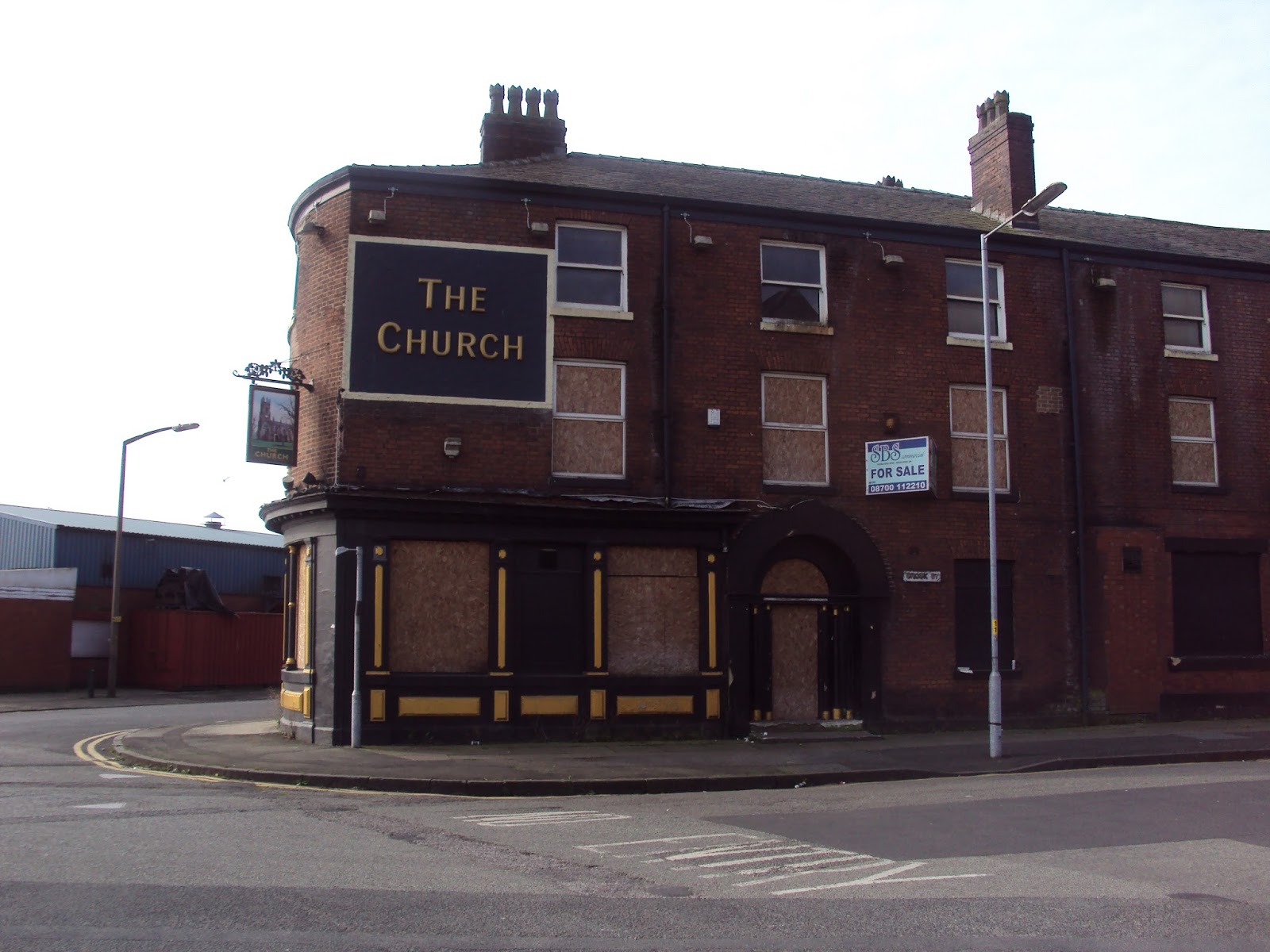
Church Hotel, Crook Street

Church Hotel Crook Street Bolton

The Church Hotel photographed in March 2011. Copyright Lost Pubs Of Bolton.

The Church Hotel was situated on Crook Street at the junction of Moncrieffe Street and was built in the 1830s, soon after the consecration of the nearby Holy Trinity Church.  

It became a Tong’s pub late in the nineteenth century before being one of 21 pubs taken over by Walkers of Warrington when they bought out Tong’s in 1923. It became a Tetley pub in 1960. [1]
During the seventies the Church gained a reputation for its live entertainment. At that point cabaret artists were largely confined to politically-affiliated clubs but the Church put on a number of top acts in a smaller, pub setting. 

By the early eighties the Church became a meeting point for Bolton’s ‘New Romantics’ and later that same decade it became a gay pub after the landlord and landlady of the Railway on Great Moor Street moved to the Church.

Terry Whalebone took pictures of the Church in 2007 (see here and here) but the pub closed a few years later and was sold in 2012 for conversion into flats.


[1] Pubs Of Bolton 1800-2000, by Gordon Readyhough, published by Neil Richardson (2000).