Showing posts with label Newport Street. Show all posts

Thursday, 10 December 2015

General Sir Robert Sale, 97 Newport Street, Bolton


Click here for the first General Sir Robert Sale.

The General Sir Robert Sale was previously on Crook Street close to the Bowling Green pub. However, it was demolished to make way for modifications to the railway, specifically an expansion of the Crook Street goods depot and improvements to the lines as they entered Great Moor Street station and the landlord, Thomas Lever, decided to move to Newport Street.

Thomas Lever had been running a beer house on Newport Street according to the 1843 Bolton Directory. With the closure of the General Sir Robert Sale he rented premises at 97 Newport Street and opened up again under the same name.

But by 1869, Thomas Lever was ready to get out of the pub business. He was now 82 years old.

“To Be Let – the Sir Robert Sale BEERHOUSE. Apply on the premises. 97 Newport Street.”

Bolton Evening News, 2 June 1869.

The pub was taken on by James Hardman. However, he was soon succeeded by John Balch, a carter whose wife Sarah came from a pub-owning family.

But rather like the original pub the General Sir Robert Sale was once again defeated by the railway. A scheme to build the Johnson Street curve linking the Bolton to Preston line with the Bolton to Blackburn line necessitated the demolition of a number of properties on Newport Street, including the General Sir Robert Sale. The pub closed in the early 1880s and a bridge over the new line was built in its place.

The bridge is still there and can be seen on this August 2015 image looking up Newport Street (copyright Google Street View).


General Sir Robert Sale, Crook Street, Bolton


The first General Sir Robert Sale was situated on Crook Street in between the junctions with Ormrod Street and Blackhorse Street. The pub took its name from a British soldier in the garrison of Jalalabad during the First Afghan War (1839-1842). Known as “Fighting Bob”, General Sale was killed in action in 1844 during the First Anglo-Sikh War and was renowned for always being in the thick of any fighting.

In Bolton during the middle of the 18th century, a pub on Crook Street named after “Fighting Bob” would have been quite apt. The area bordered by Crook Street, Newport Street, Blackhorse Street and Ashburner Street was known as Newtown. There was an influx of Irish immigrants following the Great Famine of 1848-49 and it soon became the roughest part of an already rough town.

Thomas Lever ran a beerhouse in Great Moor Street in 1836, but he was on Newport Street by 1841 and by 1849 he was on Crook Street in the pub which was now named General Sir Robert Sale. Previously the property was a private residence.Two years later he was employing a brewer, Joseph Walton, who lived on the premises along with his wife and two children.

The Bolton Directories for 1853 and 1855 both have the pub’s address as 47 Crook Street. The Bowling Green, close to the junction with Ormrod Street was number 45. Even taking into account the fact that in those days streets weren’t always numbered odd on one side and evens on the other it still puts the General Sir Robert Sale quite close to the Bowling Green.

In 1854, Thomas Lever decided to apply for a full licence for the General Sir Robert Sale. It was one of 23 beerhouses that applied for licences to sell wine and spirits as well as beer. But the application was heard by the staunch teetotaller Robert Walsh and all 23 applications were thrown out. [See here for more details].

Thomas Lever was still at the pub on the 1861. By this time he was 73 and his wife Margaret was 66. According to Gordon Readyhough, the pub was demolished a few years later to make way for modifications to the railway line in the area. The Crook Street goods depot was expanded and properties in the vicinity, including the General Sir Robert Sale, were demolished. But instead of giving up Thomas Lever simply moved to 97 Newport Street and re-opened under the same name. [1]

Click here for the second General Sir Robert Sale.

A car park now stands on the original site of the General Sir Robert Sale, on the right of the image below taken in August 2015. (copyright Google Street View)

[1] Bolton Pubs 1800-2000, by Gordon Readyhough. Published by Neil Richardson (2000).


Friday, 7 August 2015

Newport Vaults, 104 Newport Street


The Newport Vaults were situated at 104 Newport Street in premises that can still be seen today.

The first mention we have of the pub is 1869 when landlord James Crompton was placing advertisements in the Bolton Evening News advertising to 

his friends and the public generally that he has Opened a FREE and EASY for Singing and Reciting on Saturday and Monday Evenings at Six o’clock.” 

Mindful of the religious sensitivities if the time Mr Crompton advertised a programme of “Sacred Music” on Sundays. [1] 

Perhaps people didn’t flock to James Crompton’s ‘Free and Easy’ sessions because by the time the Bolton Directory of 1871 was published Joseph Hague was in charge.

In his book Bolton Pubs 1800-2000, Gordon Readyhough tells us that the Newport Vaults was a Tong’s house.  [2] However, one of the landlords in the 1890s was Wilbraham Leach, who was there in 1891. Mr Leach was just 24 and was a member of the Leach family of brewers who ran the Albert on Derby Street. It begs the question as to whether the Newport Vaults was also one of Leach’s pubs. Mr Leach went on to run the Clifton Arms, just five doors away, a few years later.

By the turn of the twentieth century the Gavagan family were in control of the Newport Vaults. John Gavagan was born in County Roscommon, Ireland in 1874 and by 1901 he was at the Newport along with his wife Margaret (nee Waterhouse - born Bolton in 1880), their two children, John’s brother, who worked as a navvy, and a number of boarders.


John Gavagan died in 1912. Margaret took over the pub and remained as licensee for the rest of its existence as a pub. She married William Yates in 1914 and when the couple decided to leave the pub in 1924 Tong’s closed it down. The building became retail premises and have remained so ever since.

The image above shows number 104 Newport Street. A pub for over 50 years the premises were Planet Pizza when this image was taken in 2008 (copyright Google Street View). It is still (2015) a takeaway but re-named McIndian.

[1] Bolton Evening News, 21 January 1869.
[2] Bolton Pubs 1800-2000, by Gordon Readyhough. Published by Neil Richardson (2000).

Saturday, 14 March 2015

Brewers Arms, 79 Newport Street


In 1851, William Whitfield was listed a brewer living in Newport Street, next to Back Newport Street on the stretch between Great Moor Street and Trinity Street. William was a brewer and when he converted part of his home into a beerhouse he gave it the name the Brewers Arms.

This appears to have been later in the 1850s. The pub doesn’t appear on an 1853 list of beerhouses, but it was being used as such by 1861. Whitfield was living there in 1861 with his wife, Catharine, two daughters and a grand-daughter. Later that decade – though six years apart - the two daughters, Hannah and Jane, each married one of the Almond brothers, Lawrence and John.

The Brewers Arms was close to the Newtown area of Bolton. The district was situated where the Morrisons supermarket now stands and was home to Bolton’s Irish community, but while the Brewers Arms was considered a rough pub it was popular with local railway workers. In 1869, an incident at the Brewers Arms led to the death of an Irish labourer, John Heyes. A man named Henry Horrocks, with whom Heyes had been drinking, was found guilty of manslaughter but was ordered to be bound over to the court for the sum of £20. [1]

William Whitfield died in 1872 and he was succeeded by Joseph Turton. The pub then began to sell beers from John Halliwell’s Alexandra Brewery on Mount Street and it was a Halliwell’s pub when it closed in 1908. [2]

The building was subsequently used as a branch of the Royal Liver Friendly Society but it was demolished in the 1950s. A new building was erected in its place which was taken over initially by Battersby’s department store who were previously further down Newport Street close to the town hall. Battersby’s were succeeded Whelan’s supermarket, owned by Dave Whelan the future chairman of Wigan Athletic. After the takeover of Whelan's in 1978 it became a branch of Morrison’s, followed by Kwik Save, Iceland and B&M Bargains. This successor building to the Brewers Arms was demolished in 2014 to make way for the new bus-rail interchange.

[1] The full story of the death is told in MurderousBolton, by Steve Fielding (2009). 
[2] Bolton Pubs, 1800 – 2000, by Gordon Readyhough. Published by Neil Richardson (2000). 


Newport Street at is junction with Back Newport Street pictured in 2012 (copyright Google Street View).


Tuesday, 3 February 2015

British Queen, 144 Newport Street

British Queen Newport Street Bolton

The British Queen pictured by Humphrey Spender in August 1937. The pub was right at the top of Newport Street which can be seen tailing off into the distance.  Image coyright Bolton Council from the Bolton Worktown website.

Every day, hundreds of Bolton people will head out of Trinity Street railway station on their way home from work. They will walk across Newport Street and head off along the dual carriageway, or perhaps cross at the traffic lights to head to Sainsbury’s. Up to 1972 neither of those choices would have been open to them without stepping into the British Queen.

According to the 1841 census, Edmund Seddon was a junior tailor living in Back Mawdsley Street. By the time Edmund’s son John Seddon married Mary Winward at Holy Trinity church in February 1865, Edmund was living at 144 Newport Street but he still described himself as a tailor for the benefit of the wedding certificate. But by the time Worrall’s published their Bolton Directory for 1871 number 144 Newport Street was a beerhouse with Edmund Seddon as its licensee. So did Edmund open a tailor’s shop at the top of Newport Street before turning it into a pub? It’s entirely possible. Either way, it seems Edmund Seddon founded the British Queen, but it wasn’t a long stay in the pub as he died in 1878, aged 62.

The British Queen subsequently became an Atkinson’s pub supplied from their brewery on Commission Street, off Deane Road. By the end of the nineteenth century it was owned by the Manchester’s Cornbrook Brewery. Cornbrook had taken over Boardman’s United Breweries in 1898 Boardman’s having themselves taken over Atkinson’s in 1895.
  
According to Gordon Readyhough’s book Bolton Pubs 1800 – 2000, the British Queen was later sold by Cornbrook to the local firm of Magee Marshall. If so, that sale would have taken place after the above photograph was taken in 1937. Given that Cornbrook wasn’t exactly over-represented in Bolton it seems a strange move to have given up one of their local pubs – and to the town’s major brewery.

The area around the British Queen underwent a huge change in the early seventies. Perhaps some older readers can recall the number 5 bus pulling into the lay-by outside the pub on its journey from Plodder Lane before continuing on its way into the town centre and on to Markland Hill. It was redirected along Crook Street and Soho Street when Newport Street was made into a one-way street from Trinity Street down to Great Moor Street.

Across the road, the Railway Hotel closed in 1972 and the British Queen shut its doors for the final time in the same year. Both were demolished in 1973 – the same year the Parkfield Inn  closed its doors. All three made way for the southern limb of Bolton’s Inner Relief Road which opened in 1979.


This image taken in September 2014 (copyright Google Street View) is from almost exactly the same position as the one at the top of the page. The long-standing firm of Clough’s opticians moved to its current premises in Newport Street in 1968 and stood next to the British Queen until the pub’s demolition in 1973.  The small wall outside the optician's marked the end of Allsop Street which still runs to the rear of premises on Newport Street.

Saturday, 15 November 2014

Railway Hotel, corner of Trinity Street and Newport Street


Railway Hotel Trinity Street Bolton


The Railway Hotel on the corner of Trinity Street and Newport Street pictured in 1937 by Humphrey Spender for the Bolton Worktown project (copyright Bolton Council). 

A number of railway stations in Bolton had pubs built nearby and they were almost inevitably named the Railway or the Railway Hotel. Moses Gate and Bromley Cross stations still have their Railway pubs. The Railway on St Helens Road and the Railway Inn on Bridgeman Street were both named in honour of the Bolton to Leigh line – the world’s second oldest – which ran close to both pubs. The Railway next to Great Moor Street station lasted long after the station was closed, but the opposite was true of the Railway Hotel on the corner of Newport Street and opposite the old Trinity Street.

The Railway dated back to the 1860s and was originally a beerhouse named the Railway Tavern. It gradually expanded into two neighbouring buildings and in 1879 it gained a six-day public house licence (which meant it couldn't open on a Sunday) when a pub named the Talbot (or Old Dog) on Brown Street surrendered its licence. Seven-day opening only arrived in 1935 when the Railway took over the licence of the Cross Keys on Cross Street.

As befits its name, the Railway operated as a hotel for a good part of its existence. There was also an upstairs function room.

Norman King reminisces about the Railway on the Bolton Worktown website. He says that in the fifties and early sixties a man named Jack Francis used to sell newspapers from a window ledge outside the Railway. Later, Jack’s son Stu Francis gained fame as a comedian and children’s entertainer as the presenter of the BBC television programme Crackerjack (“it’s Friday, it’s five o’clock….”). Mike Wilson adds that new management moved into the Railway following Jack’s death and refused to allow newspapers to be sold from their property, even if it was only from a small part of their window ledge.

The Railway was owned for many years by Threlfall’s brewery and passed into Whitbread’s hands when they took over the Salford brewery in 1967. Within six years the Railway had closed down. The pub was demolished soon afterwards for a number of years until the late eighties the site was an empty patch of land.

By the mid-eighties plans were advanced to replace the former Trinity Street station building with a new construction across the road. The plan wasn’t popular and readers of a certain age will forever compare the current building somewhat unfavourably with the far more grand building that once stood on Trinity Street bridge. Anecdotal evidence of the time from staff at the station suggested that subsidence and strain put on the bridge were apparently the reasons for the change. A new bus station was also to be built replacing a number of bus stops that had previously been sited on Newport Street a little further down from the Railway (buses to Astley Bridge were amongst those running from there).

In 1987, Bolton Interchange was opened incorporating the site of the Railway as well as the former buildings behind it on Newport Street.  After the interchange was completed the clock from the old Trinity Street railway station was placed on land formerly occupied by the pub.


This view, taken from the old Johnson Street footbridge in 1973, shows the rear of the Railway Hotel just prior to its demolition. Also shown is the Holy Trinity church, which was converted into flats in 2014 after being empty for a number of years.Taken from the Bolton Library and Museums collection  (copyright Bolton Council).

Railway Hotel Newport Street Trinity Street Bolton


A 1960s view of the corner of Newport Street and Trinity Street showing the Railway Hotel. The photo would have been taken from the offices at the corner of the Hick, Hargreaves factory on the corner of Crook Street. Taken from the Bolton Library and Museums collection (copyright Bolton Council).


A May 2012 view of the corner of Trinity Street and Newport Street with the clock from the old Trinity Street station building on the site of the former Railway Hotel. (copyright Google Street View).

Thursday, 2 October 2014

Grey Mare, 6 Newport Street

Grey Mare Newport Street Bolton


Newport Street in 1957 with Victoria Square in the distance. The third building up, beneath the Allsopp’s sign, is the Grey Mare. Picture from the Bolton Library and Museum Service collection, copyright Bolton Council. All the properties were demolished soon after the photo was taken. Battersby’s  ended up in a property further up Newport Street which was later turned into a supermarket which housed Whelan’s, then Morrison’s, Kwik Save, Iceland and B&M Bargains before being demolished as part of the new bus-rail Interchange.

The Grey Mare on Newport Street dated back to the 1830s although the building was initially constructed for other purposes. In his Historical Gleanings Of Bolton and District, TB Barton states the building was initially built to house the Bolton Chronicle, the local newspaper that began publication in 1824. By the 1830s the Chronicle had moved off and the building put to more useful purposes as a beer house before obtaining a full public house licence in 1844. [1]

In those days the address was given as 19 Cheapside rather than Newport Street. Cheapside ran from Victoria Square up to Ashburner Street. The three streets – Cheapside, Newport Street and Ashburner Street - met where the Newport Arcade now is. It was called Cheapside because in the middle of the nineteenth century this was the town’s main market place and the goods on offer in Cheapside were said to be of an inferior quality and were therefore less expensive than in the Market Place, which was where Victoria Square now is - hence the name.

The 1853 Bolton Directory gives the licensee as Squire Wolstenholme. Two of Mr Wolstenholme's sons went into the licensed trade. One of Squire's sons later ran the Lord Hill on Sidney Street.

By 1871, Thomas Ellis is listed as the landlord. Unfortunately, the entry was already out of date by the time the directory was published. Ellis had gone out of business and was living in an apartment at number 5 McHale’s Court, a row of low-grade tenements just off Derby Street. The McDonald's restaurant opposite the university now stands on the site of McHale’s Court.

Thomas Ellis was succeeded by John Wolstenholme - son of Squire - who remained at the Grey Mare until at least 1885. 

The Grey Mare was later a William Tong’s house and became a Walker’s pub when they took over Tong’s in 1923.

Last orders were called in 1957. Plans were laid to demolish all the properties on the western side of Newport Street along with properties on Old Hall Street South. The Grey Mare stood on the corner of Back Exchange Street, a small thoroughfare running down the side of the pub which was built over when Newport Street was redeveloped.

The pub's full license was transferred to the Mosley Arms, a newly-built pub on Red Lane, Breightmet.


[1] Bolton Pubs, 1800-2000, by Gordon Readyhough.

Monday, 2 June 2014

Wheatsheaf/Serendipity's, Great Moor Street


Wheatsheaf Hotel Newport Street Bolton


Newport Street with Great Moor Street running across pictured in the late-nineteenth century. The 1835 version of the Wheatsheaf can be seen on the left-hand corner.


The story of the Wheatsheaf Hotel is one of three buildings in two locations on opposite sides of the town centre.

While many people will associate the Wheatsheaf with the round building on the corner of Great Moor Street and Newport Street, the original Wheatsheaf stood on Bank Street – ‘Windy Bank’ as it was known to Bolton residents at the end of the 18th century.

In his book Pubs Of Bolton 1800-2000, [1] Gordon Readyhough claims the original Wheatsheaf opened in 1810. However, the list of Bolton pubs from 1778 shows that there was already a Wheatsheaf Hotel with Thomas Haslam as landlord.

The pub stood close to the entrance to the Unitarian chapel on Bank Street and the chapel’s bicentenary book from 1896 makes reference to the Wheatsheaf and its proximity to the chapel’s Sunday School, which was built in 1796:

“It [the Sunday School] stood between the passage to the old chapel and the old Wheatsheaf Inn. On the removal of this inn, with the inn-keeper and the name of the hotel, to the new Wheatsheaf in Newport Street, the school building, along with the inn, was pulled down, and shops built on the site.”

In those days Bank Street was a narrow passage, in fact it was “so very narrow that it was necessary for foot-passengers to step into some shop or doorway to avoid being crushed by a passing cart.” [Sayings and Doings of Parson Folds. Bolton : Geo. Winterburn, 1879, page 34]

In 1818 the landlord of the Wheatsheaf was Samuel Henry and he appears to have run the pub until shortly before it was removed to Newport Street in 1835. In the 1836 Bolton Directory [2], John Platt was the landlord of the Wheatsheaf while Samuel Henry was running a beerhouse on Bridgeman Place. [3] Samuel Henry’s departure may well have been the catalyst for the removal of the Wheatsheaf to its new location.

The Wheatsheaf was sold by auction for £8400 on 3 April 1878 [4] and was run in the 1880s and 1890s by George Walker, the proprietor of the Bolton Brewery Company Ltd. The premises were much larger than the building that still stands today and was run as a hotel, as this old photograph from the late-fifties shows. Here's another shot of the old building, this time from the Bolton Evening News taken in 1961 shortly before it was demolished.

Indeed, there appears to have been a Wheatsheaf Hotel Company that was taken over by the local brewery of Magee, Marshall and Co around 1909. Magee’s ran the pub until they were taken over by Greenall Whitley in 1958.

A few years later, Greenall’s took the decision to knock down the 1835 building and rebuild the Wheatsheaf in a modern style – complete with revolving doors. The new building was set further back than the old Wheatsheaf, but the pub had new neighbours: the western side of Newport Street had been demolished and rebuilt in 1957 and when the new Wheatsheaf was completed in 1962 it was more in keeping with the buildings that had sprung up around it. A new row of shops was later built next to the pub– including a branch of Hanbury’s and Shaw’s outfitters – so that corner of Newport Street and Great Moor Street had architecture which, while perhaps not entirely aesthetically pleasing, at least complemented each other and were much more of their time. Here's a photo from 1963.

The new Wheatsheaf had a much smaller bar area than the old building, though it did have an upstairs function room, used for weddings, engagements and the like, and also heavy rock discos for a few months around 1984.

In 1986, Greenall’s decided to refurbish the Wheatsheaf. The result was £100,000 spent on an “exciting and cosmopolitan” town centre venue known as Serendipity’s. The idea was that instead of being just a pub, Serendipity’s would also serve tea and coffee for passing shoppers.[5]

But for “exciting and cosmopolitan” read ‘one last throw of the dice’. Some of the rougher pubs were at that end of town and with the clientele to match. Serendipity’s did well at first, but towards the end it had become a pub to avoid. It closed around 1994 and after lying empty for a few years it was converted into a branch of cut-price retailer Home Bargains, which opened in 1997.


The former Wheatsheaf, pictured in April 2012. Copyright Google Street View.

[1] Pubs Of Bolton 1800-2000, by Gordon Readyhough. Published by Neil Richardson (2000).
[2] Four Bolton Directories: 1821/2, 1836, 1843, 1853. Reprinted by Neil Richardson (1982).
[3] The beerhouse on Bridgeman Place that Samuel Henry was running may well have become the Bradford, though not the pub of the same name a few hundred yards from Bridgeman Place, on Bradford Street. This one was where the petrol station now stands.
[4] Annals Of Bolton, James Clegg, 1888
[5] Bolton Beer Break, the magazine of the Bolton branch of the Campaign for Real Ale. Summer 1986 issue.


Tuesday, 27 May 2014

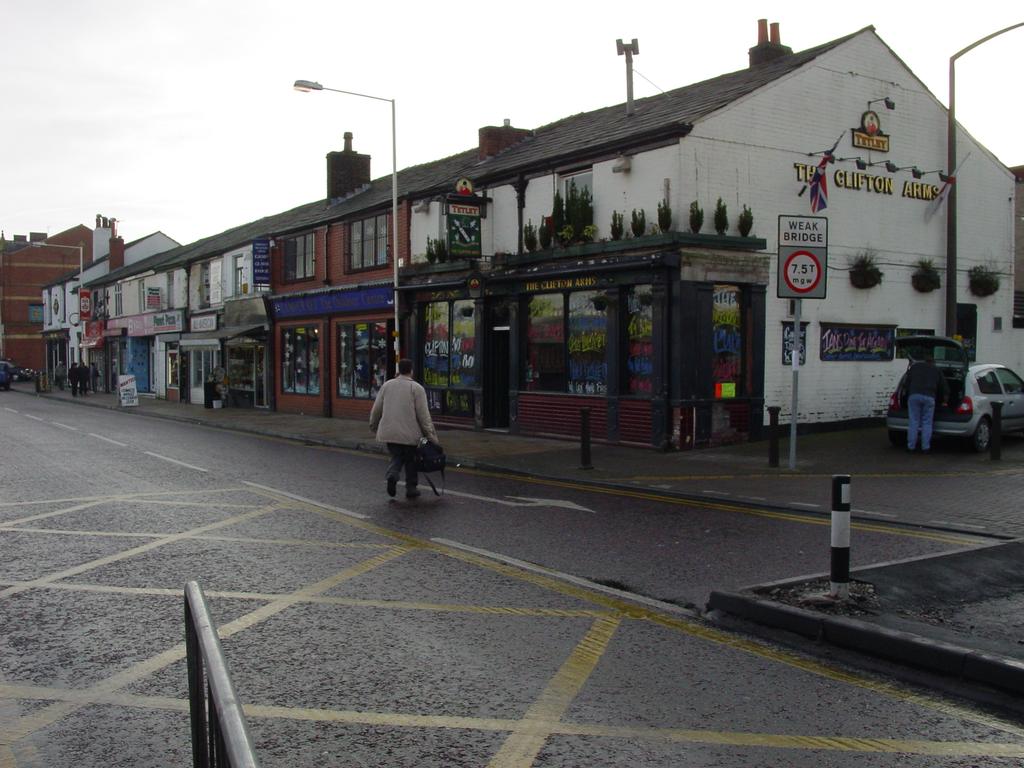
Clifton Arms/Gateway, Newport Street

Gateway Clifton Arms  Newport Street Bolton

A rather forlorn-looking Gateway (formerly the Clifton Arms) pictured in April 2012 (copyright Google Street View). By then the pub had already been closed for two years.

It’s always a shame to see a pub closed and boarded up. Sometimes the pubs that have gone are ones that only ever sold keg or smooth beer and while one feels they aren’t much of a loss even that is never the case. Some of these pubs have stood for a hundred years or more and served thousands of customers. But in the case of the Gateway – or the Clifton as most people will remember it – the fact that it closed is nothing more than a crying shame.

Twenty years ago there was a good little crawl from the Clifton to the York to the Sweet Green – or the other way round before carrying on to town.

Under the stewardship of landlord Pete Morris the Clifton began selling guest beers a full three or four years before the 1990 Beer orders chipped away at the brewery tie. Jennings Bitter was a regular on his bar alongside cask Tetley Mild and Bitter long before independent brewers from outside the area got space in a tied house.

By the time Pete retired in the early 2000s he regularly had about five real ales on the bar.
But it was never the same after he left. Many regulars left. The hand pumps soon fell into disuse and although the pub began to do food at lunchtime it simply wasn’t the same any more.

Licensees came and went and nobody seemed to be able to make a go of this once-thriving pub and it closed in early 2010.

The Clifton dated back to the 19th century and in the 1870s it was a beerhouse known as the Newport Arms. In those days that part of Bolton now bounded by Newport Street, Great Moor Street, Trinity Street and Blackhorse Street was known as Newtown and was inhabited mainly by Irish immigrants who moved to Bolton after the famine.

Despite that, the Clifton claimed to be celebrating its centenary in April 1987 although presumably it was the centenary of being renamed the Clifton. Anyone buying a pint with an old penny would get it at 1887 prices (1d, or 1/2p in new money). [1]

In the early part of the twentieth-century it was one of the few tied houses belonging to Leach’s Brewery based at the Albert Arms on Derby Street, a concern that went out of business in 1936 [see the entry for the Albert for more about Leach’s]. A member of the family, Wilbraham Leach, was the landlord of the Clifton in the 1890s and married another member of a pub-owning family, Emily Hilton, whose family owned the Uncle Tom’s Cabin pub and brewery on Lever Street. 

The Clifton was sold to the Empress Brewery of Manchester before becoming a Walkers pub in 1929. Walkers merged with Tetley of Leeds in 1961. [2]

The pub underwent a refurbishment in 1980 [3]. It was one of a number of Tetley pubs that were re-branded as Walker’s outlets and were given a new range of Walkers beers as well as a refurbishment in a more traditional style.  The bar was moved to the right-hand side of the pub and the premises were re-decorated throughout. Another refurbishment took place in 1986. [4]

The Clifton was renamed the Gateway around 2004 and after its closure it was up for sale for a few years before being converted into retail premises in 2013. The Post Office based across the road from the Clifton moved into the premises after being displaced due to the demolition of properties on that side of Newport Street for the construction of Bolton’s Bus/Rail Interchange.

The pub can be seen here in 2002  and  in the background in this picture from 2010.  But this is a great pic from 1989 Note the etched windows.

Clifton Arms Newport Street
The Clifton Arms pictured around 1930.


[1] Bolton Beer Break, published by the Bolton Branch of the Campaign for Real Ale, Summer 1987 edition.
[2] Bolton Pubs 1800-2000 by Gordon Readyhough, published by Neil Richardson (2000).
[3] What’s Doing, the Greater Manchester Beer Drinkers monthly magazine, January 1981 edition
[4] What’s Doing, September 1986

Monday, 14 April 2014

George and Dragon, Oxford Street

George and Dragon Oxford Street Bolton

The George and Dragon and surrounding properties pictured in 1907.


The George and Dragon stood on Oxford Street and dated back to at least the 18th century. It was certainly licensed in 1780 when the landlord was John Brown and in 1818 a Mr R Ainscow was the licensee.

During the early part of the nineteenth century, like in so many of the old-established pubs in Bolton, the George and Dragon played host to numerous political discussion groups [1]. In his book,  Classic Soil: Community, Aspiration, and Debate in the Bolton Region of Lancashire, 1819-1845, Malcolm Hardman states that the Liberal debating club met at the George and Dragon [2]. The Conservatives, meanwhile, met at the Swan Hotel while Hardman writes of a meeting in November 1816 of radicals at a pub “frequented by the lower orders” close to Dog Court on Brown Street. [Click here for details]. Maps of the time show a Dog Yard behind the Horse Shoe pub on Manor Street.

Although not a huge pub if the above photograph is anything to go by, the George and Dragon was used for meetings throughout the nineteenth century. As an example, when one of the pub's neighbours, the auctioneer and valuer James Holt of number 17 Oxford Street, went out of business in 1877, a creditors’ meeting was held earlier the following year at the George and Dragon. [3]

Later in the nineteenth century it was taken over by the local brewery of Joseph Sharman [4], but it was closed and demolished in 1924 when the Bolton Co-operative Society bought the site bounded by Oxford Street and Victoria Square to build a new department store. The Co-op remained at the site in 1986 when it was closed as part of the move to the new Normid Superstore built at the Embankment End of Burnden Park.

[1] Leisure In Bolton, 1750-1900, Robert Poole, 1982.
[2] Classic Soil: Community, Aspiration, and Debate in the BoltonRegion of Lancashire, 1819-1845, Malcolm Hardman. Published by Rosemount Publishing and Printing Corporation (2003).  
[3] London Gazette, January 4, 1878. https://www.thegazette.co.uk/London/issue/24538/page/96
[4] Pubs Of Bolton 1800-2000, by Gordon Readyhough. Published by Neil Richardson (2000).