Showing posts with label Pikes Lane. Show all posts

Friday, 24 October 2014

Jolly Waggoner, Deane Road


Jolly Waggoner Deane Road Bolton


The Jolly Waggoner, pictured around 1975. Image from the Bolton Library and Museum Services collection. Copyright Bolton Council.

The Jolly Waggoner was originally a shop at the gable end of Balshaw Street, which ran down the side of the pub.

In the early-1840s a local character named Joseph Atherton owned a donkey and cart and had a business selling cockles and mussels on the streets of Gate Pike, as the area at the bottom of Deane Brow was known. ‘Cockle Joe,’ as he was known, eventually moved to the top of Balshaw Street where he opened a shop and traded as a greengrocer and fishmonger. He was still known as ‘Cockle Joe’ even after expanding his product range and he was later joined in the business by his son Amos, nicknamed ‘Yam Cockle’.

An un-named beerhouse had previously been run by Richard Marsh in the 1840s from his small house in Balshaw Lane, but that had closed by 1853. The Farmers Arms closed in 1869 while the Split Crow beerhouse had also closed. In the early-1870s Cockle Joe sold his shop and on the addition of an extension the premises were converted into two separate businesses. These fronted the main road, then known as Pikes Lane but later re-named Deane Road. One of the businesses was a butcher’s shop while the rest of the premises, on the Balshaw Street side, became a beerhouse.

The licensed premises were originally known as the Red Herring Inn, perhaps as a nod to Cockle Joe, who by now had moved to the top of Gilnow Lane. 

In 1875, John Bennett became licensee. Bennett was a popular local figure, a jovial character who drove his lorry and three horses around Gate Pike and it was from Bennett that the pub took its new name – the Jolly Waggoner.

The pub was an early Magees outlet. Hazel Morgan was born at the pub in 1934 – her parents were managers there for 38 years. Her recollections of the pub are contained here on the Bolton Revisited site

One of Hazel’s anecdotes worth repeating concerned her bridesmaid, Midge, a chimpanzee belonging to Edgar and Phyllis Charlton who owned the pet shop at 148 Derby Street. Hazel’s husband, David Harrison, worked for the Charltons. One night, as Hazel and David slept at the Jolly Waggoner there was a screech of brakes from the street outside. Midge had escaped from the shop on Derby Street and had run down to Deane Road where she narrowly escaped being run over by a lorry. More recollections of Midge can be seen here and here

The Jolly Waggoner was among the first of a huge raft of Bolton beer houses to obtain full public house licenses at the start of the sixties. A large number of pubs successfully applied in 1961, but the year before, in 1960, the Jolly Waggoner was one of a small number that tested the water with an application.

By then it was a Greenall Whitley pub. The image at the top of the page was taken around 1975, according to the Bolton archive records. That would have been five years after Greenall’s had closed Magee’s brewery on Derby Street though it is possible that the photo was taken earlier than 1975.  An earlier image can be seen here in the Bolton News archives.The pub had long since expanded into the adjoining retail premises.

Greenall’s eventually got out of brewing and the licensed trade. Its tied estate was split up and by the time the Jolly Waggoner closed in 2006 it was owned by Hyperhold Ltd, a small operator of pubs and bars that has since gone out of business. 

The Jolly Waggoner was sold de-licensed. It initially became a cybercafé and business centre but is now in use as a restaurant.

The Jolly Waggoners pictured in 2012


Thursday, 17 April 2014

Gibraltar Rock, Deane Road


Two views of the Gibraltar Rock. This image was taken around 1975. The pub still advertises Magee's Ales despite there also being a Greenall's pub sign on the outer wall. This was around five years after the Magee's brewery was closed. The Pikes Lane school can be sign on the right of the pub. Image from the Bolton Library And Museums Service collection. Copyright Bolton Council.  


A second view:  the forlorn sight of the Gibraltar Rock as captured by Google Street View in 2009, some months after its closure (Copyright Google Street View). To the right of the pub can be seen the Pikes Lane Health Centre built on the site of the former primary school. The health centre opened in 1999, the school was rebuilt on a new site in Gibraltar Street behind the pub.


The Gibraltar Rock dates back to 1806 when it was known as the Gibraltar Tavern. [1]

By 1812 it was known as the Gibraltar Rock. Some time between the end of February and the beginning of March 1812 a small meeting of up to eight local weavers was held at the pub. The meeting was joined by two weavers from Stockport who urged the Bolton men to take up an “oath of engagement.” Unemployment was high among weavers and this was being blamed on increasing industrialisation. In the end only one of the Bolton weavers, Samuel Kay, swore the oath in front of the Stockport men. A fuller account of this meeting can be seen here at the Luddite Bicentenary blog from 2012  which commemorates key events in Luddite history in a series of blog entries dated to coincide exactly with the events of 200 years previous. [2] The blog also includes the Google Street View photograph at the top of the page and the image below of the Gibraltar Rock in its current use.

Several Bolton pubs had bowling greens at the start of the nineteenth century and the Gibraltar Rock seems to have been one of them. Robert Poole trawled through old copies of the Bolton Chronicle from the 1820s and unearthed a report concerning a green at the Gibralter Rock [sic] [3].

A green can be seen behind the pub in an 1849 map of the area.  That end of Deane was quite sparsely populated in 1849, at least when compared to the centre of Bolton. Gilnow Lane had a row of 11 houses named Cobden Terrace close to its junction with the main road, while behind the pub, on land now occupied by Gibraltar Street, was another row of 11 houses named Bright Terrace. The area directly opposite the pub was largely undeveloped though there were houses further up and down Pikes Lane (Deane Road). A few hundred yards down from the Gibraltar Rock and heading towards town, stood Chamber Hall and its grounds. At one time this was the home to the Ormrod family of cotton spinners whose firm of Ormrod and Hardcastle was prominent in the town.

By 1880, the pub was owned by Elizabeth Rostron, who also owned the Founders Arms - which still stands on St George’s Street - as well as the Bridge Inn on Bridge Street

Gibraltar Rock Deane Road Bolton bowling green
The bowling green was central to the Gibraltar Rock’s existence for many years. In August 1937, Humphrey Spender took a superb set of 13 photographs that can still be viewed at the Bolton Worktown website. (Image copyright Bolton Council). [4] With smart-looking park benches around the outside of the green and even a small covered terrace this was serious business and big events could attract hundreds of spectators.

The competitions weren’t trifling affairs, either. When the formidable local professional bowler Tom Mayor reached the semi-final of the Bolton Infirmary Handicap at the Gibraltar Rock in 1924 he was in the last four of a tournament that had begun with no fewer than 1024 entrants, meaning he had had to get through eight rounds just to get to that stage. [5] The competition was held at greens all over the town but the final was regularly contested at the Gibraltar Rock cementing its reputation as Bolton’s premier bowling venue.

Click here for an image from the Railway Club on Green Lane showing a packed Gibraltar Rock for the 1926 Bolton Infirmary Handicap final. 

Tom Mayor was unsuccessful in the 1924 competition but triumphed ten years later in 1934 out of an initial field of 880 entrants defeating Jack Martin in the final of a competition designed to raise funds for the infirmary.

The Gibraltar Rock became a Magee’s tied house followed by Greenall Whitley when they bought Magee’s in 1958.

In 1987, the local beer drinkers’ monthly magazine reported that landlord Jim Hunter was leaving the Gibraltar Rock after 19 years (further down Deane Road and at the same time, Fred Croft was leaving the Gilnow after 25 years). [6]

Greenalls got out of the brewing industry themselves in 1991 and they also sold off their entire tied estate – including the Gibraltar Rock - to Scottish & Newcastle in 1999.

The Gibraltar Rock lost its bowling green, which was bought by the NHS in the early part of this century. Anyone parking their car next to Pikes Lane health centre will be treading the place where local heroes Tom Mayor, Jack Martin as well as thousands of amateur bowlers played over a period of almost 200 years.

The end for the Gibraltar Rock came in 2008 by which time it was owned by Enterprise Inns. The pub closed and was put up for sale – as seen here in June 2009, captured by Terry Whalebone.   


The pub was bought by a Spar franchise and can be seen here in 2011. In a nod to the pub’s past – or perhaps by way of saving money – the new owners have left the pub’s lettering on the outside of the building.

(photo credit Mike Faherty under a Creative Commons License)


[1] Pubs Of Bolton 1800-2000, by Gordon Readyhough, published by Neil Richardson (2000).
[2] Luddite Bicentenary. Retrieved 16 April 2014.
[3] Leisure In Bolton, 1750-1900, Robert Poole, 1982. Mr Poole accessed copies of the Bolton Chronicle dated 14 April 1827, 5 May 1827, 6 October 1827, 23 May 1829, 27 June 1829, 15 August 1829, 8 October 1831.
[4] Bolton Worktown project. Retrieved 16 April 2014. There are a total of 13 images in the set.  
[5] Tom May genealogy. Retrieved 16 April 2014. 
[6] What’s Doing, the Greater Manchester beer drinkers’ monthly magazine. September 1987 issue.


Wednesday, 9 April 2014

Farmers Arms, Pikes Lane


Two possible sites for the Farmers Arms on Deane Road. The pub was numbered 190 Pikes Lane which was renamed Deane Road around 1902. The building in the centre of the top photo was the Red Sea Shop of 190 Deane Road  in 2012 when the image was taken. However,  Hannah Cotterill places the Farmers Arms beerhouse a few hundred yards further up Pikes Lane in Gate Pike at a place known as "Hell's Mouth" because of the number of booze outlets in such a short space. This is  Gate  Pike now. Fern Street runs to the right of the picture, the Lillian Hamer home (closed 2009) is  in the middle and Jolly Waggoner stands boarded up in the distance although it is now an Asian restaurant. Photos copyright Google Street View.

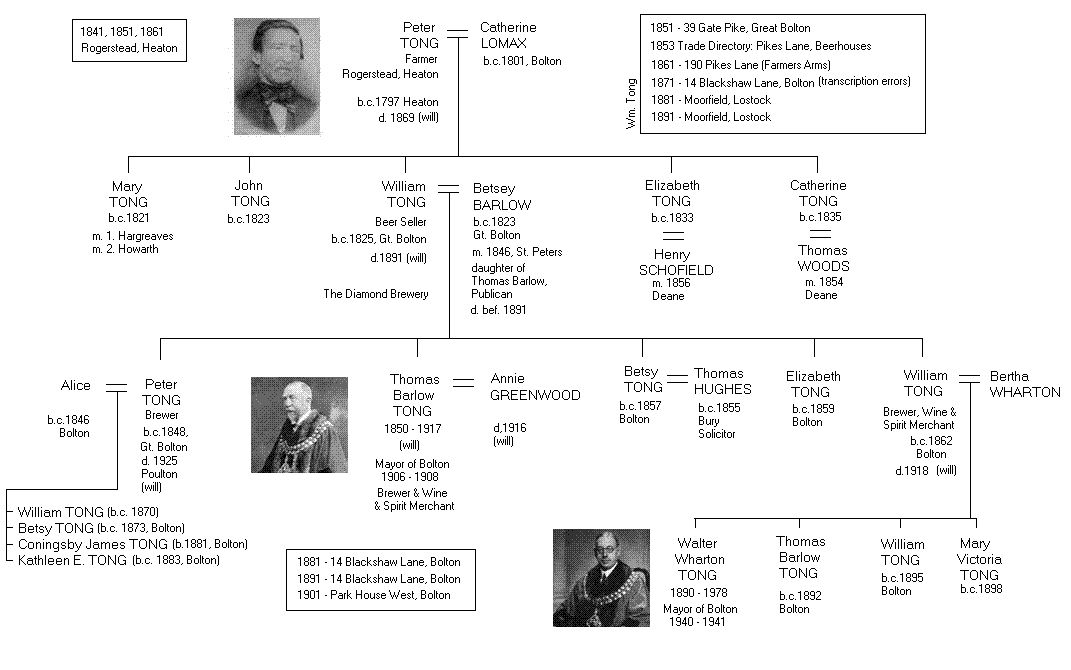
According to Hannah Cotterill’s book Gate Pike [1], by the early-1840s William Tong was brewing his own beer in a small brewhouse behind his pub, the Farmers Arms. Gordon Readyhough puts the address at 190-192 Pikes Lane (now Deane Road) and dates the pub to the 1850s [2]. Given that William Tong was born in 1825 it does sound unlikely – though not impossible – that he was brewing as a teenager in early 1840s. Even so, by August 1846, when he married Betsey Barlow, he was described as a ‘beer seller’ by trade. His wife was also familiar with the licensed trade. She was the daughter of Thomas Barlow, a publican, who was listed in a trade directory seven years later as the licensee of the Three Crowns on Deansgate. [3]

If we take the property number on Pikes Lane to be numbered the same as Deane Road then the Farmers would have stood on a site now occupied by the Red Sea Shop on Deane Road, but there is no saying that it was the same building. Mrs Cotterill places the Farmers Arms in the Gate Pike area. This was a small part of Deane around the area now occupied by the (now closed) Lilian Hamer home and the former Jolly Waggoner, which was then an un-named beer house. A website devoted to the Tong and Tonge families puts the address of William Tong at 39 Gate Pike in 1851 and 190 Pikes Lane in 1853 [4]. The Bolton Directory of 1853 lists William Tong as a beerseller in Pikes Lane, though it does not supply a number for the property. [3]

As a devout Methodist it is not surprising that Mrs Cotterill had no time for the booze-related activities that went on in the area. With the Farmers Arms, the beer house that was eventually named the Jolly Waggoner and the nearby Split Crow beer house she referred to the area as “Hell’s Mouth.” From her description it seems no worse than any other part of Bolton and certainly a good deal tamer than life in the slums of the town centre in the middle of the 18th century. Beer was also sold from an off-licence run by somebody who rejoiced in the nickname ‘Owd Woof.’

Gate Pike was written to celebrate the story of the Methodist church in the area. The religion was established in Deane at a house in Moss Street which later renamed Fern Street when the area was incorporated into the County Borough of Bolton. It later moved to a purpose-built church in Fern Street. The book is interesting if only for Mrs Cotterill’s description of life in that part of Bolton in the 1840s and her descriptions of the characters that lived there and is available at the central library.

As for the Farmers Arms, Gordon Readyhough tells us that the pub lost its licence in 1869, but a few years later, William Tong, whose beermaking activities had grown to an industrial scale from large premises at the top of Balshaw Lane, arranged for a beerhouse licence to be transferred from the Rifle Volunteer on Bridgeman Street in 1872. The Farmers later became an off-licence but closed in 1876.

Tong’s Brewery was registered as a private limited company, William Tong & Sons Ltd, in 1897 with an address of the Diamond Brewery at the top of Balshaw Lane, Deane, though there was also an office on Mealhouse Lane, Bolton. But by then William Tong was dead having retired to Moorfield at Lostock where he died in 1891. 

The brewery was taken over by the Warrington firm of Walker Cain Ltd in 1923 along with its 23 pubs, although 66 pubs were owned by the company in 1997. Walker Cain had only been formed in 1921 by a merger of Peter Walker Ltd of Warrington and Robert Cain Ltd of Liverpool and the new concern photographed the whole of its tied estate in the 1920s. A good  many of those images can be seen in Mr Readyhough’s book.

There is some confusion as to how long brewing continued at the Diamond Brewery after the takeover. The Brewing History: A Guide To Historical Records claims brewing continued until 1940, although it lists a catalogue for the auction of the brewery in 1924, a year after the takeover which suggests it was already closed. [5]

Walkers merged with Joshua Tetley & Son of Leeds in 1960 to form Tetley Walker. Up to the brewing industry divesting itself of much of its tied estate in the nineties a number of the former Tetley pubs in the town were once Tong’s pubs and the inscription of Wm Tong & Sons can still be seen outside the Market Hotel on Brackley Street in Farnworth. Image here.  The Vulcan Inn on Junction Road also advertised Diamond Ales etched into one of its windows. Image here

William Tong’s son, Thomas Barlow Tong, was a Conservative mayor of Bolton from 1906 to 1908. He worked as the Bolton area manager for Walker’s after their takeover of the family brewery. [6] William’s nephew, Walter Wharton Tong, was also a Conservative mayor of Bolton from 1940 to 1941 and was knighted in 1955. [7]

The company’s livery can still be seen on offices above the former Crown & Cushion in Mealhouse Lane. [8]Image here. 

[1] Gate Pike by Hannah Cotterill. Published 1828.
[2] Pubs Of Bolton 1800-2000, by Gordon Readyhough. Published by Neil Richardson (2000).
[3] Four Bolton Directories: 1821/2, 1836, 1843, 1853. Reprinted by Neil Richardson (1982)
[4] www.tongefamily.info. Accessed 9 April 2014. 
[5] The Brewing History: A Guide To Historical Records. Accessed 9 April 2014.
[6] Bolton Mayors. Thomas Barlow Tong. Accessed 9 April 2014. 
[7] Bolton Mayors. Walter Wharton Tong. Accessed 9 April 2014. 
[8] Brewery History Society. Accessed 9 April 2014.