Friday, 13 February 2015

King William The Fourth (King William IV), 202 Manchester Road


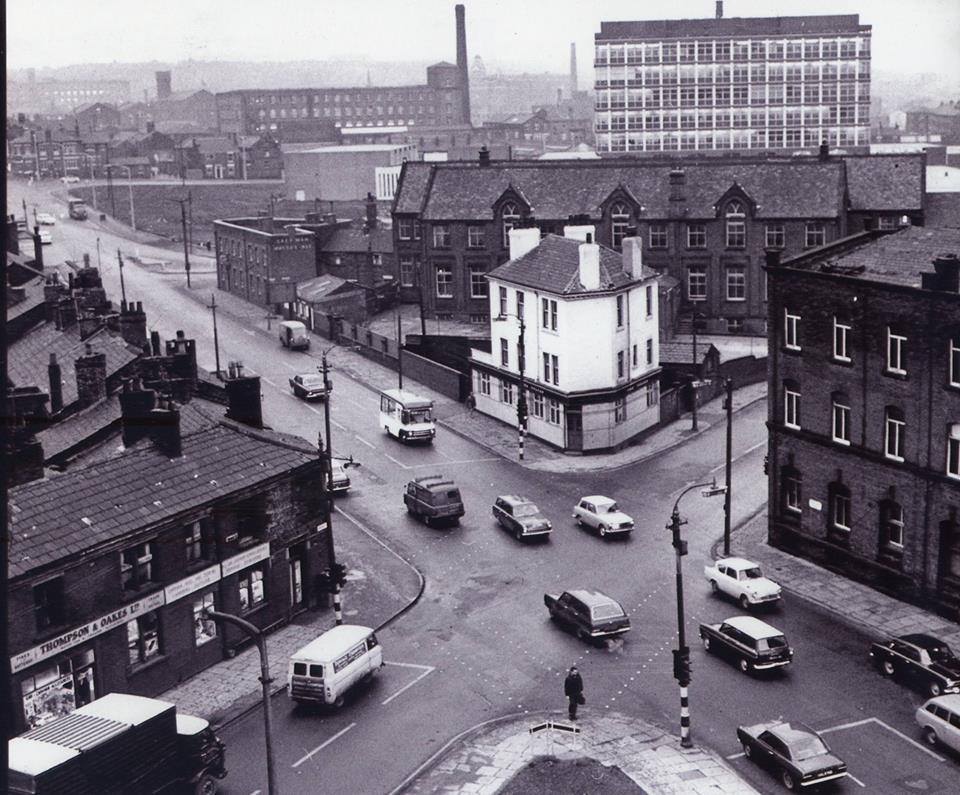
The King William IV pictured around 1974


The King William IV – the ‘King Bill’ as it was always known – was situated on Manchester Road, opposite Burnden Park. The pub dated back to the 1830s when a man named James Lawton opened a beerhouse that he named after the reigning monarch of the day, King William IV, who was on the throne from 1830 to 1837.

William Lawton was born in 1810. He married Sarah Allen in 1834 and the couple had two daughters: Alice, born in 1844, and Amelia, born in 1850. In 1841, the Lawtons were shopkeepers on Coupe Brow which was the name for the incline towards the top of Lever Street. They moved to the King William IV following the death of  William's father  James in 1846 and the pub was doing well enough by 1851 for them to employ a live-in servant. 


The pub suffered a suspension of its licence in 1869. The government had just passed a new act of Parliament that gave local magistrates the power to take away a beer house’s licence. All the beerhouses in  Bolton came in front of the authorities in the late summer of 1869. The police objected to the renewal of the King Bill’s licence saying it had been fined three times and that the pub was “very troublesome”. Fines were usually levied for opening during prohibited hours – most likely on a Sunday morning when people were expected to be in church rather than the pub – but the police also objected to the pub’s music saloon. There was almost a war at the time on what was deemed as low culture with a number of pubs offering live music closed down by the police for what was deemed as unworthy cultural offerings.

The King William IV can be seen on the right of this image of excavations at Burnden Park in the 1960s following the demolition of houses close to the ground.

The King Bill was closed from the beginning of September to the end of October 1869 when an appeal was heard. But right at the start of the hearing, the representative for the council, Mr Grimshaw, told the court that he had been instructed not to oppose the granting of a licence and the King Bill was back in business. William Lawson even received costs out of the county treasury. No reason was given for the withdrawal of the justices’ objections. A number of other pubs were also handed back their licenses at the same hearing.  

The 1871 Census return shows the 60-year-old William still at the pub along with his wife Sarah, his two daughters and a grand-daughter, Blanche, born to Amelia in 1870. Oddly, Amelia had the child baptised twice, on both occasions at the nearby St Mark’s church, once in September 1870 shortly after her birth, and again in 1873.

William Lawton died on 18 September 1882. He was 72. The pub business had been good to him and his estate of just under £2000. His wife Sarah died on 5 March 1886.

Normally, the pub would have been sold, but by then it was a livelihood – as well as a home - for the Lawton sisters. Alice and Amelia took over the running of the King Bill and it turned out to be a fortuitous move. The arrival across the road of Bolton Wanderers, whose Burnden Park ground was completed in 1895 cannot have been bad for business. By that time, the King Bill looked pretty much as it does today but there were no other buildings on that side of Manchester Road from the railway bridge a few yards further up the main road down to Luton Street a hundred yards or so away. It remained like that until the early-twenties.

Amelia Lawton married Walter Downs, a chemist originally from Ipswich, in 1885 and subsequent directories showed the pub as being run by ‘Lawton & Downs, beer retailers’ which presumably refers to the two sisters. But Walter is also described as a publican when Madeline Downs, one of the two daughters he and Amelia had, was married in 1908. However, by the time of the 1911 Census only Alice and Amelia and Amelia’s youngest daughter, Gladys Downs, then aged 24, were living at the pub. There was no sign of Walter.

But the sisters were getting on in years. Alice was 67 and Amelia 61 by 1911. Had either of the sisters a son then they could usually be relied upon to take over the business. The sisters were unmarried when their father died so the succession was relatively simple, but Alice was a spinster and childless while Amelia had three daughters. Two of the girls were married and one was about to be. The pub was sold to local brewers William Tong’s in 1915 and the two sisters retired to 157 Ivy Road where they spent the rest of their days. Gladys Lawton married Aaron Royle, a draper, that same year and the newly-weds lived at first with the two elderly sisters.

Alice died in 1924 at the age of 80. Amelia died the following year aged 76. She left an estate worth £4686, the equivalent of a quarter of a million pounds today.

The King Bill was upgraded from a beerhouse to a fully-licensed public house in 1934 after Walker Cain, who had taken over Tong’s brewery in 1923 and now owned the King Bill, applied to have the licence of the Arrowsmith’s Arms transferred to the pub. William Lawton described himself as a ‘beer and wine seller’ on the 1881 Census return so the transfer of the Arrowsmith’s licence allowed the pub to sell spirits, as well.

Tetley Walker took ownership of the King Bill after the merger of Leeds-based Tetley with Warrington-based Walker in 1961.

Just as the presence of Bolton Wanderers would have been good for trade then the club’s move to Horwich in 1997 must have hit takings. The pub was always busy on home matchdays even when attendances were down to just a few thousand.

The move eventually led to the closure of every single pre-match watering hole close to Burnden Park. The King William IV closed in 1999. It had already been sold to the Mistry family who moved their Minerva Print business to the premises.

Thursday, 12 February 2015

St James's Hotel, Buxton Street


Buxton Street was a normal, working-class Bolton street. It ran off Calvin Street which was itself situated off Waterloo Street. Both streets still exist with Calvin Street now hosting the Royal Mail sorting office.

Buxton Street was only around 100 yards long. There were 38 buildings on the street in total. But you couldn’t get out of Buxton Street without passing a pub. At the Calvin Street end was the Buxton Arms, but at the other end – the Luther Street end – was the St James’s Tavern which we’ll deal with in this piece.

The St James’s Tavern dated back to 1870 and was named after the nearby St James The Apostle church and primary school. St James’s church was completed in 1867, though the size of the debt incurred in building the church meant that it wasn’t consecrated until 1871. [1] 

But just as the church was planned to serve the spiritual needs of growing industrial area, so the St James’s Tavern was instituted to satisfy needs of a different nature.

The first landlord was Charles Cordingley who appears as the licensee in the 1871 Bolton Directory. Cordingley grew up in Little Bolton, in Independent Street where Folds Road car park now is. By 1861 he was living at 15 Blackburn Road and working as a patternmaker. By 1864 he was a shopkeeper, again at 15 Blackburn Road, but by 1871 – still working as a patternmaker – he was running the St James’s beer house at 1-3 Buxton Street.

Charles later moved to the St George’s Hotel – perhaps he had a thing for pubs named after churches – but by 1883 he was dead at the age of just 59.

Magees later took over the St James’s and it was subsequently sold to Swales of Manchester. Now there was a brewery with reputation – and not a particular good reputation, either. Its beers were so bad it was known as ‘Swales swill’. The Lodge Bank Tavern and the Prince William were other examples of Swales' pubs.

Swales sold out to Boddingtons in 1971, but whether the customers of the St James’s Tavern got to taste any is open to question. The pub closed in the early-seventies and the whole area was cleared. While much of the area around Calvin Street and Waterloo Street has since been redeveloped with industrial units, there is a patch of land where Buxton Street once stood. A September 2014 view of the area is below (copyright Google Street View).


[1] Lancashire On-Line Parish Clerks project. Accessed 12 February 2015.
[2] Bolton Pubs 1800 – 2000, by Gordon Readyhough. Published by Neil Richardson (2000).

Railway Hotel - Shamrock's, 2-4 St Helens Road

Railway Hotel St Helens Road Bolton

This old postcard was from 1905 was put on Google Earth by Mel Travers. It shows the Railway on the left in the middle of the picture. Willows Lane runs down by the side of the pub.


The Railway Hotel was situated on the corner of Willows Lane and St Helens Road, but at the time it opened in the 1860s the Railway Tavern, as it was then known, was the first building beyond the Bolton borough boundary which was marked by Willows Lane.

The first landlord was James Hodson.  He was the son of Peter Hodson, who had run the nearby Ram’s Head for a number of years and like his father he initially opened the pub as a dual-purpose establishment. Not only was the Railway a beerhouse, but it was also a butcher’s shop.

The pub’s name came from the Bolton to Leigh railway line which opened in 1828 and which still ran just a couple of hundred yards away along what is now Auburn Street. The route was diverted in 1885 to run under Ellesmere Road and Higher Swan Lane.

But James wasn’t destined to be at the Railway for long. His mother had been running the Ram’s Head following the death of his father and by 1870 and at the age of 62 she wanted to give up the pub trade. James made the decision to quit the Railway and he moved to the Ram’s Head in 1870.

The new landlord of the Railway was perhaps the youngest licensee in Bolton at that tome. Thomas Grundy Orrell was just 21 years old when he moved into the pub. He was joined by his wife, Mary Ellen (nee Gee) – who was only 18. The couple were married in February 1870, at which time Thomas was a patternmaker. A child, Edith, was born in the middle of 1870.

But Thomas had lofty ambitions beyond the pub trade. Daubhill formed part of the old township of Rumworth, part of which was incorporated into the County Borough of Bolton in 1872. The new Rumworth ward was entitled to send two councillors to the town hall, but in November 1880, one of the ward’s councillors, Councillor John Miles was elevated to the post of Alderman. That left a council vacancy for Rumworth. Thomas Grundy Orrell was named as the Conservative party candidate and as the Liberals failed to put up a candidate Orrell was elected unopposed. He was just 29 years old. [1]

Thomas wasn’t a councillor for long. He completed his three-year term and then stepped down from the council and concentrated on running his pub. And it was a fully-licensed public house before long. The premises – now comprising number 2 and number 4 on St Helens Road – had been a beerhouse since its inception, but the closure of the Rose and Crown on Deansgate meant that a full licence was up for grabs. The Railway’s nearby competitor, the Ram’s Head was already fully licensed and had been for many years so to bring himself on a par with one of his competitors Thomas successfully applied for a transfer of the Rose and Crown’s license. That means the Railway could also serve wine and spirits.

Thomas Grundy Orrell died at the Railway on 5 February 1890, just 40 years old and four days short of his 20th wedding anniversary. Twenty years of being in the pub trade had been good to him and he left an estate worth £1785 – the equivalent today of around £200,000 in today’s money. His wife, Mary went to live in Blackpool where she died in 1923 at the age of 73. She never remarried.

The immediate fate of the Railway lay within Mary’s family. The Gees already owned the Royal Hotel on Vernon Street which was being run by Mary’s brother, Robert. Another brother, John Heaton Gee, worked as a maltster and he took over the Railway after Thomas Orrell’s death.

Perhaps John wasn’t cut out for the pub trade. By 1905 Joseph Rowlinson was in charge and according to the 1911 Census the pub was doing well enough for Joseph to employ three bar staff who lived on the premises.

In his reminiscences of the area, local historian Norman Kenyon said that while he often drank at the Waggon and Horses further up St Helens Road he and his father-in-law Bill Morgan occasionally drank at the Railway, which Bill thought was a better class of pub.

Norman tells an amusing story of how his brother-in-law, Cliff Atkinson, who suffered from poor eyesight at the best of times, spent one winter’s Saturday night drinking at the Railway. He had been out earlier on in the day and was somewhat the worst for wear so his pals decided to walk him home to nearby Shepley Avenue. They left him at his garden gate and went back to the pub just as it began to snow. Later, on their way home, they went back to Shepley Avenue. As they approached Cliff’s gate they could see a huge pile of snow. It was Cliff, still draped over his garden gate having passed out and been covered in snow as it fell. [2]

Both the Railway and the Royal were taken over by the Salford brewery Threlfalls and they owned both pubs until 1967 when the brewery was taken over by Whitbread.

The Railway pictured in 1978


Real ale drinkers celebrated the sporadic return of cask beer to the Railway on a number occasions. In 1978, a new real ale called Special Cask Bitter was trialled at a number of local pubs, including the Railway. [3]

In 1981, Dutton’s Cask Bitter was put on sale in the pub. [4]

In the early eighties Whitbread were refurbishing their pubs in a distinct style that wasn’t altogether welcome by the brewery’s critics. But the Railway was given just a lick of paint and escaped the usual peephole barrels and sewing machines used as tables. [5] A couple of years later cask Trophy Bitter (‘the pint that thinks it’s a quart’) was on sale. [6]

In the late eighties, the Blackburn brewer Matthew Brown took over the Railway and in the early nineties they renamed it Shamrock’s, a vaguely Irish-themed pub. But, as with pubs on all main routes in and out of Bolton, Derby Street and St Helens Road have suffered from pub closures and the Shamrock shut in 1997. The building has been subdivided into small retail units on the ground floor and flats on the top floor.

* Anyone with any interest in the history of the area should look at the excellent Daubhill website containing articles and old photos of the area. Click here.


The site of the Railway Hotel in September 2014 (copyright Google Street View). The building on the right was number 2 St Helens Road, the original Railway Tavern. 

[1] Annals Of Bolton, John Clegg, 1888.
[2] Bolton, Daubhill and Deane: A Sentimental Journey, by Norman Kenyon. Published by Neil Richardson (1998).
[3] What’s Doing. The Greater Manchester Beer Drinkers’ Monthly Magazine. October 1978 issue. Extract accessible here
[4] What’s Doing. July 1981. Extract accessible here. 
[5] What’s Doing, June 1983. Extract accessible here

[6] What’s Doing, October 1983. Extract accessible here.

Monday, 9 February 2015

Old Original British Queen (Pomps), 107 Blackburn Road

Old Original British Queen Blackburn Road Bolton

Happier times for the Old Original British Queen pictured here in August 2008 (copyright Google Street View). 


The Old Original British Queen was a prime example of the practise in Bolton in the eighteenth- and nineteenth centuries were a pub was given a similar or the same name as one nearby.  The centre of town had two Millstones, two Three Crowns and two Nags Heads and at the bottom of Blackburn Road in the 1840s there were two British Queens. However, it was joined across the road by one named the Victoria British Queen, so the owner of the British Queen re-named his pub the Old Original British Queen.

For much of its existence the Old Original British Queen was known as ‘Pomp’s’. So who was Pomp?

George Pomfret was born in 1860. His father – also named George – was a coal miner who moved the family from Atherton in search of work in the Middle Hulton area of Bolton where there were a number of small coal mines. In 1861 the family were living at Whitegate Brow, which is that part of St Helens Road where the road dips down towards Four Lane Ends. Ten years later they at nearby Pasquill Fold and by 1881 they had moved to 144 Deane Church Lane, one of a newly-built row of terraced houses.

George married a local girl, Elizabeth Howcroft, in 1883. At 29 she was six years older than George and she lived on Morris Green Lane. The couple’s marriage certificate described George as working as a coal miner. But a life digging underground wasn’t what George had in mind.

How George and Elizabeth got into the licensed trade on the other side of town isn’t known, but by the time the couple’s first child, Walter, was born at the beginning of 1886 they were already ‘mine hosts’ at the Old Original British Queen. And they were to remain there until George died almost 40 years later.

George’s nickname was ‘Pomp’ and before too long the Old Original British Queen was known as ‘Pomp’s’, one of the few pubs in Bolton to be known after a landlord or former landlord.  Ninety years after his death it is still known as such.

George remained at the pub until his death in 1925. But he was obviously a very shrewd businessman. He left an estate valued at £5177 – that’s the equivalent today of over £270,000. Not bad from a small beerhouse on Blackburn Road!

Pomps was sold to the Bromley Cross firm of John Hamer’s and it was subsequently a Dutton’s pub when the Blackburn brewer purchased Hamer’s in 1951. The pub received a full licence in 1961.

Dutton’s was taken over by Whitbread in 1964 and many older readers may remember it as a Whitbread pub.

Greenwood Leisure bought the Old Original British Queen in the early-nineties and real ale returned for a while in the form of Holts Bitter, but the pub closed at the beginning of 2014. The image below was taken in September 2014 (copyright Google Street View).


The building was demolished in April 2016. The image below was taken in August 2016 and shows an empty site (copyright Google Street View). A five-bedroomed house was subsequently built on the site.


Sun Inn, 54 Bradshawgate


Primark's Bolton store in the Crompton Place shopping centre is the building that replaced the building that replaced the Sun Inn.

The Sun Inn on Bradshawgate dated back to at least the 18th century. James Best was shown as the pub’s landlord on the 1778 list of Great Bolton Alehouses.

Friendly societies often met at pubs and by 1820 the Foresters were meeting at the Sun Inn. [1]

The pub was nicknamed Loader’s Vaults after its owner, John Loader. [2] A number of licensed premises were owned by wine and spirit merchants and it was common practise to nickname such pubs after their owners.

Loader, a native of Henley-on-Thames, was the owner of the Sun Inn in 1832. In that year he buried his wife, Mary Anne, at the young age of 29 but five years later, John married Elizabeth Wrigley who came from a family of Manchester pub owners and spirit merchants. The two families were further entwined a few years later in 1839 when one of John’s relatives, Ellen Loader, married another member of the Manchester family, pub landlord John Wrigley.


Not only did the Sun stock wines and spirits, but it brewed its own beer and in the 1871 Bolton Directory, Elizabeth Loader is described as both a brewery and a wine and spirit merchant. John Loader had died in 1863 and the running of both the Sun Inn and the wine and spirits business was being undertaken by the couple’s eldest surviving son, Charles Price Loader (a number of John and Elizabeth’s children had died in infancy). He was listed as living at the pub while the rest of the family lived on Manchester Road.


Sadly, Charles died on 25 March 1879 at his home, 8a Boden Place, Manchester Road. His eldest son, three-year-old Ernest Charles Loader, also died at the same time in what seems to have been a tragic accident. But the incident effectively marked the end for the Loader family's connection with the Sun Inn.


Charles’ wife, Ada King Loader, sold the Sun Inn and the drinks business to another local wine and spirit merchant, Ross Munro and Co. But the decision was contested by other members of the Loader family who felt that, by rights, the business should have passed to the next eldest son Leopold Cooper Loader. In 1883, solicitors acting on behalf of the six-year-old Leopold ued Ada and her new husband, Thomas Daniel, a Mancunian she married in 1881,  but the action failed.


Thomas Daniel died in 1901, the couple having had two children. Ada was in St Annes-on-Sea in 1911, but she left for South Africa a few years later and she died in Cape Town in 1925.


As for the Sun, it closed in 1905. The council had plans to widen Bradshawgate and wanted to demolish properties on the west side of the street from the junction with Deansgate down to Nelson Square. But while a number of nearby pubs such as the Saddle and the Fleece were re-built on the new street, Ross, Munro and Co took the money and ran.


The Sun was demolished in 1906 to make way for a row of shops. The building that replaced it was demolished in the late-sixties to make way for the Arndale Centre.  The site of the Sun is the front of the Primark store on Bradshawgate, or to be more accurate the pavement the front of the shop is given that the street was widened over a hundred years ago.

[1] Leisure In Bolton, 1750-1900, Robert Poole, 1982

[2] Bolton Pubs 1800 – 2000, by Gordon Readyhough, Published by Neil Richardson, 2000.

Tuesday, 3 February 2015

British Queen, 144 Newport Street

British Queen Newport Street Bolton

The British Queen pictured by Humphrey Spender in August 1937. The pub was right at the top of Newport Street which can be seen tailing off into the distance.  Image coyright Bolton Council from the Bolton Worktown website.

Every day, hundreds of Bolton people will head out of Trinity Street railway station on their way home from work. They will walk across Newport Street and head off along the dual carriageway, or perhaps cross at the traffic lights to head to Sainsbury’s. Up to 1972 neither of those choices would have been open to them without stepping into the British Queen.

According to the 1841 census, Edmund Seddon was a junior tailor living in Back Mawdsley Street. By the time Edmund’s son John Seddon married Mary Winward at Holy Trinity church in February 1865, Edmund was living at 144 Newport Street but he still described himself as a tailor for the benefit of the wedding certificate. But by the time Worrall’s published their Bolton Directory for 1871 number 144 Newport Street was a beerhouse with Edmund Seddon as its licensee. So did Edmund open a tailor’s shop at the top of Newport Street before turning it into a pub? It’s entirely possible. Either way, it seems Edmund Seddon founded the British Queen, but it wasn’t a long stay in the pub as he died in 1878, aged 62.

The British Queen subsequently became an Atkinson’s pub supplied from their brewery on Commission Street, off Deane Road. By the end of the nineteenth century it was owned by the Manchester’s Cornbrook Brewery. Cornbrook had taken over Boardman’s United Breweries in 1898 Boardman’s having themselves taken over Atkinson’s in 1895.
  
According to Gordon Readyhough’s book Bolton Pubs 1800 – 2000, the British Queen was later sold by Cornbrook to the local firm of Magee Marshall. If so, that sale would have taken place after the above photograph was taken in 1937. Given that Cornbrook wasn’t exactly over-represented in Bolton it seems a strange move to have given up one of their local pubs – and to the town’s major brewery.

The area around the British Queen underwent a huge change in the early seventies. Perhaps some older readers can recall the number 5 bus pulling into the lay-by outside the pub on its journey from Plodder Lane before continuing on its way into the town centre and on to Markland Hill. It was redirected along Crook Street and Soho Street when Newport Street was made into a one-way street from Trinity Street down to Great Moor Street.

Across the road, the Railway Hotel closed in 1972 and the British Queen shut its doors for the final time in the same year. Both were demolished in 1973 – the same year the Parkfield Inn  closed its doors. All three made way for the southern limb of Bolton’s Inner Relief Road which opened in 1979.


This image taken in September 2014 (copyright Google Street View) is from almost exactly the same position as the one at the top of the page. The long-standing firm of Clough’s opticians moved to its current premises in Newport Street in 1968 and stood next to the British Queen until the pub’s demolition in 1973.  The small wall outside the optician's marked the end of Allsop Street which still runs to the rear of premises on Newport Street.

Sunday, 1 February 2015

Vulcan Inn, 130 Great Moor Street

Vulcan Great Moor Street Bolton

The Vulcan pictured in 1961. Great Moor Street runs from left to right across the front of the pub; Crook Street can be seen running down the side of the pub. Derby Street Secondary school is in the background.

The Vulcan Inn stood on the junction of Great Moor Street and Crook Street. It began as a beerhouse around 1860, but became a fully-licensed house in 1874 [1] following the closure of the Angel and Woolpack on the corner of Deansgate and Mealhouse Lane. The Angel and Woolpack’s wine and spirits license was transferred to the Vulcan thus enabling it to save the full range of alcoholic drinks.

The Vulcan was a Magee’s pub at the end of the nineteenth century, but a few yards along from the Vulcan was the Grey Man, also a Magee’s pub. The brewery decided to sell one of the pubs rather than have two outlets so close together so the Vulcan was sold on to the Manchester Brewery Company in the early-twentieth century.

The move perhaps wasn’t for the best for the Vulcan. At that time, MBC had already expanded its tied estate in Bolton through the takeover of TR Wingfield’s Silverwell brewery which stood on the site of what is now the Pack Horse student accommodation. But the purchase of Wingfield's, plus that of Manchester brewery, Broadbent’s, had financially stretched the company. A shareholder’s committee was formed in 1904 which drank its way across the whole of MBC’s tied estate. This included pubs in Preston, Oldham, Manchester plus a sizeable number of pubs in Staffordshire around the Black Country area. Disgruntled tenants and a lack of investment in the company’s pubs coupled with poor beer meant that some pubs were actually losing money. [2]

Vulcan Great Moor Street Bolton
The Vulcan Inn taken from Hargreaves House shortly before the pub closed in 1973.


In 1912, MBC was taken over by the Salford brewery of Walker and Homfray. They were in charge until 1949 when the Vulcan was one of 477 Walker and Homfray’s pubs to be bought when the brewery was taken over by Wilson’s of Manchester.

The Vulcan was reputed to have been a gay pub in the early seventies which would have made it one of the earliest such pubs in Bolton. It closed in 1973 and was demolished as part of the construction of the Trinity Street dual carriageway. That part of Moor Lane which runs along the side of Bolton One now stands in its place.

In 1937, the photographer Humphrey Spender took a number of shots of the interior of a Bolton pub. It is believed to be the Vulcan because of the image in the pub’s vault window. Two of the photos are reproduced below. The photos are from the Bolton Worktown website and are copyright Bolton Council. Other photos from the set are here, here and here.


Vulcan Great Moor Street Bolton


Vulcan Great Moor Street Bolton


[1] Bolton Pubs 1800-2000, by Gordon Readyhough. Published by Neil Richardson (2000).
[2] Manchester Breweries Of Times Gone By, by Alan Gall. Published by Neil Richardson (1982).