Showing posts with label Blackburn Road. Show all posts

Sunday, 23 January 2022

Corn Mill Tavern, 120 Blackburn Road, Bolton


The Corn Mill Tavern was situated at 120 Blackburn Road just two doors down from the Victoria British Queen. The pub dated back to the 1840s but the building itself was older and its name suggests it may once have been in operation as a corn mill.


There is no record of the pub in the Bolton Directories of either 1843 or 1848. The first record we have of the building being licenced is in 1849 when John Seddon is named as licensee on the list of Little Bolton beerhouses.


By 1861 the Corn Mill was in the hands of the Grundy family and it would remain so for the next 20 years. John Grundy was a former crofter from the Waters Meeting area of Little Bolton close to Astley Bridge. In 1851 he and his family were all working at Thwaites bleachworks at Waters Meeting. Ten years later he was the landlord of the Corn Mill. John Grundy died in 1867 and the Corn Mill passed to his son William. He ran it until his death in 1882 at the age of 51.


The Corn Mill was noted not just as a pub but as a brewery. Certainly in 1895 William Green is listed as a brewer at the pub but he also had an office in the centre of town at 42 Silverwell Lane to organise the distribution of the brewery’s products to the wider area. He was one of nine so-called ‘common brewers’ in the town in 1895, i.e. brewers who sold products to other pubs. But while William Green is listed as the pub's brewer its licensee was Robert Rawsthorne. He committed suicide in 1895 shortly before a court appearance to answer allegations of an indecent assault. Shortly afterwards the Corn Mill and its brewery was sold to the much larger concern of Joseph Sharman & Co Ltd. By 1901 William Green was running another Sharman's pub, the Stanley Arms on Egytpian Street, less than a quarter of a mile away from the Corn Mill.


The Corn Mill lasted little more than a decade under Sharman's. There were numerous pubs at the bottom end of Blackburn Road and nearby Halliwell Road and Sharman's also owned the Bowling Green less than a hundred yards away. 


The Corn Mill closed in 1906. Gordon Readyhough writes in Bolton Pubs 1800-2000 that the licence was given up as part of a deal to grant a full licence to the Sunnyside Hotel  at the bottom of Adelaide Street, off St Helens Road. However, press reports at the time of the licensing session make no mention of the Corn Mill although it is entirely possible that magistrates insisted on Sharman's giving up one of its own licences. Sharman's paid £1500 to Bolton Council for the licence of a pub that they didn't own. the Ship Inn, a long-established inn on Bradshawgate that was being demolished as part of a road-widening scheme. The council had bought the Ship under a compulsory purchase order and the Ship's licence was transferred to the Sunnyside.


The Corn Mill eventually became part of Relphs Funeral Service, now Relphs Funeralcare and owned by the Co-Op. The building still stands.

Friday, 23 August 2019

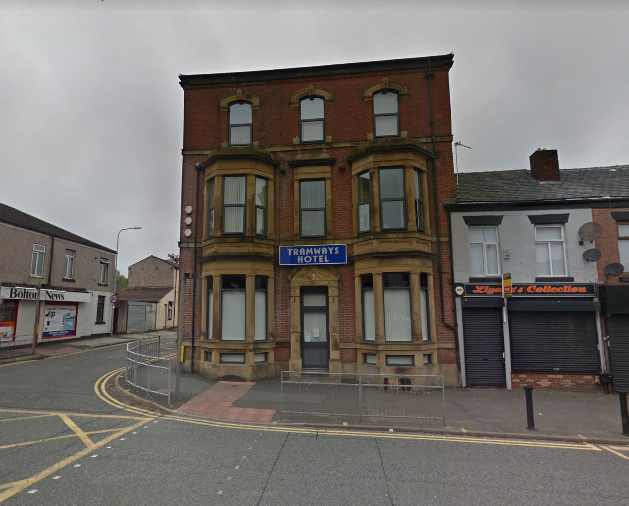
Tramways Hotel, 307 Blackburn Road, Bolton


Tramways Hotel pictured in October 2018. Copyright Google.


On 31 August 1880, Her Majesty's Inspector Of The Board Of Trade, Major-General Hutchinson, joined the Mayor of Bolton, Alderman Richardson, the Town Clerk, Mr Hinnell and the chairman of the Astley Bridge local board, Major-General Hesketh and a number of other local dignitaries on a horse-drawn tramcar driven by a Mr John Metcalf that had pulled up outside the Town Hall. The tram made its way along Newport Street and headed for Moses Gate. It then returned back to Bolton where the three horses at the front of the car were replaced by four for the journey on the remainder of what was Bolton's new tram network. Crowds gathered on all aspects of the route on what was a test run for the town's new transport network.

As the tram made its way towards the border that marked the border with Astley Bridge – then a separate township – it passed a building under construction on the site of an old beerhouse and butcher's shop and which would be named the Tramways Hotel in honour of this new mode of public transport.

Six days earlier on 25 August 1880, Thomas Morris, who had been granted a provisional licence the previous year, agreed to give notice for its confirmation on 30 September. By early November 1880 the Tramways was open. The pub was aimed both at billiards players and at hotel guests who wanted to stay within reasonable distance of Bolton without the bustle of town centre. The full licence of the Red Lion, Deansgate had been transferred to the Tramways and the pub had managed to gain a billiards licence. It employed James Craven, formerly of the Balmoral Hotel, as a marker. Craven marked when, in February 1881, Walter Grundy took on Herbert Wortley in a game billed as the championship of Bolton. Wortley was suffering from a cold and was no match for Grundy who won by 1000 to 397.

While Thomas Morris had applied for the licence of the Tramways he was neither the owner or the licensee. By the time the pub opened James Atkinson was the landlord. Born in Wigan in 1835, Atkinson was a brickmaker by trade and owned the Tanners Hole brickworks in Great Lever close to what is now the junction of Settle Street and Nugent Road. He had also turned his hand to property development and along with Robert Horridge, Barnard Henry and James Holden had formed the Great Lever Building Company. He was living in Sidney Street, off Bridgeman Street, in 1861 and by 1871 he was living with his wife Margaret at Woodside Terrace, Rishton Lane. He was a successful Liberal candidate for the election to the Bolton Board Of Guardians in 1876.

However, all was not well. In an advertisement in the Bolton Evening News of 26 November – little more than a year after the Tramways opened, Atkinson filed for bankruptcy with debts estimated at £4500 – the equivalent of over £500,000 today. This suggests Atkinson, perhaps with some of his partners, built the Tramways but in doing so he perhaps over-stretched himself. In January 1882 the licence of the pub was transferred to one of his business partners, Robert Horridge.

In March 1891, a former self-actor minder named Peter Thompson of no fixed address was found dying in the middle of Blackburn Road outside the Tramways. At his inquest it was heard that the 37-year-old Thompson hadn't worked for some 12 or 13 years but made small sums of money singing or dancing at pubs. When he was found his clothes were saturated with rain and he was helplessly drunk. Any attempts to obtain a name or address out of him elicited the response that he was “the champion singer and clog dancer of Farnworth”. A doctor was called for but Thompson died before medical help arrived [Bolton Evening News, 31 March 1891].

The Tramways remained a sporting pub. Bolton Harriers often started some of their inter-club matches outside the pub. The North End Angling Society were certainly meeting there in 1908 and around that time there is mention of a Tramways in the fixtures for the Bolton Wednesday Football League for 1908 playing against the likes of Market Hall, Farnworth Wednesday and Pawnbrokers. However, this may well have been employees of the local tramways department rather than the pub's customers.

There was unwelcome attention for the Tramways in 1905 when Herbert Taylor, a 22-year-old labourer, was accused of taking bets in the vicinity of the pub and its yard. He was fined £3.

The Tramways became a Magee's house before becoming a Greenalls pub in 1958 on their takeover of Magee's Crown Brewery.

The pub was sold by Greenall's in 1988. It remains licensed premises and there is a bar on site but it is no longer a pub. It has been run for a number of years as a guesthouse/bed-and-breakfast.

Friday, 2 September 2016

Junction Inn - Smoothing Iron, 77 - 79 Egyptian Street, Bolton


The Junction Inn was situated at the meeting of three thoroughfares: Egyptian Street, St John’s Street and the northernmost part of Higher Bridge Street close to where it meets Blackburn Road and Kay Street.

The building was used as a pub in at least the 1860s. The first record we have of it as licensed premises is from 1869 when the licensee, George Pownall decided to sell the lease. [1]

However, the advertisement suggested that the lease agreement dated back to 1837, the likely date of construction although it may not necessarily have been a pub right from the start. At that time of the 1869 sale the pub was known as the Smoothing Iron due to its unusual rectangular shape and it was still known by that name as late as 1876.

For over ten years, the Junction was in the hands of Martha Cope and it seems to have taken on that name under her tenure. Born in Grantham, Lincolnshire in 1859, Martha moved in to the pub in the 1880s with her first husband, Joseph Smith. He died in 1890 leaving Martha and three children and she took over the running of the pub.

In 1893, Martha married the pub’s barman, the Nottingham-born William Henry Cope, who was already living at the pub according to the 1891 census. They went on to have two children together, but in March 1898 on a visit to his home town, William died at the age of just 26.

Martha Cope died in 1901. By the time of the 1911 Census the eldest child, Minnie Smith, was married to William Kirkman. The two other children she had with Joseph Smith were living with their aunt and uncle in Darbishire Street. Two other children, Ethel and Martha, later emigrated to Canada.

Martha Cope was succeeded by Joseph John Goodlad, a career licensee who had previously been at the Union Arms on Deane Road. At the time of his death in 1920 he had moved on again, this time to the Windsor Castle at the bottom of Halliwell Road.

By then the Junction Inn was in the hands of Magee’s brewery after their takeover of previous owners, Halliwell’s Alexandra Brewery in 1910. Although Greenall Whitley were the owners when the pub closed in the 1960s it was still being supplied by beer brewed by Magee’s Crown Brewery just off Derby Street.


 [1] Bolton Evening News, 12 May 1869.


Blackburn Road goes off to the right and Egyptian Street to the left in this August 2015 image (copyright Google Street View). The Junction Inn stood where the trees are in the middle distance. The short thoroughfare heading off to the right of where the pub stood was once the bottom end of St John’s Street.

Saturday, 9 January 2016

Foresters Arms, 421 Blackburn Road, Bolton


The Foresters Arms was situated at 421 Blackburn Road, Bolton. Its original address was 21 Blackburn Road, but when Astley Bridge was incorporated into the County Borough Of Bolton in 1896 the number of the house was changed along with all those on the other side of the bridge further down Blackburn Road that marked the former boundary between Bolton and Astley Bridge.

The first mention we have as a beerhouse is on the 1876 Post Office Bolton Directory when the landlord was Peter Hardman. Born in Harwood in 1824, Mr Hardman was listed as living in Kelly Row on Blackburn Road in 1851. By 1871 he was listed as a “watchman and beer seler” in what was now the Foresters Arms. He remained at the pub until his death in 1887.

On the 1895 Directory the landlord was given as Richard Thornborough. However, directories were often compiled up to a year in advance. Richard Thornborough (b. Rumworth, 1857) had actually died in February 1894 and his widow Martha was now running the pub. The Thornboroughs had also been at the premises on the 1891 census.

In February 1895 Martha Thornborough married John Wilcock, a shoemaker from Snowden Street close to the town centre. In October of that year the freehold of the pub was put up for auction. [1] It was leased to Magee, Marshall and Co but the lease was due to expire in 1898 and the brewery bought the freehold to secure their interest in the pub.

John and Martha Wilcock remained at the Foresters Arms. The 1901 census shows that they were living at the premises along with three of Martha’s children from her first marriage to Richard Thornborough along with two children she had with John Wilcock.

The Foresters Arms closed in 1913 when the Bolton licensing magistrates referred the pub and six other licensed premises to the Compensation Authority. [2] The authority bought licensed premises in order to cut down on the number of pubs and beerhouses in the town. However, the Wilcock family continued to live there. The 1924 Bolton Directory shows John Wilcock still at 421 Blackburn Road and working as a boot repairer. He died in 1932 at the age of 69. Martha Wilcock moved to Baythorpe Street on the other side of Blackburn Road. She died two years later at the age of 77.

Number 421 Blackburn Road still exists and an August 2015 image can be seen below (copyright Google Street View). Since 1987 it has been the Talking Heads hairdressing salon. According to contributors on Rootsweb, the gate next to the former pub led to an area known as ‘the Hovel’ though the land actually belongs to one of the properties in Viola Street. [3]

[1] Manchester Courier, 12 October 1895.
[2] Manchester Courier, 25 April 2013.
[3] Rootsweb. Accessed 9 January 2016.


Monday, 14 December 2015

Crawford Arms, 19 Bolton Street, Bolton


The Crawford Arms on Bolton Street was built in 1869. Local builder Robert Bolton built the pub – and the whole street – on land off Draycott Street and he was offering the pub to let by the end of March that year. It was taken on by Isaac Greenhalgh, a former cotton spinner from Kestor Fold, who was there until he died in 1876.

By the 1890s it was being run by Mrs Emma Hargreaves while her husband Robert worked as a slater. They had left the pub by 1901 and were living in Hibbert Street next door to the Cricketers Arms

A later landlord was Jack Bradshaw. According to the author Alison Bruce, Bradshaw’s daughter’s grandfather-in-law was the executioner, William Billington, whose father kept the Derby Arms on Churchgate. More on Alison Bruce’s recollections of Jack Bradshaw can be seen here

The Crawford was bought by Hamers, a sizeable concern which managed to supply a tied estate of some 42 pubs from a relative small brewery at the back of the Volunteer Arms at Bromley Cross. The last of the Hamers, former Mayor of Turton John Hamer, sold out to Duttons of Blackburn for £316,000 in 1951. Duttons became part of the Whitbread group in 1964 and it was a Duttons pub that the Crawford Arms ended its days in 1979. [1]

The pub was demolished in the eighties.  

Bolton Street no longer exists, though Back Bolton Street is still visible off Draycott Street. A housing estate has been built on the site of both Bolton Street and Prospect Mill No 3 which stood to the street. 

[1] More on the sad story of John Hamer can be read here


Draycott Street runs along the bottom of this 2015 picture (copyright Google Street View). The electricity substation in the foreground is on the corner of Back Bolton Street. Bolton Street ran down the other side of the substation starting where the trees are situated.

Friday, 27 November 2015

Royal George (Ship Royal George), 59 Blackburn Road, Bolton


The Royal George was named after one of the eight Royal Navy ships that carried the name HMS Royal George.

The pub - which was originally known as the Ship Royal George - dated back to the 1830s when local directories gave its address as Blackburn Street (1836), Halliwell Road (1843 and the 1849 licensing list), and back to 28 Blackburn Street by 1855. By 1870 the address was given as 59 Blackburn Road. It was actually situated close to what is now the Blackburn Road/Halliwell Road junction on the corner with Moss Street.

One constant in all this is the Settle family who ran the pub from its establishment until around 1870. John Settle was the pub’s founder and he ran the pub until the 1860s when he was succeeded by his son, Thomas. Thomas also married into the pub trade in 1864. His wife Mary Anne was the daughter of Benjamin Hart, landlord of the Horse Shoe in the New Market Place (now Victoria Square).

But either Thomas doesn’t seem to have made a good fist of running the pub or he decided to get out of the trade when John Settle died in 1870. Thomas and Mary Anne were still at the pub on the 1871 census, but by 1881 they were living at Clyde Street where he is described as a retired beerseller. 

After the settles Reece Ivill is listed as the licensee in 1876 and William Street was there according to the 1881 Census. He had been at the Bank View on Kestor Street in 1876. 

The Royal George was unusual in that it was owned at various time by two of Bolton’s ‘big three’ brewers having been a Magee’s house in the late-nineteenth century and then owned by Sharman’s up to its closure. Sharman’s was a relatively local concern being situated next to Mere Hall.

The pub closed in 1922 and the building was converted to alternative uses. It was demolished in the 1960s as part of the clearance of much of the area between Blackburn Road and Halliwell Road.

Royal George Ship Royal George Bolton site of

Blackburn Road near its junction with Halliwell Road in August 2015 (copyright Google Street View). Thanks to various road improvements Blackburn Road is much wider than it was before the 1970s.  Indeed, the Royal George was demolished to help facilitate those improvements. But the old layout can be gauged by the fact that the pavement we can see on Blackburn Road as it disappears into the distance ran at the same level on this stretch. The junction with Moss Street was just before the junction with Halliwell Road so this shot is within a few feet of where the Royal George used to stand.

Wednesday, 25 February 2015

Waterloo Hotel, 306 Waterloo Street


Waterloo Hotel Waterloo Street Bolton


The Waterloo pictured in the late-fifties. It was the last building on Waterloo Street with Blackburn Road going up the centre of the picture and Halliwell Road off to the left. 

The Waterloo Hotel – not to be confused with the Waterloo Tavern at the Folds Road end of Waterloo Street – opened in 1820 with Robert Brooks as its first landlord. The pub was situated on the corner of Waterloo Street and Blackburn Road though directories up to about the middle of the nineteenth century tend to give the address as Waterloo Place.

The pub was owned by the Manchester wine and spirit merchant Henry Carswell towards the end of the 19th century, but it was later sold to Magee, Marshall and Co. [1]

The Waterloo closed in the late-sixties. The Bolton Evening News printed this picture in 1965 when it was announced that the pub would be demolished as part of a slum clearance. 

[1] Bolton Pubs 1800-2000, by Gordon Readyhough. Published by Neil Richardson.


A similar view to the above picture but taken in September 2014 (copyright Google Street View).

Monday, 9 February 2015

Old Original British Queen (Pomps), 107 Blackburn Road

Old Original British Queen Blackburn Road Bolton

Happier times for the Old Original British Queen pictured here in August 2008 (copyright Google Street View). 


The Old Original British Queen was a prime example of the practise in Bolton in the eighteenth- and nineteenth centuries were a pub was given a similar or the same name as one nearby.  The centre of town had two Millstones, two Three Crowns and two Nags Heads and at the bottom of Blackburn Road in the 1840s there were two British Queens. However, it was joined across the road by one named the Victoria British Queen, so the owner of the British Queen re-named his pub the Old Original British Queen.

For much of its existence the Old Original British Queen was known as ‘Pomp’s’. So who was Pomp?

George Pomfret was born in 1860. His father – also named George – was a coal miner who moved the family from Atherton in search of work in the Middle Hulton area of Bolton where there were a number of small coal mines. In 1861 the family were living at Whitegate Brow, which is that part of St Helens Road where the road dips down towards Four Lane Ends. Ten years later they at nearby Pasquill Fold and by 1881 they had moved to 144 Deane Church Lane, one of a newly-built row of terraced houses.

George married a local girl, Elizabeth Howcroft, in 1883. At 29 she was six years older than George and she lived on Morris Green Lane. The couple’s marriage certificate described George as working as a coal miner. But a life digging underground wasn’t what George had in mind.

How George and Elizabeth got into the licensed trade on the other side of town isn’t known, but by the time the couple’s first child, Walter, was born at the beginning of 1886 they were already ‘mine hosts’ at the Old Original British Queen. And they were to remain there until George died almost 40 years later.

George’s nickname was ‘Pomp’ and before too long the Old Original British Queen was known as ‘Pomp’s’, one of the few pubs in Bolton to be known after a landlord or former landlord.  Ninety years after his death it is still known as such.

George remained at the pub until his death in 1925. But he was obviously a very shrewd businessman. He left an estate valued at £5177 – that’s the equivalent today of over £270,000. Not bad from a small beerhouse on Blackburn Road!

Pomps was sold to the Bromley Cross firm of John Hamer’s and it was subsequently a Dutton’s pub when the Blackburn brewer purchased Hamer’s in 1951. The pub received a full licence in 1961.

Dutton’s was taken over by Whitbread in 1964 and many older readers may remember it as a Whitbread pub.

Greenwood Leisure bought the Old Original British Queen in the early-nineties and real ale returned for a while in the form of Holts Bitter, but the pub closed at the beginning of 2014. The image below was taken in September 2014 (copyright Google Street View).


The building was demolished in April 2016. The image below was taken in August 2016 and shows an empty site (copyright Google Street View). A five-bedroomed house was subsequently built on the site.


Saturday, 31 January 2015

Tippings Arms - Bedrock Cafe - Astley's, Blackburn Road


The site of the Tippings Arms in September 2014. The pub knocked into its neighbouring properties many years ago and part of the premises had already been sold off and converted into a taxi office when this image was taken.

The Tippings Arms opened in the 1820s and was named after the Tipping family, local landowners who owned land in the Little Bolton area north of the River Croal. The pub was one of the last buildings in Bolton, at least until Astley Bridge was incorporated into the County Borough of Bolton in 1896. The bridge itself over Astley Brook was just a few yards away up Blackburn Road.

John Grime was an early landlord of the Tippings and he was followed by Humphrey Nightingale and his son John who ran the pub from around 1836 until 1848.

Mr Nightingale was succeeded by Jesse Langshaw, previously a warehouseman in Little Bolton. Jesse had married a Turton girl, Alice Wood, in February 1848 and once they had settled in at the Tippings the couple took the opportunity of the relative stability of life as pub licensees to start a family. In the space of less than two-and-a-half years, Alice gave birth on no fewer than three separate occasions – a girl followed by two boys.

The Langshaws were gone by 1870 and were running a beerhouse further up Blackburn Road.

Later in the nineteenth century, the Tippings was bought by Eden and Thwaites, who since 1770 had owned the Water’s Meeting bleachworks at the bottom of what was then known as Tippinge’s Road (now Water’s Meeting Road).  The deal made commercial sense to Eden and Thwaites who would see their employees trudge up Tippnge’s Road every night into the pub. Buying the Tippings at least ensured that they reclaimed what was perhaps a fair chunk of their employees’ wages.

There was a more munificent side to Eden and Thwaites. When one of the partners, James Eden, died in 1874 he left money for the establishment of a children’s home. The Eden Orphanage stood on  Thorns Road from 1878 to 1951 when it was taken over by the Isis Independent School. It closed in 1966 and most of the buildings were demolished. Pendle Court now stands on the site. [1]

The Thwaites side of the partnership built The Watermillock in the 1880s. After ending its days as a private residence it was an old people’s home for many years before being converted into a restaurant in the 1990s by Banks’s Brewery. It is now a Toby Carvery

Eden and Thwaites eventually sold the Tippings to Threlfalls brewery of Salford. Threlfalls were bought by Whitbread in 1967.  That led to handpumps being pulled out of the pub and Whitbread’s ubiquitous national brand Trophy Bitter being pushed. Local drinkers reported in 1981 that it did, however, sell two of Whitbread’s real ales from time to time: Special Cask Bitter and Dutton’s Best Bitter. [2]

The pub was taken over in the mid-eighties by the same licensees that ran another Whitbread pub, Scandals (formerly the Painter’s Arms) on Crook Street. They renamed it Astley’s and turned it into a kind of disco pub with regular live acts. It did well – at least for a while.

In January 1999, Astley’s was taken over by Willy Richards, described by the Bolton Evening News as “a larger than life character” who had previously run The Jungle (previously Pink Panther) on St George’s Street. Willy renamed Astley’s as the Bedrock Café, based on a Flintstone’s theme. Opening-night invitations were sent out on slate. There were three bars, two floors and two DJs. [3] When that didn’t work out the pub reverted back to being the Tippings Arms.

The Tippings closed in 2006 and the premises remained empty for a number of years. A taxi office opened in one part of before work began converting the rest of the premises into houses in 2014.

Bridge Inn Tippings Blackburn Road Bolton


The Tippings can be seen in the distance in this 1970s image of Blackburn Road. In the middle distance people are crossing Astley Bridge itself, which at one time marked the Bolton boundary. But in the near distance is the Bridge Inn which was demolished some time after the turn of the millennium. The site of that pub has remained vacant ever since.

[1] Bolton.org.ukhttp://www.bolton.org.uk/edenhome.html. Retrieved 31 January 2015. 
[2] What’s Doing, the Greater Manchester Beer Drinkers’ monthly magazinie, July 1981 issue. Retrieved from the Bolton Camra website, 31 January 2015. What’s Doing’s Bolton items from 1975 to 1984 have been collated onto two files (the otherfile can be accessed here). 
[3] Bolton Evening News, 22 January 1999. Retrieved from the Bolton News website, 31 January 2015.


Wednesday, 7 May 2014

Cricketers Arms, Hibbert Street


The site of the former Cricketers Arms pictured in May 2012. Copyright Google Street View.


The Cricketers Arms was situated at 33-35 Hibbert Street, off Blackburn Road.

The bottom end of Blackburn Road from Waterloo Street up towards was often referred to as Back O’Th Bank, owing to its proximity to the banks of the River Tonge. Back O’Th Bank House was owned by the Slater family who owned the Little Bolton Bleachworks on Slater Lane.

Bolton Cricket Club played in the Back O’Th Bank area during its formative years but the cricket club left for a new home at Green Lane in 1875.  A few years before their exit the Cricketers Arms opened in premises not far away from Back O’Th Bank House.

The Cricketers Arms provided liquid sustenance for the residents of the recently-built rows of terraced houses: streets such as Hibbert Street, Charles Rupert Street and Blackbank Street. In 1874 William Lee, the pub’s landlord who was also the owner of the pub, obtained a full licence after the closure of the Millstone on Deansgate (not to be confused with another Millstone, on Crown Street, which still stands). [1]

In later years it also drew custom from Warburton’s Bakery, built on the site of Back O’th Bank House and which opened in 1916.

The Cricketers became a Threlfall’s pub and then a Whitbread pub after Threlfall’s were taken over in 1967.

A refurbishment in the early-eighties was done in the Whitbread style of the day. Not as garish as the "House Of Horrors" treatment meted out to the Trotters’ which was fashionable amongst Whitbread’s design teams for a while in the north-west – it was a little more tasteful.

The whole area around Hibbert Street has been redeveloped and while the street is still there the old terraced houses have all gone. But while the Cricketers closed in the 1990s the building still exists, the last of the originals left standing. It was sold off by Whitbread and is now a youth and education centre.  


The Cricketers was one of those ‘street corner’ locals that are dying breed. With the explosion of licensed premises following the 1830 Beer House Act there were many street-corner locals such as the Cricketers. Mill Hill, Halliwell and part of Great Lever were full of them. Now, in Bolton at any rate, these places are few and far between. The New Globe (formerly the Rock) closed earlier in 2014; the Portland  went in the nineties; the Spread Eagle earlier than that. The Edge Tavern and the Howcroft shut a few years ago, while estate pubs such as the Prince Rupert  and the Schooner have also taken a hammering. There aren’t many of these places left. 

[1] Pubs Of Bolton 1800-2000, by Gordon Readyhough. Published by Neil Richardson (2000).