The
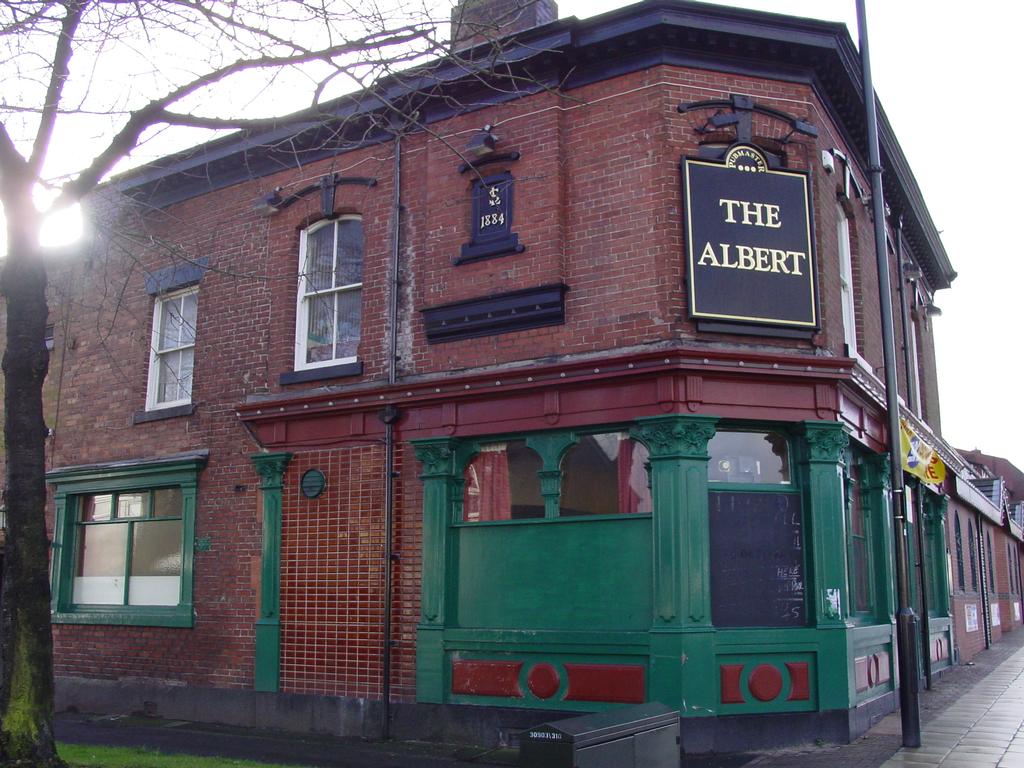
Albert was situated on Derby Street opposite what is now the Lidl
supermarket. The building still stands and has been a restaurant
since around 2012 but while the date stone on the side of the pub
notes that it was built in 1884 it actually dated back to 1852 as a
pub. The stone also includes the initials 'SL' – Sarah Leach, the
pub's formidable landlady for much of the second half of the 19th
century.
In
1841, 28-year-old James Leach was a carder in a local mill. He lived
on Bridgeman Street with his wife Ann and children Francis, Alice and
Selina. But James was an entrepreneur. He also owned a shop on
Bridgeman Street with Ann running the business while he was at work
in the mill.
By
1843, the Leaches had opened a beerhouse, the Bridgeman Arms,
just across the road from their old shop premises and James gave up
his job at the mill to work full-time at the pub. They had pinched
the name from an established pub by that name that had only recently
closed down on Crook Street.
In
1852, James Leach moved with Ann and their four children to a new
pub, the Albert, situated on Derby Street. Like the Bridgeman Arms,
the Albert had a licence that restricted it to the sale of beer. But
James had grand plans and the following year he applied for a full
public house licence that would enable the Albert to sell wines and
spirits as well as beer. At the annual licensing session in August
1854, James Leach was one of the 23 applicants for full licenses
along with such neighbouring pubs as the Derby Arms, the Greengate, the Royal and the British Oak. The hearing didn't go well. For a start, the chairman of the
magistrates bench was staunch teetotaller Robert Walsh. Then a local
factory owner James Barlow presented a petition against increasing
the number of public houses signed by 3000 ratepayers, the local
middle classes many of whom rarely used pubs. Mr Walsh threw out all
23 applications. He had calculated that there was one alehouse for
every 106 people in Bolton. In his view one for every thousand people
would be enough. [Manchester Courier, 2 September 1854]
 |
| The Albert taken around 1973 as part of a photoset for Tetley Walker |
Leach
was to apply for a spirit licence for the Albert every year until he
was finally successful in 1865. It was common practice for applicants
to get a petition - known in those times as a 'memorial' - signed by
as many people as possible to support the application. Discouraged by
his previous failures James Leach failed to get many of the
influential middle-class business owners to sign his memorial on this
occasion. However, his solicitor, Mr Hall, pointed out to the bench
that almost a new town had sprung up alongside Derby Street in the
previous 20 years but that no provision had been made for an
additional fully-licensed public house. A number of beerhouses, such
as the Albert, had sprung up instead. He went on to request that if
the bench was happy that Mr Leach was a respectable man and that the
house was suitable enough for the purpose of becoming an inn then
there was no reason why a licence to sell spirits should not be
granted. The magistrates agreed and a full licence was granted to the
Albert and the Prince Of Wales, Mount Street – the only two
successful applicants out of 45.
By
the end of 1865 the Albert had been refurbished. Business was brisk
enough for James Leach to advertise in the Bolton Chronicle spent
grains from the brewing process for use as animal feed. The ad
mentioned that he was brewing nine times a week.
Ann
Leach died in 1854 at the age of 39. The following year, James
married Sarah Renshaw in the rather grand setting of Manchester
Cathedral. By now he was 45 year old, but his new wife was just 23.
In
1861, James was at the Albert with his wife Sarah; children Francis –
at 24 just five years younger than his stepmother and working as a
brewer at the Albert – Selina (19), Levi (12), James Albert (9),
Jane Ellen (4) and William Henry (2). The latter two were his
children with Sarah.
Not
only did the Albert brew for its own pub but beers were sold in to
the wholesale trade and over a period of time it built up a small
tied estate. Amongst Leach's pubs in the late-19th century
were the Clifton Arms on Newport Street,
the Albion on Moor Lane, Uncle Tom's Cabin
on Lever Street and two pubs on the other side of town: the WindsorCastle
on Halliwell Road and the Woodman Inn on Carlyle Street.
James
Leach died on 19 April 1876 at the age of 67. His estate at time of
death was worth just under £14,000 – around £1.5million in
today's money. On his death, control of the Albert Inn, the brewery,
and a small estate of tied houses, passed to Sarah.
By
all accounts, Sarah Leach wasn't a woman to be messed with. Her
daughter Jane Ellen Leach married James Grant Urquhart at Ormskirk in
1875, but by 1880 the marriage was at an end. In January 1881,
Urquhart sued Sarah Leach at Manchester Crown Court for the sum of
£500 damages for what he described as “assault and unlawful
seizure”. The court heard an account of a miserable domestic life –
and with Sarah Leach at the centre of it. Urquhart claimed he had
been harassed by Mrs Leach and that she had induced Jane to leave him
and live in adultery. He now ran a provision shop in Morris Green but
he sold beer supplied by Leach's Albert Brewery. On 16 August 1880
Urquhart went to Bolton on business but on his return he found his
wife in the house of neighbour named Margerison. Urquhart castigated
his wife for being at the house but she responded by striking him on
the side of the head with a poker. Sarah Leach had arrived at his
house with a man named Waring – possibly her brother-in-lsaw and
another man and that the two men had badly assaulted Urquhart. In her
defence, Mrs Leach described Urquhart as “a wastrel” and that he
had treated his wife so badly that she had been forced to go and live
in America. Mrs Leach had put him in the shop and he hadn't paid any
ingoings. The judge ruled that as there had been faults on both sides
he was throwing out the charge. [Bolton Evening News, 31 January
1881; Manchester Courier, 3 February 1881].
In
January 1879 the Albert received a billiards licence. But in March of
that year it was hit by tragedy when a barmaid, Ellen Mather (nee
Smith), was fatally stabbed while on her way from the Albert to a St
Patrick's Day dance at Bridgeman Street baths. Mrs Mather had worked
at the pub as far back as 1860 and had been courted by a local man,
William Cooper. The relationship was ended by Mr Cooper who then
joined the army. Ellen Smith married a man named Mather but on
Cooper's discharge from the army he returned to the Albert to seek
out his former sweetheart and reproached her in no uncertain terms
over her marriage. However, he also married and was now the father of
six children.
In
1872, Ellen Mather's husband left for America with his mother taking
with him their three sons but leaving behind a daughter, now aged
nine. Ellen went back to work at the Albert but once again found
herself the subject of the attentions of William Cooper despite the
fact that he was married.
On
17 March 1879 Sarah Leach organised the refreshments at the St
Patrick's Day ball and she instructed Ellen Mather to go to with Mrs
Leach's sister Ellen Wareing to Bridgeman Street baths at 11.30pm
after the Albert had closed in order to assist behind the bar there.
As Mrs Mather and Mrs Wareing reached the junction of Derby Street
and Crook Street they encountered Cooper who had been drinking in the
Albert that evening. He tried to prevent Ellen Mather from going on
to the baths and struck her with his fist on the side of the head.
The two women fled down Crook Street but Cooper caught up with them
and grabbed Ellen round the neck and put his knee in her back. He
then took out a pocket pen knife and slashed her throat. Mrs Wareing
screamed for help as Ellen Mather lay dying in the street. William
Nightingale, an employee at the Trinity Street railway yard,
apprehended Cooper who is reported as saying: “I won't run. I have
done what I intended”. A cabman named Patrick Hughes then arrived.
Cooper said: “See Patsy. That's Ellen. I have killed her.” Ellen
was taken to Dr Johnston's surgery on Bridgeman Street where she died
shortly afterwards. Cooper was charged with her murder and found
guilty at Manchester Assizes.
The
1881 census shows that Sarah was the proprietor of the business but
her son William, her first with James Leach and now 22 years old, was
in charge of the day-to-day running of the pub and brewery. He
appears to have been promoted ahead of two of his older half-brothers
– Francis and James Albert. Francis, the eldest Leach child, had
been employed by the business, but by now he was in the workhouse
where he died in 1888. James Albert was working as a brewer at the
pub. He died in 1893 at the age of 41. Another son, Levi Leach, had
been the landlord of the Greengate Inn in nearby Hammond Street and also the Tanners Arms on Lever Street.
He died in April 1896 aged 47.
The
original Albert burned down in February 1884. A fire began in the
taproom and tore through the building with the conflagration aided by
several kilderkins of spirits that were stored in the vault and the
taproom. Mrs Leach and around a dozen family members, friends and
lodgers were at the pub and had to be rescued. Various memorabilia
belonging to the Oddfellows and Foresters clubs who met at the pub
were completely destroyed. Fortunately, the building was insured with
two companies. The Albert was rebuilt that same year. A stone with
the year 1884 and the initials SL – for Sarah Leach – remains on
the side of the building to this day.
Sarah
Leach died on 23 April 1902. She was 70 years old. That day's edition
of the Bolton Evening News remarked that she was “an exceedingly
generous friend of the poor”. She was buried alongside her husband
in Tonge Cemetery. A few years after Mrs Leach's death a number of streets were developed around Clarendon Street school. One of them was named Leach Street in the family's honour.
The
Leach business comprising the Albert, the brewery and a small number
of pubs, had continued to grow since James Leach's death and Mrs
Leach's estate was worth over £25.000 when she died – the
equivalent of £2.8million today. Her son William Leach was appointed
executor of the estate along with his sister Selina Gilchrist who had
married a noted physician, Robert Munn Gilchrist in 1901 (the couple
lived at Dr Gilchrist's surgery at 343-345 Derby Street).
William
took over the running of the business. He lived next door to the
Albert at 185 Derby Street. The 1911 census shows his brother Charles
Edwin Leach was also involved. He lived at the pub along with his
wife Sarah. They had no children but two barmaids and three servants
were living on the premises.
Wilbraham
Leach, James's first son with Sarah, ended up in jail in 1907. He had
run a number of the brewery's pubs in Bolton including the Newport Vaults
in Newport Street and the Clifton Arms a few doors away. He was
living in semi-retirement in Blackpool although he still had a senior
position within the Leach company. Wilbraham was accused of
indecently assaulting a woman while drunk on a Manchester to
Blackpool express train. He was described as having a wife and six
children and was in “a good position” at the brewery. The
complainant said that an ample apology in court would satisfy her and
Leach produced references from the Mayor Of Bolton and the Chief
Constables of both Bolton and Blackpool. Nevertheless, the case was
sent to trial and Leach was found guilty and sentenced six months in
jail. He had retired to Blackpool in 1904 where he died on 11
January 1927. [Manchester Courier, 1 February 1907 and 22 February
1907].
William
Leach remained as the proprietor of the business until 1927 when he
died aged 66. He had by then retired to a house in Cardigan Road,
Southport where he died on 18 April 1927. He had taken a back seat in
the business and the Albert – still owned by the Leach company -
was being run by Robert Hall. The business was bequeathed to
William's two children. James was a surgeon while Lily, who had
married a member of another notable industrial family, the
Crumblehulme's, who owned a foundry opposite the Albert.*
Leach's
Brewery carried on until 1936 when it was decided to wind up the
business. The last of the Leach family to be involved was Charles
Edwin Leach, the chairman of the company's board of directors who was
now in his late-sixties. It was a time of takeovers and the company
had done well to remain independent for over 80 years since James
Leach first began brewing at the Albert. The First World War had
wiped out a number of small breweries and two of Bolton's big three,
Sharman's and Tong's were now part of the Warrington-based Walker
Cain company (the other big Bolton brewer, Magees was just a couple
of hundred yards from the Albert up Derby Street).
The
Albert, the Albion and the rest of Leach's business became part of
another Warrington firm, Cunningham’s. Brewing ceased at the
Albert. In 1951 both the two were part of a parcel of 34 pubs and 18
off-licences sold by Cunningham’s to Joshua Tetley & Son of
Leeds for a sum of £550,000. Tetley's were seeking to expand into
Lancashire. They merged with the Walker's of Warrington in 1960
In
the nineties, Tetley’s got out of vertically-integrated business
model where breweries owned huge tied estates. The Albert was sold to
Pubmaster and later came under the control of the Mistry family, the
owners of the adjoining Bantry Club. They connected up the two
licensed premises
Around
2009 the Albert closed down. The building is now an Afghan
restaurant.
*The
Crumblehulmes' foundry business collapsed in 1911. At the time of
their marriage in 1917 Lily Crumblehulme was living at Hexham Avenue,
Doffcocker. Her husband, William Lewis Robinson Crumblehulme, was
resident at The Hotel, Shawbury, Shropshire. William's father, also
William, was the founder of the Crumblehulme business based at Emblem
Street, Bolton and at Rothwell Street. The Rothwell Street works was
re-purchased by William LR Crumblehulme and his brother James.
Chrstine Crumblehulme's detailed history of the Crumblehulme businesscan be found here.
“At
the Borough Court this morning Sarah Leach, landlady of the Albert
Inn, Derby-street, was charged with selling intoxicating liquors
during prohibited hours. PC Shepherd said that on Sunday morning at
24 minutes past 12 o'clock he found the defendant's public house open
and three men with glasses of beer in front of them. He asked
defendant by what clock she opened her house, and she answered by the
one in the bar which was then only 26 minutes past. By Mr Fielding:
He believed defendant asked him if he had better close the house
until half past and he answered that it was immaterial. The Mayor
said the Bench were unanimous in their view that a breach of the law
had really occurred, but they thought the offence was so trivial they
would discharge the case, defendant to pay the costs. It would no
doubt act as a warning.” - Bolton Evening News, 13 November 1879.
“Breaksmen
(L&NW) Annual Dinner. The dinner was held at the Albert Inn,
Derby-street on Christmas Day. Mr Flitcroft presided in the absence
of Mr Atkinson and an enjoyable evening was spent. The usual toasts
to the Queen and Royal Family, also James Shaw and L.D. Price and the
subscribers in general were given.” - Bolton Evening News, 29
December 1891.
“Bolton
Bowling Association. The annual general meeting of the Bolton Bowling
Association was held on Wednesday night at the Albert Inn Hotel,
Derby Street. There was a good attendance of the various clubs
connected with the association.” - Bolton Evening News, 10 November
1893.
“There
were laid at rest this afternoon at St Peter's Churchyard, Halliwell,
the remains of the late Mr John Haworth, proprietor of the Albert
Hotel, Derby st. The officiating clergyman was the Rev P Stott. There
was a number of beautiful wreaths among the senders being the Bolton
And District Managers And Overlookers Association, minders at
Parrot-st mills, customers of Albert Hotel, Dr Ryan, Messrs
Crumblehulme, Gulland, Wood, Bennet, Worrall, Hibbert, Hart, Skinner,
Leach's Brewery, Leach's employees, servants at Albert Hotel,
cardroom hands at Messrs Marsden's No 3 mill and others.” - Bolton
Evening News, 6 November 1906.