Thursday, 24 July 2014

Kings Head Hotel, Deansgate


Blackhorse Street with the Hen and Chickens to the left of it in this April 2012 image (Copyright Google Street View). The King’s Head directly adjoined the Hen and Chickens although it was the ‘junior’ of the two pubs.  

Many readers will know the King’s Head on Junction Road – one of Bolton’s oldest pubs – but there was another pub by that name in the town centre until the late sixties.

The King’s Head Hotel dated back to the late-eighteenth century, according to Gordon Readyhough [1]. We can narrow that down to the final 20 years of that century as it doesn’t appear on the list of Bolton pubs from 1779.

Although the Kings Head ended its days as a Tetley Walker House it was a Magee’s pub at one stage and we can only guess that it was sold by the brewery as it was right next door to another Magee’s pub, the Hen and Chickens.

The King’s Head came undone by the needs of public transport. When Bolton  Corporation decided to close Howell Croft bus station and directed the vast majority of bus traffic into Moor Lane they realised that the Blackhorse Street junction with Deansgate was far too small to cope. A projected increased in the size and nature of traffic from the north of the town meant the junction needed to be widened.

Sadly, the King’s Head had to go and it, along with a small shop next door, closed in 1968 and were demolished that year.

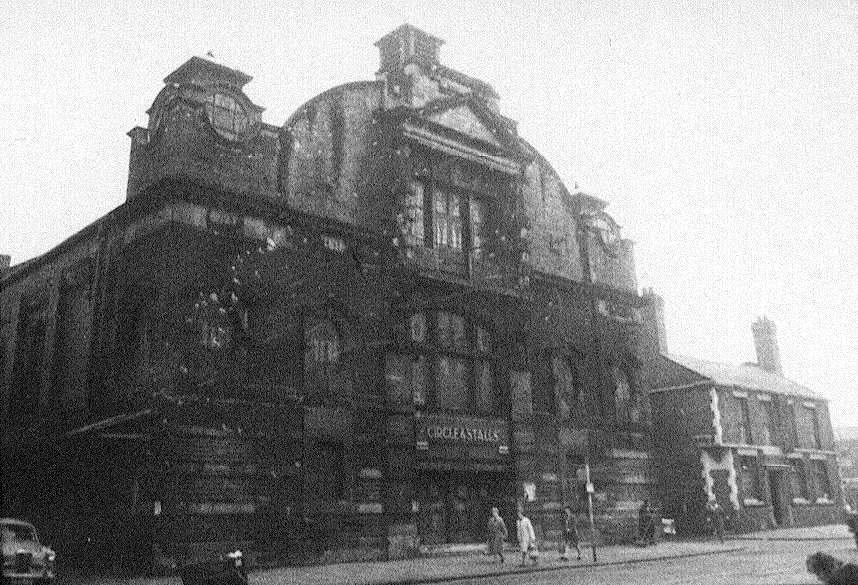
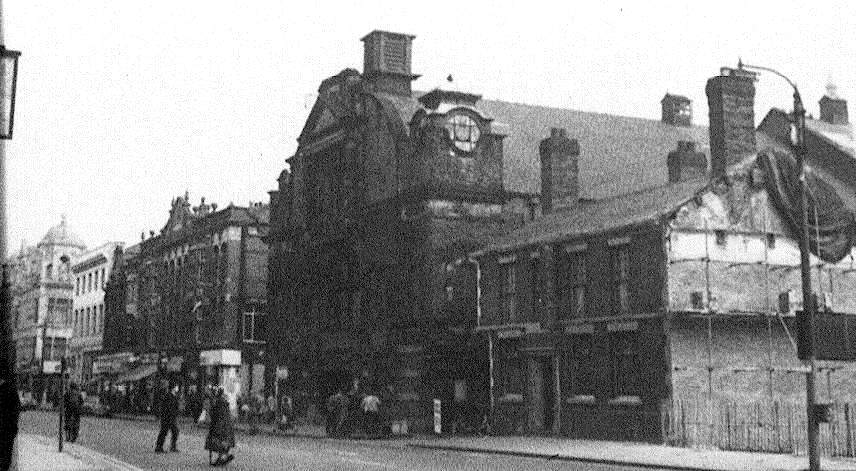
Next door but one to the King’s Head stood the Hippodrome Theatre and the King’s Head, the Hen and Chickens, and other nearby pubs such as the Greyhound, the Gypsy’s Tent, the Blue Boar and the White Lion would have served many thirsty patrons both during and after performances.

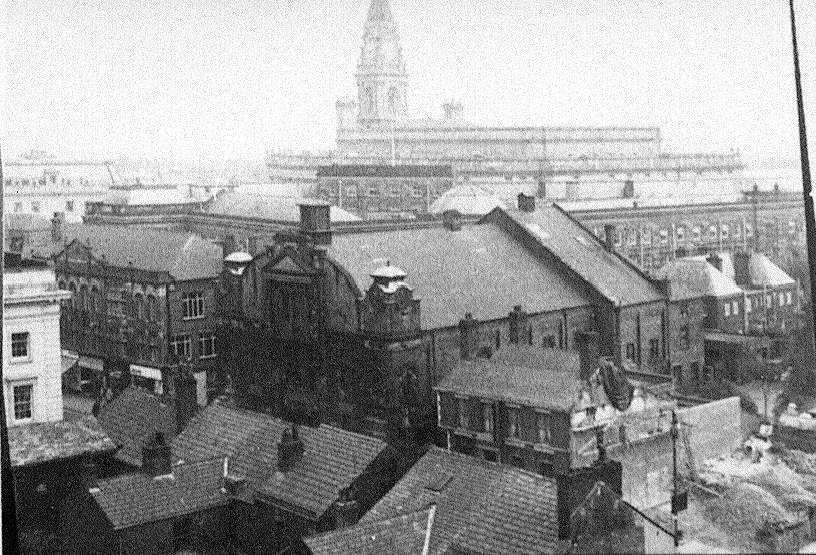
Photos of the Hippodrome can be seen here , here, and here. The photos are dated 1950, but given that the demolition of the King’s Head is in progress in at least two of the photos the images are more likely to be from 1968 or 1969.


[1] Pubs Of Bolton, 1800-2000, by Gordon Readyhough (2000). 

Monday, 21 July 2014

Waggon and Horses, 84 Moor Lane


Moor Lane runs across the centre of this October 2009 photo {Copyright Google Street View). The Waggon and Horses was actually situated on the far-left side of the railway bridge. The fire station (built 1971) is on the left. Prior to its construction the entrance to the fire station was formerly the entrance to Partridge Street.

This isn’t a pub that any readers will remember, as it closed in 1903.

The Waggon and Horses stood at 84 Moor Lane on a site now occupied by an expansion of the railway line. It was a beerhouse and was in existence during the second half of the nineteenth century. At that time Moor Lane had a number of pubs: the 1853 Bolton Directory lists six beerhouses – along with two longer established public houses, the Three Tuns and the Dog & Partridge (not the one on Manor Street). [1]

Wingfield’s Silverwell Brewery owned the Waggon and Horses for a time towards the end of the nineteenth century, but Wingfield’s was taken over by the Manchester Brewery Company in 1899. [2]

In the end, the Waggon and Horses closed not through lack of trade but for the needs of the railway. The Bolton to Preston line was built in 1841 but by the turn of the twentieth-century the Lancashire Yorkshire Railway decided to double the tracks on the approach to Bolton station running under Moor Lane and to build sidings at Bullfield. That necessitated the demolition of a number of streets just off Moor Lane as well as properties on the lane itself.

Hulton School, which was on Moor Lane but had been built on the bridge running over the top of the railway was demolished. Back Partridge Street went and as the Waggon and Horses was on the corner of Back Partridge Street it, too, bit the dust.


A few yards away the Dog and Partridge was reprieved and lasted another 66 years until it was demolished prior to the construction of the new fire station. Only the Albion survives on Moor Lane and its viability could be threatened when the bus station moves to Great Moor Street.

[1] Four Bolton Directories 1821/2, 1836, 1843, 1853. Reprinted by Neil Richardson (1982).
[2] Bolton Pubs, 1800-2000. Published by Neil Richardson (2000).

Friday, 18 July 2014

Mortfield Tavern, Gaskell Street


Gaskell Street as it turns into Bromilow Way, pictured in April 2012 (copyright Google Street View). Nelson Mill and the adjoining cottages, which date back to the early-nineteenth century, are pretty much as they were when the Mortfield Tavern was in existence. The car park on the right marks site of the Mortfield.

The name ‘Mortfield’ crops up frequently around the Chorley Old Road area. An area on the north-eastern side of the bottom end of Chorley Old Road was known as Mortfield and even today the name lives on in the Mortfield Angling Club fishing at Mortfield Lodge, while Bolton Rugby Union Club’s ground is known as the Mortfield Pavilion and a housing development on the site of the former Polish Club is named Mortfield Gardens.

Previously, there was the Mortfield Bowling Club on Osborne Grove – now one of our lost clubs – and the Mortfield Bleachworks, owned by the Cross family (later known as Shepherd-Cross) and which was in existence from around 1821 to 1961. It is pictured here in 1927. [1] The Shepherd-Cross family lived in Mortfield House, just off Mortfield Lane, at the back of the bleachworks.

The Mortfield Tavern was situated at number 18, Gaskell Street, a bit further along from the bleachworks and it probably took its name from its proximity to Mortfield Street, which ran down by the side of the pub.

This area of Bolton was built up in the 1870s and the Mortfield Tavern opened up as a beerhouse around that time. It was owned by Robert Wood of the Prince Arthur Brewery, which was situated in St John Street, off Higher Bridge Street.

When the Prince Arthur Brewery ceased trading in 1915, the Mortfield Tavern was sold to William Tong’s, whose brewery was situated on Deane Road. There was an element of having their ‘tanks on someone else’s lawn’ as the Mortfield was only a stone’s throw away from Sharman’s Mere Hall Brewery.

Not that it mattered, ultimately. Both breweries’ pubs ended up in the hand of the Warrington company Walker Cain with Tong’s selling out in 1923.

The Mortfield Tavern continued until 1957. Walker’s had just built the Castle on Crompton Way and in order to get a full drinks licence they had to surrender the licences of no fewer than three beerhouses. The Mortfield; the Pineapple on Radcliffe Road, Darcy Lever; and the Bee Hive on Duke Street all bit the dust as Tonge Moor gained a rare pub.

The whole of that part of Gaskell Street was redeveloped in the sixties and seventies. The Mortfield Tavern was demolished and the likes of Mortfield Street, Lyon Street and Orm Street were all swept away. The old Gaskell Street Primary School, which stood near the Mortfield, was knocked down and rebuilt.

The site of the Mortfield now forms part of the car park of the Church Of Jesus Christ Of The Latter Day Saints a new church set back from the road.  Ironic, really, given the Mormons’ less than welcoming attitude to booze.

[1] St Mark’s website, David Dunne.


Tuesday, 10 June 2014

One Horseshoe, Manor Street


Two images of the One Horseshoe from the Bolton Library and Museum collection (copyright Bolton Council). The image at the top dates back to the 1930s and shows Manor Street being widened at the bottom. The One Horseshoe can be seen on the left of the image. On the right, the building in 1975 when it was being used by Manor Carpets, a company that still exists at premises on Chorley Old Road. 

The One Horseshoe was situated on Manor Street and when it opened in the late-eighteenth century it was known simply as the Horse Shoe. It was a departure point for a number of stagecoaches. The 1824 Pigot Directory stated that the ‘Accommodation’ departed for Manchester every morning at 8, while the 1836 Directory listed coaches for Haslingden and Ramsbottom leaving every Monday afternoon at 4.


The One Horseshoe was to play a role in the development of two sizeable Bolton brewing concerns: Atkinson's and Magee, Marshall. In 1864 it was bought by William Atkinson. A native of Leeds, Atkinson was living in Water Street in 1861 where he worked as a common brewer. At that time it was common for pubs to brew their own ale but a common brewer brewed for outlets that didn't have their own breweries. Either Atkinson made enough from brewing to buy his own pub or he needed a guaranteed outlet for his products but he enjoyed a seven-year spell at the pub.


But the final year of Atkinson's tenure at the One Horseshoe was marked by a court case that resulted in its temporary closure. In May 1870 Atkinson was charged by PC John Hopkins with refusing to admit police to the pub at a quarter past one on a Tuesday morning. PC Hopkins claimed to have seen five or six men leave the pub after which a woman came to the door and looked out. After she went back inside PCs Hopkins and Bedford knocked on the door. “Who's there?” the woman shouted. “It's the police,” replied PC Hopkins. PC Bedford knocked loudly on the door with his stick but the two policemen waited outside for 15 minutes without the door being answered. In his defence William Atkinson claimed he was the last person up and that he went to bed at midnight but he insisted neither he nor Mrs Atkinson had heard the policemen knock. The bench considered that the case was proved and fined Atkinson 20 shillings (£1) with 14 days' imprisonment if he failed to pay the fine. [Bolton Chronicle, 4 June 1870]. Worse was to come. In August 1870 the annual licensing hearing suspended the pub's licence and it only re-opened at the end of September following an appeal. [Bolton Chronicle, 1 October 1870].


In March 1871 Atkinson left the One Horse Shoe and the licence was transferred to Samuel Smith. Smith before being taken over three months later by John Wardle, formerly of the nearby Dog and Partridge.  By then Atkinson had bought the Commission Street Congregational School which he converted into a wholesale brewery. He died in 1879 but his son John Atkinson had followed him into the brewing business. The firm was converted into a limited company, John Atkinson & Company Ltd, in 1882. By that time it had 27 beerhouses and eight off-licences. It was to last until 1896 when it was taken over by Boardman United Breweries Ltd of Manchester.


Wardle was a different type of landlord to Atkinson. For one thing he was a prominent Conservative. He was urged to become a candidate for the Church Ward at the 1871 local elections when he was put forward by another pub landlord, James Pitney Weston of the Star Inn on Churchgate although he refused the nomination.


John Wardle spent less than two years at the One Horseshoe but the next landlord, Ellis Marshall was there for 18 years from 1873 until his death in 1891. He had previously been at a nearby beer-house, the Same Place Again in Independent Street. Ellis Marshall's brother was a local brewer named Daniel Marshall who ran the Grapes Hotel and brewery on Brown Street as well the Horse Shoe Brewery on Water Street to the rear of the One Horseshoe. It is likely that he bought the One Horseshoe and installed Ellis as the licensee.


In 1885, Marshall merged his business with Magee's, a firm owned by the three sons of Daniel Magee. The One Horseshoe became one of the first Magee,  Marshall pubs when the limited company of Magee, Marshall and Co. Ltd was formed three years later in 1888 Daniel Marshall had a 27 percent stake in the new company.


In January 1879 Ellis Marshall put on a substantial supper for 150 of the poor and distressed people of the neighbourhood. The streets to the rear of the One Horseshoe were among the poorest in the town.


Ellis Marshall committed suicide at the One Horseshoe in 1891. The Bolton Evening News of 28 May reported that his son was accustomed to being woken so he could go to work but as his father failed to do so this morning he went to see if he was ill. He found Ellis's body hanging “suspended by a hook by means of a riding rein”. He had been seen the previous evening going about his business as usual and nobody suspected anything strange in his behaviour. However, his wife had died several months previously and he had been low-spirited since then. Ellis's son, also called Ellis, took over the pub but he died in 1899.


In their book Looking Back: Photographs and Memories of Life in the Bolton Area 1890-1939, Anne Bromilow and Jim Power recount the tale of a landlord of the One Horseshoe who became known locally as ‘Elephant Man’ after he stored six elephants in the pub’s cellar after a circus arrived in Bolton. The landlord isn’t named, nor is the story dated and the elephants were obviously not fully grown as their heights are given as being between 5ft and 5ft 6. They only just fit into the pub’s cellar and were presumably there alongside vented barrels of beer. However, the landlord was worried about the authorities finding out about the elephants – hardly surprising – and he also stated that their arrival at his pub with hundreds of children in tow created something of a stir on Bank Street.


The One Horseshoe became a Greenall Whitley pub when that company bought out Magee, Marshall's in 1958. However, it continued to be supplied from Magee's brewery in Cricket Street.


When the One Horseshoe closed in 1966 the premises were bought by Gentleman John’s wallpapers. It was later occupied by Manor Carpets before becoming Bar Peru in the nineties. Later, it was known as Nicholas Bar


Article updated 15 November 2020 with added historical information.


Manor Street pictured in April 2012 with Bank Street just beyond the bridge over the River Croal. Bar Nicholas in the foreground was One Horseshoe from the late-eighteenth century until 1966. Image copyright Google Street View.


Sunday, 8 June 2014

Monteraze, Manchester Road


The site of Monteraze in April 2012 (copyright Google Street View). The former pub is now an orthodontist's surgery.

A relatively short-lived pub – it lasted 15 years – Monteraze was situated at 464 Manchester Road, about half a mile away from Burnden Park. The pub was run for a number of years by a former Bolton Wanderers player, Roy Greaves.

The stretch of Manchester Road from Burnden Park down to the former Greyhound near St Michael’s church never had a reputation for its pubs. The other main roads out of town – Bury Road, Derby Street, Deane Road and Blackburn Road – all benefited from the explosion of pubs following the 1830 Beerhouse Act. Tonge Moor Road didn’t, largely because various covenants forbade pubs to be built. 

Manchester Road didn’t have many pubs largely because it became sparsely populated once you got through Burnden. The King William IV was the last pub for almost a mile.

Of course, those that did live there – the middle- and upper-class mill-owners – weren’t likely to slum it with the hoi-polloi in the local boozer.

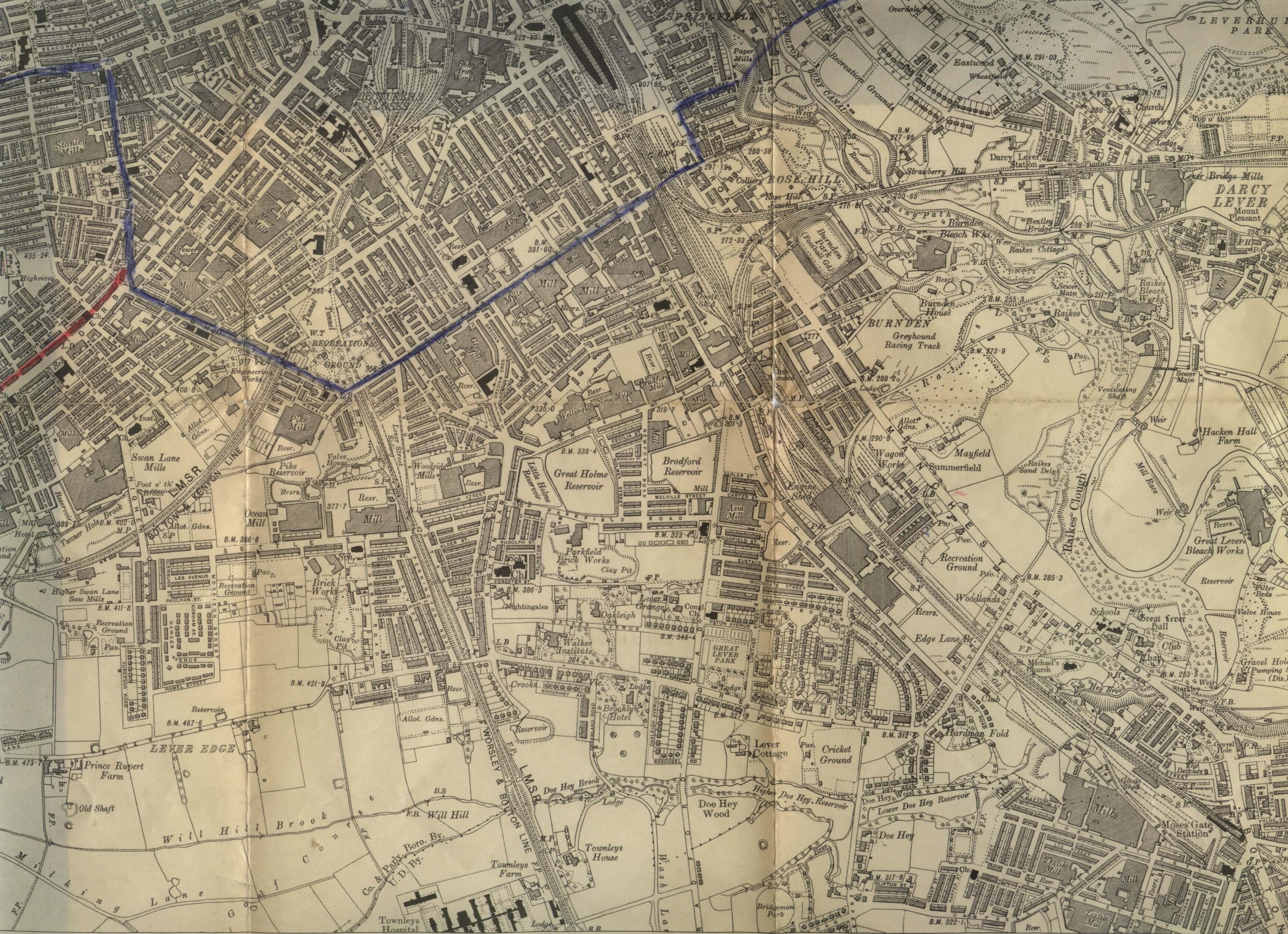
Have a look at this map of the area from the late-twenties. By then the pub boom of the nineteeth century was long gone and the urbanisation of the outskirts of Bolton was just beginning. The map shows Manchester Road lined with homes with names such as Woodlands, Mayfield and Summerfield. Mayfield Avenue and Bradford Avenue had been built on the site of another villa-type residence, Bradford House. Summerfield was next door to the building that became Monteraze and was home to the Baines family of cotton manfacturers.

That was the kind of person that lived on Manchester Road in the nineteenth century.

Monteraze opened in the autumn of 1989 with the local beer drinkers’ magazine reporting that cask beer from John Smith’s and Courage was being sold [1]. It became popular on Bolton Wanderers match days as offering something a little different to other pre-match pubs such as the Cattle Market or the King Bill.

But perhaps the Wanderers connection was to be its downfall. A few years after Monteraze opened for business the club announced it was moving to Horwich and while the move took a few years from inception to completion it meant a long, slow death for Monteraze.

The pub closed around 2004 and is now an orthodontist surgery. It still looks similar to its days as a pub with a reception area where the bar once was and the pub’s two rooms now waiting areas.


[1] What’s Doing, the Greater Manchester beer drinkers' monthly magazine. November 1989 issue.
Friday, 6 June 2014

Black Horse Hotel, Blackhorse Street

Black Horse Blackhorse Street Bolton

The Black Horse - and next-door neighbour - pictured in the 1920s.


The Black Horse Hotel was located on Blackhorse Street and dated back to the late-nineteenth century.
Blackhorse Street was initially known as Thweat Street and was named after James Thweat, whose surname was often spelt Thweats or Thwaites. He opened one of Bolton’s first cotton mills in nearby King Street.

The Black Horse pub dated back to the late-eighteenth century and it first appeared in the local licensing records of 1801. [1] Isaac Dobson lived at the pub shortly after he arrived in Bolton in 1789, while Lane’s Masonic Records suggests that the Lodge Of Antiquity, which was formed in Leigh in 1776, met at the Black Horse from 1793 to 1802.
In the early part of the nineteenth century Thweat Street was lined with houses, but it became a heavily-industrialised area as the century went on.

Dobson went into business with Peter Rothwell, the owner of a timber yard on Thweat Street and the firm that eventually became Dobson and Barlow was born.

With Isaac Dobson still resident at the Black Horse the pub eventually became a meeting point form some of the town’s most prominent business people and during the first decade of the nineteenth century the street took on the name of Blackhorse Street – after the pub - which it retains to this day.

These same prominent businessmen, Isaac and Benjamin Dobson, Peter Rothwell and Benjamin Hick, formed ‘the Black Horse Club,’ an informal business club which secured an annuity of £63 15s for the inventor Samuel Crompton, who often drank at the pub and attending meetings of the club. Crompton, who lived in nearby King Street, was famed at the Black Horse for sitting with his one glass of ale and “seldom speaking, except when directly addressed, and then always briefly and to the point.”

Dobson’s business prospered as did Rothwell’s nearby Union Foundry and, presumably, the Black Horse. Dobson's had moved to Kay Street by 1860, by which time the firm was employing 1600 workers.

The Black Horse Inn lasted until 1937. It was a Tong’s house in the early years of the twentieth century and was transferred to Walker Cain Ltd of Warrington when they bought out Tong’s in 1923. As Bolton Council further developed the Civic Centre around the back of the Town Hall they knocked down the Black Horse and landscaped the area. In the late-sixties Black Horse Street was widened to accommodate the increase in bus traffic going into Moor Lane bus station.


[1] Bolton Pubs, 1800-2000, by Gordon Readyhough (2000).


Blackhorse Street pictured in April 2012 (copyright Google Street View) looking towards Moor Lane bus station. The Black Horse Hotel was situated on the left-hand side of this view. When Howell Croft bus station was closed in 1969 and bus traffic transferred to Moor Lane, Blackhorse Strreet was widened. The Black Horse Hotel was situated where the pavement now stands, roughly just past the lamp post on the left.

Monday, 2 June 2014

Wheatsheaf/Serendipity's, Great Moor Street


Wheatsheaf Hotel Newport Street Bolton


Newport Street with Great Moor Street running across pictured in the late-nineteenth century. The 1835 version of the Wheatsheaf can be seen on the left-hand corner.


The story of the Wheatsheaf Hotel is one of three buildings in two locations on opposite sides of the town centre.

While many people will associate the Wheatsheaf with the round building on the corner of Great Moor Street and Newport Street, the original Wheatsheaf stood on Bank Street – ‘Windy Bank’ as it was known to Bolton residents at the end of the 18th century.

In his book Pubs Of Bolton 1800-2000, [1] Gordon Readyhough claims the original Wheatsheaf opened in 1810. However, the list of Bolton pubs from 1778 shows that there was already a Wheatsheaf Hotel with Thomas Haslam as landlord.

The pub stood close to the entrance to the Unitarian chapel on Bank Street and the chapel’s bicentenary book from 1896 makes reference to the Wheatsheaf and its proximity to the chapel’s Sunday School, which was built in 1796:

“It [the Sunday School] stood between the passage to the old chapel and the old Wheatsheaf Inn. On the removal of this inn, with the inn-keeper and the name of the hotel, to the new Wheatsheaf in Newport Street, the school building, along with the inn, was pulled down, and shops built on the site.”

In those days Bank Street was a narrow passage, in fact it was “so very narrow that it was necessary for foot-passengers to step into some shop or doorway to avoid being crushed by a passing cart.” [Sayings and Doings of Parson Folds. Bolton : Geo. Winterburn, 1879, page 34]

In 1818 the landlord of the Wheatsheaf was Samuel Henry and he appears to have run the pub until shortly before it was removed to Newport Street in 1835. In the 1836 Bolton Directory [2], John Platt was the landlord of the Wheatsheaf while Samuel Henry was running a beerhouse on Bridgeman Place. [3] Samuel Henry’s departure may well have been the catalyst for the removal of the Wheatsheaf to its new location.

The Wheatsheaf was sold by auction for £8400 on 3 April 1878 [4] and was run in the 1880s and 1890s by George Walker, the proprietor of the Bolton Brewery Company Ltd. The premises were much larger than the building that still stands today and was run as a hotel, as this old photograph from the late-fifties shows. Here's another shot of the old building, this time from the Bolton Evening News taken in 1961 shortly before it was demolished.

Indeed, there appears to have been a Wheatsheaf Hotel Company that was taken over by the local brewery of Magee, Marshall and Co around 1909. Magee’s ran the pub until they were taken over by Greenall Whitley in 1958.

A few years later, Greenall’s took the decision to knock down the 1835 building and rebuild the Wheatsheaf in a modern style – complete with revolving doors. The new building was set further back than the old Wheatsheaf, but the pub had new neighbours: the western side of Newport Street had been demolished and rebuilt in 1957 and when the new Wheatsheaf was completed in 1962 it was more in keeping with the buildings that had sprung up around it. A new row of shops was later built next to the pub– including a branch of Hanbury’s and Shaw’s outfitters – so that corner of Newport Street and Great Moor Street had architecture which, while perhaps not entirely aesthetically pleasing, at least complemented each other and were much more of their time. Here's a photo from 1963.

The new Wheatsheaf had a much smaller bar area than the old building, though it did have an upstairs function room, used for weddings, engagements and the like, and also heavy rock discos for a few months around 1984.

In 1986, Greenall’s decided to refurbish the Wheatsheaf. The result was £100,000 spent on an “exciting and cosmopolitan” town centre venue known as Serendipity’s. The idea was that instead of being just a pub, Serendipity’s would also serve tea and coffee for passing shoppers.[5]

But for “exciting and cosmopolitan” read ‘one last throw of the dice’. Some of the rougher pubs were at that end of town and with the clientele to match. Serendipity’s did well at first, but towards the end it had become a pub to avoid. It closed around 1994 and after lying empty for a few years it was converted into a branch of cut-price retailer Home Bargains, which opened in 1997.


The former Wheatsheaf, pictured in April 2012. Copyright Google Street View.

[1] Pubs Of Bolton 1800-2000, by Gordon Readyhough. Published by Neil Richardson (2000).
[2] Four Bolton Directories: 1821/2, 1836, 1843, 1853. Reprinted by Neil Richardson (1982).
[3] The beerhouse on Bridgeman Place that Samuel Henry was running may well have become the Bradford, though not the pub of the same name a few hundred yards from Bridgeman Place, on Bradford Street. This one was where the petrol station now stands.
[4] Annals Of Bolton, James Clegg, 1888
[5] Bolton Beer Break, the magazine of the Bolton branch of the Campaign for Real Ale. Summer 1986 issue.