Tuesday, 20 May 2014

Gypsy's Tent/Gipsy's Tent/Winston's, 178 Deansgate


The site of the Gypsy's Tent in April 2012 (copyright Google Street View). The pub has been closed for some years and work began in 2017 on converting the building into flats. 


The Gypsy’s Tent (or Gipsy’s Tent as it was spelt up until the nineties) was built in the 19th century. Although the pub’s address  is on Deansgate it was severed from the rest of the street when Marsden Road bridge was built in 1877.

During the latter half of that century a band of travelling dentists would extract teeth at the rear of the building. As seems to have been common in Victorian dentistry a brass band was often present and would play tunes in order to drown out the patient’s screams. [1]

The pub came into the hands of local brewers William Tong in the early part of the 20th century before being taken over by Walkers of Warrington in 1923. Walkers merged with Tetley’s in 1961 to form Tetley Walker but in August 1981 it was decided to put the Gipsy’s Tent (as it was then) up for sale. [2]

When the De Havilland company opened its first factory on Bolton on Garside Street, off Spa Road, in 1937 there were only 50 employees on site. However, a sports and social club was soon formed and lunchtime darts and domino sessions were held at the Gypsy's Tent.

A local firm, Bandmatic, took over the pub in 1983. They operated pool tables in a number of local pubs and had also bought the Rose Hill on Manchester Road, which they named Churchill’s.  The Gypsy’s Tent was renamed Winston’s when it reopened in September 1984 and a refurbishment saw the former three-roomed pub turned into an open-plan arrangement. Previously, there had been a vault to the left of the front entrance with a lounge on the other side of an 'island' bar.

By 1989 Regal Knight Hotels were the new owners [3] and the pub was sold again in 1996 with the upstairs room transformed into Romany’s function room.

The Gypsy’s Tent was closed in 2007 and although it was put up for sale it appears not to have been sold.  According to Bolton Council’s empty property list the owner ws a company named PJM Trading Ltd although a company by that name based in Widnes was dissolved in 2011. Attempts to sell the pub appear were unsuccessful until 2016 when it was sold by auction to a company hoping to turn it into flats. Work began in 2017.

The pub is situated on a slight incline leading down to the River Croal and there have been rumours that the foundations are now unsafe.


This eerie yet intriguing photoset by urban explorer website 28 Days Later shows the inside of the Gypsy's Tent in 2015 by which time the pub had been closed for eight years. Note the empty bottles on the bar, seemingly abandoned.

[1] Bolton Town Centre, A Modern History. Part One: Deansgate, Victoria Square, Churchgate and Surrounding Areas, 1900-1998. Published by Neil Richardson.

[2] What’s Doing, the Greater Manchester beer drinkers’ monthly magazine, August 1981.

[3] What’s Doing, March 1989.

Sunday, 18 May 2014

Albion Hotel, Bridgeman Street


The bottom end of Bridgeman Street pictured in May 2012 (copyright Google Street View). The boarded-up Church Hotel is on the left. Station Street is on the left-hand side of the street running across the picture, Moncrieffe Street runs to the right. The Albion Hotel was actually situated on the other side of the role on the corner of a very brief continuation of Bridgeman Street, with the railway line running behind it.

This isn’t the Albion Hotel on Moor Lane. That’s very much alive and well, thankfully – this is another Albion, a long-lost pub once situated at the very bottom of Bridgeman Street, and although both pubs date back to around the middle of the nineteenth century by the dawn of the twentieth-century only the Moor Lane Albion remained.

Bridgeman Street was once said to be the longest street in Bolton. Initially it ran from Bradford Street all the way up to High Street and was later extended even further up to Adelaide Street.

In 1838 Bridgeman Street was affected by the opening of the Manchester to Bolton railway. This involved digging a huge ditch to accommodate the new rail tracks with Bridgeman Street carried over the line by means of a bridge.

By 1849 the Albion Hotel was in existence as a public house – not a beer house - at the corner of Bridgeman Street and Station Street, a street that still exists to this day. Station Street ran down the side of the old Trinity Station building for just a few yards until it met Moncrieffe Street outside the Church Hotel, but when the old station building was pulled down in 1987 Station Street was truncated just a few yards where it met the main carriageway.

The Albion’s existence became a little more precarious in 1884 when Bridgeman Street bridge was pulled down and the street split into two: the original Bridgeman Street, which ends where it meets Crook Street with the Church Hotel on the corner, and Lower Bridgeman Street which runs on the other side of the railway line.

The pub’s luck ran out in 1899. By then the Lancashire & Yorkshire Railway owned the premises and they decided to pull it down. An 1891 map of Bolton shows the Albion all alone, opposite the Church Hotel and with the railway line running behind it. It was very much in the way. Nathaniel Tyldesley had run the pub for over 20 years and, in his late sixties, he sold out to the railway company

Thursday, 15 May 2014

Duke/Archduke Charles, Deane Road


Duke Deane Road Bolton


The Duke – or the Archduke Charles Hotel – to give it its full original name was situated at the bottom of Deane Road, close to its junction with Mayor Street and University Way (formerly College Way).

The pub was actually one of the earliest in the area and Gordon Readyhough states that it dated back to the late-eighteenth century. [1]

By the middle of the nineteenth century terraced streets had begun to spring up on the opposite side of Deane Road, which in those days was known as Blackburn Street from town up to Cannon Street and Pikes Lane from Cannon Street onwards. Punch Street, Duncan Street and Noble Street were all in existence by 1849 and soon the stretch beyond the Duke and down towards town would consist of more housing and more than a dozen beerhouses in the space of just a few hundred yards.

Not far from the Duke was Chamber Hall. This was the seat of a branch of the Ormrod family, wealthy industrialists who made their money from cotton and banking. James Ormrod was a partner in the Bolton Bank, which through various takeovers and mergers, now forms part of the Royal Bank Of Scotland.

Chamber Hall and its land ran from close to the Duke all the way up towards what is now the Pikes Lane Health Centre and down towards the Bolton to Preston railway line.

On James’s death in 1825, his son Peter inherited his stake in the bank as well as his cotton manufacturing business. From 1856 to 1858 Peter built Wyresdale Hall at Scorton, near Garstang, some 40 miles from Deane. Chamber Hall appears to have been abandoned as the Ormrods left for their country estate and the hall was later demolished.

Rows of streets sprang up on the former Chamber Hall site and by the end of the nineteenth century the Duke, which still had its own brewery at that time, had an abundance of potential custom on its doorstep. It also had competition in the shape of the Deane Conservative Club, which had opened up just a few doors away. Indeed, when the new streets close to the pub were laid out two of them – Beaconsfield Street and Salisbury Street - took the names of prominent Conservative politicians of the day.

The Duke’s brewhouse lasted until the early part of the twentieth century. The pub was then bought by a local firm, William Tong’s, whose Diamond Brewery was situated little more than half a mile from the Duke, further up Deane Road – as it had by then become known – at the junction with Balshaw Lane. Tong’s were bought out by George Shaw of Leigh in 1923 and Shaw’s were in turn swallowed up by Walker Cain Ltd of Warrington a few years later. Walker’s merged with Joshua Tetley of Leeds in 1961 to form Tetley Walker.

It was as a Walker’s pub that the photograph at the top of the page was taken in the late-twenties. By then all reference to Archduke Charles was gone and it was operating under its former nickname. Given that the original Archduke Charles was an Austrian general there is every chance that the name was changed during World War 1. 

Note the words ‘Parlour’ and ‘Vault’ etched into the windows. The pub had a central entrance with a classic two-roomed layout and that arrangement continued until it closed in the 1990s.

The Duke Deane Road Bolton


The Duke was sold off and a takeway now stands on its site. For a while a sign proclaimed that short row of buildings as ‘Duke’s Corner’ though that has now gone.

The Conservative Club moved some years ago to a site further up Wigan Road, though it closed in 2011.  The building was demolished and is now a parking site noted for the presence of a takeaway situated in a converted airliner.


[1] Bolton Pubs 1800-2000, by Gordon Readyhough. Published by Neil Richardson (2000).


The Duke pictured as it looked in April 2012 (Copyright Google Street View). The red double-decker bus in the distance is a mobile takeaway that often stands on the site of the original Deane Conservative Club.

Wednesday, 14 May 2014

Great Eastern/Claremont Hotel, Waterloo Street


The site of the Great Eastern pictured in September 2009 (copyright Google Street View) painted in green. In the mid-1990s it was a dark shade of blue. The pub stood on the corner of Calvin Street although in its previous incarnation as the Claremont Hotel it was situated across the road, where the back of the B&Q Superstore can be seen on the right-hand side of the photo. The whole of Waterloo Street was changing even before the Great Eastern closed in 1968. Car breakers now dominate one side of the street - scrapyards have been in the area for many years - while offices and retail outlets are on the other.  Indeed, the former Great Eastern premises probably challenges the Bolton Gate Company’s factory at the bottom of Waterloo Street as the oldest building left on the street.

The story of the Great Eastern on Waterloo Street is actually the story of two pubs.

The Claremont Hotel beerhouse – not to be confused with the pub of that name on Halliwell Road – existed for some years on Waterloo Street, possibly as early as the 1850s. However, in 1883 the owners decided to move from number 221 Waterloo Street to number 228, just across the road on the corner with Calvin Street. [1] A licence transfer application was put into the local magistrates and number 221 – the Claremont Hotel – closed as a pub and was converted into a private residence. The back of the Bolton branch of B&Q now stands on the site.

But instead of opening number 228 Waterloo Street as the ‘new Claremont Hotel’, the pub’s owners decided on a totally different name, the Great Eastern.

The new pub took its name from a ship, the SS Great Eastern, built by Isambard Kingdom Brunel and, at the time of its launch in 1858, by far the biggest ship that had ever been built. By the 1880s, though, the SS Great Eastern was coming to the end of its life. It was reduced to acting as a giant advertising hoarding sailing up and down the Mersey advertising Lewis’s Liverpool department store and it was broken up towards the end of that decade - not long after its namesake pub opened in Bolton. Its flagpole was later bought by Liverpool FC to stand on top of the Kop end at their Anfield ground.

Bolton’s Great Eastern pub lasted a good deal longer. As long ago as the 1930s it was nicknamed ‘the Ship’ by locals as a nod to the type of vessel that gave it its name. [2] It was owned by John Halliwell & Son who operated from the Alexandra Brewery on Mount Street in Halliwell. In December 1910, Halliwell’s were bought by another local firm, Magee, Marshall & Co, who supplied the Great Eastern from its Cricket Street brewery on Daubhill until the pub closed in 1968.

The Great Eastern was sold off for use as offices. A firm of accountants occupied the building for a number of years but it is now used as offices for a nearby firm of car breakers.

[1] Bolton Pubs 1800-2000, by Gordon Readyhough. Published by Neil Richardson (2000).
[2] As noted by Mass Observation. See Ron Pattinson’s Barclay Perkins blog for more Bolton pub nicknames from the 1930s. 

Follow us on Twitter:  https://twitter.com/LostPubsBolton

Tuesday, 13 May 2014

Coe Street Tavern, Coe Street


Coe Street pictured from Bridgeman Street in April 2012 (Copyright Google Street View). Albion Mill can be seen in on the left in the distance. Edbro’s offices on Lever Street can be seen at the far end of the street. One of Coe Street’s two pubs, the Coe Street Tavern, stood on the right-hand side about halfway down this first block.

The area in between Bridgeman Street and Lever Street became heavily-pubbed during the latter part of the eighteenth century. Indeed, it wasn’t unusual for a street to have two or even three beerhouses.

Take Coe Street, for example. The street began to be built up in the early part of the nineteenth century and old maps from 1850 show around half the houses built on the street.

Two beerhouses arrived in the street that century. At number 45 was the New Inn while just across the road, number 52, became the Coe Street Tavern. We’ll take a look at the latter.

The 1853 Bolton Directory shows no beerhouse licences in Coe Street but the 1849 list of Bolton beerhouses show a Coe Street Tavern owned by William Whittaker. By 1877 as the Holy Trinity parish records show the daughter of the landlord, Alfred Rolphs, baptised at the church that year. Their address is 52 Coe Street and Alfred’s profession was given as a ‘beerster’ – or beer seller. He wasn’t in that profession for long and by the time his next daughter, Mary Ellen, was baptised at Holy Trinity in 1882 he was working on the railways and appears to have done so for the rest of his life.

By the end of the century the Coe Street Tavern was owned by the Bolton brewery of John Atkinson on Commission Street, close to where the fire station now is. Atkinson’s pubs were bought by the Manchester brewery of Boardman’s in 1895 and became the property of another Manchester brewery, Cornbrook’s, when they bought out Boardman’s three years later.

The Coe Street Tavern remained a beer house. A number of pubs went for wine and spirits licences but the Tavern remained a beer house until it closed in 1949. Its neighbour across the street, the New Inn, continued in business until 1961 and the whole street was pulled down for redevelopment in the mid-sixties.

Coe Street still exists but it has been part of an industrial estate for almost 50 years.

White Lion, Deansgate


The former White Lion, pictured as a sports goods shop in April 2012 (copyright Google Street View). The area was the shutter is on the far right-hand side was formerly the entry to a courtyard. This was bricked up when the pub expanded into the open area in 1985.

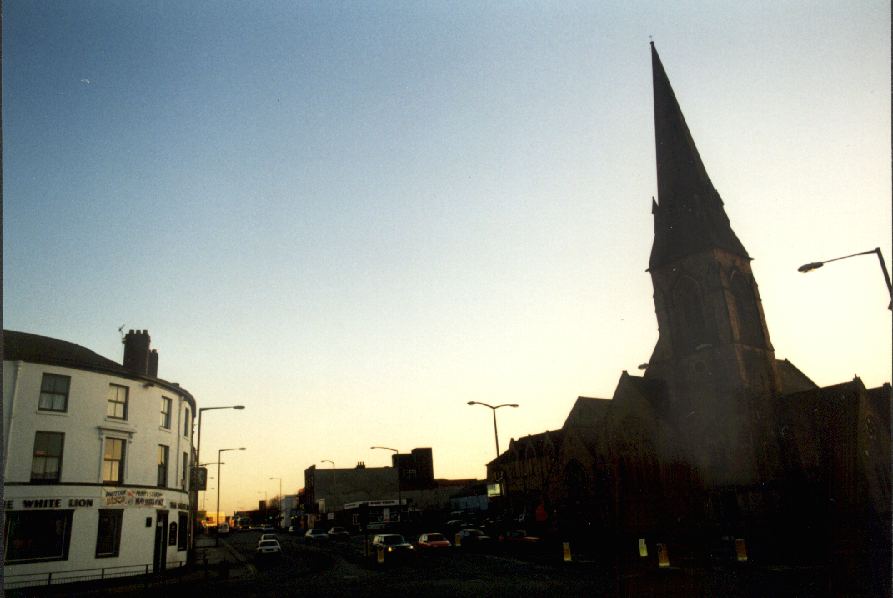
It was a case of ‘another good ‘un gone’ when the White Lion closed its doors for the last time around 2001. It’s now a sports shop.

It was a decent enough pub with pleasant surroundings and back in the day sold well-kept ale – Wilson Mild and Bitter, perhaps even Websters Choice when that came out. It even made the Good Beer Guide on one or two occasions in the eighties and nineties.

So what went wrong? It was probably at the wrong end of town, for one thing. The Albion, Gypsy’s Tent, Greyhound, Hen and Chickens and Blue Boar were all within a few hundred yards and with trade dropping over the years it was inevitable that at least one or two of them would go. And so it proved with the White Lion and its nearest neighbour the Gypsy’s Tent both biting since the turn of the millennium.

The White Lion dated back to the late-nineteenth century so the fact that it lasted over 200 years before closing is doubly tragic. It came into Wilsons ownership in 1949 with their takeover of Walkers and Homfrays, the Salford brewery that had taken over the Manchester Brewery Company in 1912. A number of pubs that ended up owned by Wilsons pubs were earlier owned earlier by local brewery, Wingfields and which was taken over by Manchester Brewery in 1912 although it continued to act as a spirit merchant for some years afterwards.

A refurbishment in 1985 was quite tastefully done considering how some of other Wilsons pubs were knocked about in the early eighties. The vault and games room were extended into the former courtyard and they even retained the table football machine for a while. It was the first time the White Lion had been refurbished since the early sixties.

The nineties, though, were a tougher time as the big brewing combines of the time chose to get out of pub ownership or brewing - even both in some cases.

The White Lion spent a period closed in 1994-95 until it was bought by the Unique Pub Company. When it closed in around 2001 it was put up for sale again and was sold de-licensed to a company dealing in sports goods.

For much of the 20th century the White Lion’s immediate next-door neighbour was the Deansgate railway goods warehouse. From 1828 a railway line ran from Great Moor Street station, which was situated where Morrisons supermarket car park now is, and traversed across the sites of what are now the market and Moor Lane bus station – then a steel works - into the warehouse. The railway line was dismantled in the late-1920s and the warehouse was leased to a firm called Harry Mason & Sons Ltd. They left in 1962 and the warehouse was demolished the following year.

This 1996 shot shows the White Lion on the left-hand side of the image a few years before it closed. The image below shows the pub in the 1980s.


[1] What’s Doing – the Greater  Manchester Beer Drinkers Monthly Magazine. December 1985 issue.


Monday, 12 May 2014

Horse And Jockey, Bradshawgate


The junction of Great Moor Street and Bradshawgate pictured in May 2012 (copyright Google Street View). In 1875 the bottom end of Great Moor Street was known as Old Acres and was less than half the width it is now. As part of a road widening scheme a number of buildings on Bradshawgate were demolished and the row including the Balmoral was built in their place.

This isn’t a pub that any living person will remember given that it closed in 1875, but we’re going back to the eighteenth and nineteenth-centuries now for a pub that was actually a predecessor to one of our current licensed premises.

The Horse and Jockey opened in the 1790s [1] at a site close to the modern-day junction of Bradshawgate and Great Moor Street, the bottom end of which was known as Old Acres. Emen Davenport was listed as the pub’s owner in the 1818 and 1824 Bolton Directories, by which it time it was more commonly known as the Old Horse & Jockey despite only having been in existence for perhaps 30 years or so. By 1836 it was being run by Samuel Horrocks, who was also a musician.

Henry Dutton was in charge during the 1840s and 1850s and in 1859 it was the meeting place of the Waltonian Angling Club with a local politician, Alderman Richard Dunderdale, as its chairman. [2] The club took its name from Izaak Walton, the seventeenth-century author of The Compleat Angler, an early fisherman’s handbook and a number of towns opened ‘Waltonian’ fishing clubs in his honour.

Dunderdale was a tea dealer operating from premises on Deansgate and sat on Bolton Council. The title of ‘Alderman’ suggests he was chosen by his fellow councillors rather than having to submit to what passed for the electoral process in the middle of the nineteenth-century.

By the 1870s Old Acres was just a narrow street at its junction with Bradshawgate, but it was the point of entry into the town for people travelling from Bolton Moor, which had grown in population during the nineteenth century meaning that traffic had become much heavier. The council decided to improve the junction, but also to widen Bradshawgate down to where it meets Nelson Square.

In February 1875 the owner of the Horse and Jockey, William Bridge, received a letter from the council asking for him to deliver possession of the premises. Another similarly-named pub the Horse and Groom, further along Bradshawgate, was also purchased along with a number of other properties along the same row. The properties were demolished later that year and a new row of buildings emerged in their place.

The Horse and Jockey’s public house licence was transferred to the Derby Arms at the bottom of Derby Street; however, one of the new properties built in place of the Horse and Jockey was the Balmoral Hotel, which opened in 1876 and which continues to trade to this day.

[1] Pubs Of Bolton 1800-2000, by Gordon Readyhough. Published by Neil Richardson (2000).

[2] Leisure In Bolton, 1750-1900, Robert Poole (1982).