Monday, 8 June 2015

Jolly Carter, 281 Derby Street


Derby Street runs across the centre of this 2012 image (copyright Google Street View). High Street runs off into the distance. The Jolly Carter was situated on the right-hand corner as we look, where the sign is. The Rams Head still stands on the opposite corner though it is now an Asian food shop.

The Jolly Carter was situated at 281 Derby Street on the corner of Derby Street and High Street, directly opposite the Rams Head.

James Green was a carter living on Derby Street in 1841. Aged 36, he lived with his wife Mary, also 36, and their five children. Business must have been good because the Greens were able to afford to employ a servant. While the image of domestic help is somebody working in a large house in an Upstairs, Downstairs setting it is surprising just how many tradespeople in more modest households utilised servants in the nineteenth century. Pubs were full of them.

James Green branched out into the beerselling business around 1842 and like many who converted their homes into beerhouses in the middle of the 18th century he named his pub after his ‘other’ job and called it the Jolly Carter.

The Greens remained at the pub well into the 1850s; however, they were gone by 1861 when the pub was being run by John Smith. He was a coal miner living at Edge Fold with his wife and baby in 1851. Like James Green he remained in his other job working as a coal miner while his wife, Mary, ran the pub.

The Jolly Carter appears to have struggled as landlords came and went. But Derby Street at that time was a competitive market. The pub was bought by local brewers Magee Marshall & Co whose Cricket Street brewery was about 200 yards away from the Jolly Carter.

The problem for the Jolly Carter was that Magees owned a number of other pubs on Derby Street. Magees houses the Rams Head, the Crown and the Pike View were all nearby and Magees wanted a full licence for one of those pubs, the Pike View, enabling it to sell wines and spirits as well as beer. Licensing magistrates were loath to simply upgrade a beerhouse’s licence to a full licence. They expected some horse-trading to take place as they wanted to reduce the number of licensed premises. A brewery had to be prepared to give up other licences before the magistrates could be expected to grant a full licence.

In 1904, Magees applied for a full licence for the Pike View. In return they said they were prepared to give up the licence for the Jolly Carter, a beer off-licence at 68-70 Rosamund Street, as well as the Elephant and Castle on Blackhorse Street, a fully-licensed pub since 1804. The magistrates granted a full licence to the Pike View and the Jolly Carter closed.

The old beerhouse became a shop and for a number of years it was a tripe dressers owned by Vose and Sons who merged with a number of other Lancashire tripe shops in 1920 to form United Cattle Products (UCP). It was a poodle parlour in the seventies and was demolished along with the rest of the row in the 1980s.

As for the original Jolly Carter himself, James Green decided that he had to choose between selling beer and being a ‘lurryman’ as carters were also known. He was a carter by trade and in 1861 he was living at 74 John Street (now University Way) and was still working as a carrier of goods. He remained in the trade until his death in 1873 at the age of 68.

Saturday, 6 June 2015

Albert, 30-32 Progress Street


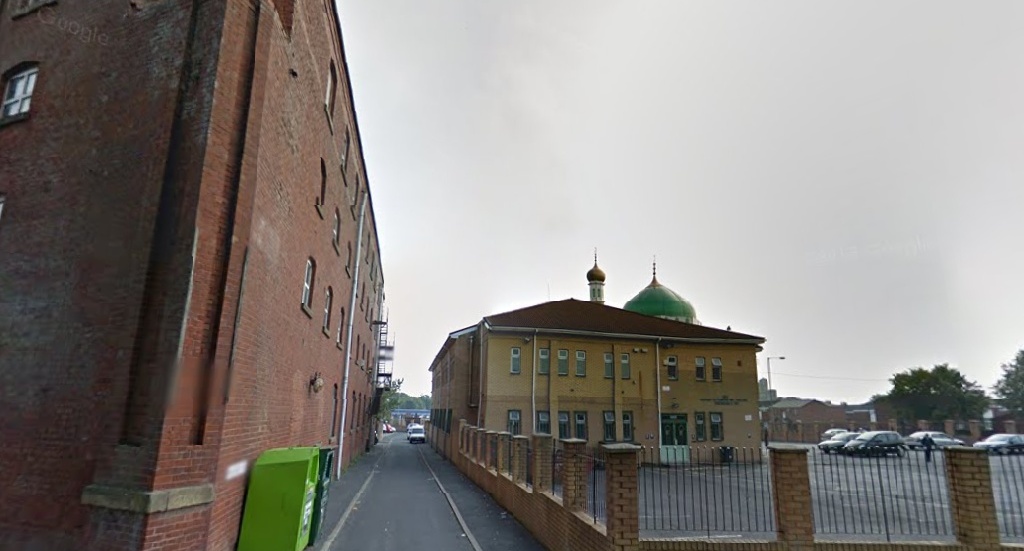
Back Progress Street pictured in 2012 (copyright Google Street View). The former Prospect Mill No 3 is on the left and the Masjid –E-Noor-Ul-Islam mosque on the right where Progress Street once stood. The rear of the Albert pub backed onto this thoroughfare about half-way down the street on the right-hand side.  

The Albert was situated at 30-32 Progress Street, off Prospect Street.

The first record we have of the pub is William Casstles running a beerhouse in 1870 until his death in 1873. That area at the bottom of Halliwell Road was just being developed at the time. Prospect Mills opened in 1867. On the other side of Halliwell Road, Waterloo Mill was already in existence. Progress Street was a row of some 50 or so cottages built in the 1860s.

Halfway down Progress Street there was a break in the terrace with Linen Street connecting Progress Street with Back Progress Street. On the corner of Progress Street and Linen Street was the Albert.

Sometimes, having a pub on a residential street was a smart move. However, the fact that the Albert closed soon after the turn of the 20th century suggests that wasn’t always the case. Over on the other side of Blackburn Road, Buxton Street supported two pubs, but Progress Street struggled to support one. It was a tough market and perhaps people gravitated towards the bright lights of Halliwell Road. Never mind the ‘Halliwell Mile’. The New Inn, the Windsor Castle, the Ship Royal George and the Black Dog weren’t much more than 100 yards away and all were competing for the same custom as the Albert.

In 1901, the pub’s owners, Magee, Marshall & Co, applied to have the beerhouse licence converted into an off-licence. The pub’s final licensee was Simeon Rigby (1840-1912) who left the Albert to go and live on Gibbon Street just off Derby Street where he worked as a coachman. The former pub premises were occupied by William Fallows in 1924.

Progress Street was demolished in the 1970s. The Masjid –E-Noor-Ul-Islam mosque stands on its site. Oddly, Back Progress Street still exists.


Milk Street Tavern (the Old Ivy House), Milk Street

Milk Street, Pump Street, Tin Street, Basil Street – there were some great street names around the bottom end of Daubhill in the nineteenth century. In fact the last two of those named still exist – at least on maps. Tin Street is a small thoroughfare that runs off Shaw Street between the children’s nursery and some industrial units, though it is now gated off outside working hours. Pump Street was renamed Basil Street in the 1920s and the street still runs off Houghton Street down to Derby Street.


Houghton Street pictured in 2012 (copyright Google Street View). Shaw Street runs across the image  in the near distance. Milk Street was closer but ran parallel to Shaw Street. 

Milk Street, though, is long gone but it was the only of those named to include a pub. The area was pretty well-pubbed towards the back end of the nineteenth century. The Houghton Street Tavern and the Rothwell Street Tavern were both nearby while the Bee Hive was at the end of Milk Street where it met Back Derby Street.

The Milk Street Tavern was originally named the Old Ivy House [1] but like two of its neighbours it lost its given name in favour of being named after the street on which it stood. [2]

In 1871, 70-year-old Mary Smith was running the pub along with her son John and his wife Ann. Mary had previously run a corner shop at 73 Rothwell Street. Her husband John was a tea dealer by trade but died in the 1850s.

Mary appears to have only turned to running a beerhouse quite late in life. She was still at the shop in 1861 so she must have moved to the pub later that decade.

By 1894, the Milk Street Tavern was being run by Nathan Entwistle. On 4 May that year, the night before a big race meeting at Kempton Park, the Milk Street Tavern was one of three pubs raided by police. [3] They found a variety of sporting literature at each of the pubs, but more damningly for Nathan Entwistle they found on his person a balance sheet.

They say you never meet a poor bookie and that was certainly the case with Nathan Entwistle. He had taken £32 in bets and profited to the tune of over £19. That’s the equivalent of over £2000 in today’s money – all in one afternoon. He must have been taking bets from all over the district.

Mr Entwistle was fined £25 plus costs and was given two months to pay the fine otherwise he faced two months of hard labour.

The licence of the Milk Street Tavern came up for renewal at the annual Brewster sessions a few months later. It was refused on the grounds that the pub was a “disorderly house”. It became a private residence and was demolished along with Milk Street and much of the rest of the area in the late sixties.

[1] Bolton Pubs 1800-2000, by Gordon Readyhough. Published by Neil Richardson (2000).
[2] The Houghton Street Tavern was originally the Bricklayers Arms, the Rothwell Street Tavern was once known as the Shakespeare.
[3] The other two were the Kay Street Arms on Kay Street, and Uncle’s Tom Cabin on Egyptian Street (not the one on Lever Street). Manchester Courier, 19 May 1894.

Bar Tavern, Deane Lane (Wigan Road)


Another long-lost Deane pub, the Bar Tavern was situated on Deane Lane, now known as Wigan Road. It was another example of a shop that became a beerhouse and was quite short-lived, lasting not much more than about 20 years in the middle of the nineteenth century.

The pub took its name from the nearby toll bar and was located nor far from the tollkeeper’s house which itself was on a stretch of the main road close to Deane church.

The Bar Tavern was owned by the Silcock family. Peter Silcock (born 1781) ran a general provisions store on the main road through Deane village. He must have had the idea to broaden his scope by selling beer but inevitably takings from beer must have overtaken those from other items. By the time the 1848 Bolton Directory was published Peter’s wife, Ann Silcock, was in charge, Peter having died  in 1845. It also had a name – the Bar Tavern.

Ann Silcock died in 1858 leaving an estate valued at just under £200.  The Bar Tavern was taken over by her son, John Silcock (born c1815) and his wife Elizabeth (born c1820).

John Silcock died in 1865 and the pub was sold. It later reverted back to a shop. John’s widow Elizabeth went to live with relatives, also named Silcock, on Platt Hill Farm situated not far from what later became Hulton Hospital. Bolton’s first council estate was built on the site of the farm in the 1920s.


Elizabeth was living on Wigan Road by 1881 when she is described as a retired grocer. She died in 1889.

Friday, 5 June 2015

New Brook House Inn, Junction Road


Junction Road tails off the right and the Kings Head is on the let on this 2012 shot (copyright Google Street View). Two properties stood where the area of trees is in the centre of the image and it is believed the New Brook House Inn was one of those properties. 


Like the rest of Bolton, the Deane area has suffered from pub closures in recent years. Two of the five pubs in the ‘village’ itself – the Church and the Stag’s Head – have both closed, but there are a couple of long lost pubs worth giving a mention to. The New Brook House Inn, was one of them. Long lost, indeed, as it appears on very few historical records.

The New Brook is numbered 52, Junction Road on old directories.  The Kings Head is today numbered 52-54 Junction Road. However, we believe the New Brook is likely to have been one of two now-demolished properties on the front of Junction Road just before the entrance to the Kings Head. Certainly, the 1911 Census enumerator surveyed Sunny Bank, the New Brook Inn and the Kings Head, in that order. Any information that proves us right or wrong on that would be gratefully received.

The first definitive record we have of the New Brook Inn is with Betsy Pasquill running a shop and beerhouse on Junction Road according to the Worralls Directory of 1871. That suggests the pub dates back to at least the late-1860s.

In 1891, the vicar of Deane church, the Reverend HS Patterson proposed the establishment of the Deane Village Club, a temperance and educational institution. The club was to incorporate a cafĂ©, a gymnasium, meeting rooms and a bowling green and in a pamphlet detailing his plans, the Reverend Patterson gave notice of where he saw the club’s custom coming from: 

“This building will be situated on Junction road, opposite the Church, which is a street of 300 yards and has the following public-houses:- The Vulcan, Queen Anne, New Brook Inn, and King's Head. Here the forces are against thrift and social progress.” [1]

But the Reverend Patterson’s grand plans didn’t quite come to fruition on the scale he intended and in the end only a small corrugated building was constructed. Of the four pubs in the good reverend’s sights, the New Brook was to continue for another quarter-century or so, the rest a good deal longer with three still in existence.

Another member of the Pasquill family, Robert Pasquill, was running the New Brook by the early-1890s. Prior to taking over the pub he was living in Fernhill Gate and working as a coal miner, presumably at the Victoria Pit where the garden centre now stands.

Robert’s tenure didn’t last long and by 1894 the beerhouse was in the hands of the Workman family who ran it for the rest of its time that it was open to the public.

Landlord Thomas Workman was hauled before the magistrates in 1895 on a charge of having permitted betting at the pub. Then, as now, gambling in pubs was illegal, but the charge was of an extremely petty nature. Plain-clothes policemen entered the pub on 15 November 1895. There were nine men in the tap room, four of whom were sitting round a table playing dominoes.  The officers watched the four men play three games. At the conclusion of each game the losers paid for half-pints of beer for the winners. Despite a string of witnesses testifying that no gambling for booze took place the magistrates found Mr Workman guilty of allowing gambling on his premises. He was fined £2 with one guinea (£1.05) as an advocate’s fee - £3.05 in total or the equivalent of over £330 today. [2]

Fortunately, Mr Workman didn’t have his licence endorsed which may have affected his chances of renewal at the annual Brewster sessions.

The officers went straight from the New Brook to the nearby Church Inn on Wigan Road where they found ten men playing dominoes for cash stakes of two old pence (or 1p) per corner. The licensee, William Gaskell, was fined £5 plus a one guinea advocate’s fee.   

The New Brook continued as a pub until 1915. A few years before, in 1906, Deane Golf Club was formed. But in May 1915 their clubhouse was destroyed by fire. They were offered the New Brook Inn as alternative premises and occupied the former pub until their new club house was completed in 1920. [3] They continued to use the New Brook for some years after. It was probably demolished in the 1940s.

Newbrook Inn Junction Road Bolton

An aerial shot - date unknown - of the Kings Head in the top left of the photo with the building that was formerly the Newbrook Inn in front of it.

[1] Deane Church website. Accessed 5 June 2015.
[2] Manchester Courier, 30 November 1895.
[3] Deane Golf Club website. Accessed 5 June 2015.          


Wednesday, 27 May 2015

Arkwrights Ale House - Gardeners Arms (Monkeys Nest), Valletts Lane


Shorn of its pub signage, but still a classic example of late-nineteenth century pub architecture, Arkwrights Ale House in late 2014. The pub was awaiting sale as a residential property.

Article updated 18 January 2022 with photos of the pub from 1964 (see below).

In olden days, a pub given the sign of the name of an occupation would denote that it was often used as a meeting place for workers in that trade. But the increased number of licensed premises when beerhouse licences became freely available after 1830 led to new entrants into the trade and many of those named their pubs after a former profession or after the trade of members of their family.

In 1871, Ralph Southern was a gardener living at number 2 Valletts Buildings, just off Valletts Lane. Ralph was 61 and a widow and he lived with his two sons, William (25), who was also a gardener, and 21-year-old Alfred who was working as a butcher and who, before long, had opened up a meat stall in the Market Hall in town.

Next door to the Southerns, at number 4 Valletts Buildings, was a beerhouse run by one of their relatives, Moses Halliwell, and his family. This enterprise was short-lived, but later in the 1870s, Alfred opened a beerhouse of his own at number 10 Cope Bank, just a bit further up Valletts Lane, and he named it the Gardeners Arms in honour of his father and his brother. Sadly, this venture didn’t work out. In June 1883, Alfred Southern petitioned for bankruptcy at the Bolton County Court with debts estimated at £1300 – a huge sum in those days.

The Gardeners Arms was bought by local brewers Joseph Sharman’s. But as the nineteenth century wore on, the area around Valletts Lane and Cope Bank became more populous and the decision was made to rebuild the pub a little further down from Cope Bank on Valletts Lane  itself, next to a bowling green that the brewery already owned. The new Gardeners Arms opened in 1895.

Sharman’s were taken over by Shaw’s of Leigh in 1927 and like the rest of Shaw’s estate the pub was bought by Walker Cain Ltd in 1931.

The Manchester Archives hold this image of the Gardeners during the Sharman’s era. It has been dated to around 1920 when the landlord would have been Percy Stafford.

The Bolton News published a piece about the pub towards the end of 2014 and they received this response from a Mr Hardman:

"Valletts Lane used to run from Church Road to Ivy Road and off the lane was Horrocks Street and Benson Street. On the other side was a council land fill site.

"The pub was called the Gardeners' Arms and the landlord was a former international football called Donaldson.

"He turned the bowling green into a football pitch for the young of the area, which put the old men's backs up," he says. [1]

This would have been in the 1950s. Alex Donaldson was born in 1890 in Barrhead, East Renfrewshire. An outside forward, he was signed by Bolton Wanderers in 1912 from Scottish minor side Ripley Athletic. He spent nine years at Burnden Park in a career that was interrupted by World War I before leaving for Sunderland in 1921. He subsequently had spells at Manchester City, Chorley and Ashton National and made six international appearances for Scotland, most of those caps earned during his time at Bolton. [2]

After his playing career ended, Mr Donaldson opened a sports shop in Gorton, Manchester, but he eventually went into the licensed trade and ran the Gardeners Arms during the late-forties and early-fifties. He was running the pub in 1951 when his 20-year-old daughter June married a local motor mechanic, Frederick Parkinson and the couple lived at the pub after they wed. Alex Donaldson died in Bolton in 1972.

The layout of the Gardeners was of a classic pub design. The lounge-best rooms were on the left of the entrance while the vault – and its curved bar - was to the right of the entrance.

The pub was nicknamed ‘The Monkey’s Nest’ though the origin of this name isn’t known.

The Gardeners became a Tetley pub when they took over Walkers in 1960. The bowling green was eventually converted into a car park and after another licensee fell into bankruptcy, the Gardeners was sold into the free trade in the mid-1980s. It became Arkwrights Ale House in an attempt to give a typical down-to-earth feel to a traditional pub.

But despite being based in a built-up area, Arkwright’s struggled particularly during its final years. Licensees came and went – there were 11 changes of supervisor between 2005 and 2013. The pub closed in June 2014 and was sold for residential use later that year. Trust Inns, the Chorley company that were its final owners, were looking for just £165,000 for what was a sizeable property.

The property’s Rightmove entry for its 2014 may still be seen here

The pub was sold and was later demolished to be replaced by housing.

[1] Bolton News, 21 January 2015. Accessed 27 May 2015. 
[2] Wikipedia entry for Alex Donaldson. Accessed, 27 May 2015.

Thanks to reader Tony Kelly for these photos of the Gardeners Arms taken in 1964.


Thursday, 9 April 2015

Music Tavern, Gaskell Court, off Churchgate


The Music Tavern was situated on Gaskell’s Court, off Churchgate, and although it was only a pub for perhaps 20 years or so in the nineteenth century it became one of the town’s most notorious beerhouses. It grew out of a lodging house on one of the many courts that led down tiny alleyways off the main streets of Bolton. Practically all have disappeared, though the entrance to Gaskell Court can still be seen next to the Churchgate pub, formerly the Brass Cat.

There is no mention of any licensed premises on Gaskell Court prior to the 1851 census when 26-year-old John Roberts was named as a beerseller. He lived there with his 21-year-old wife, Ellen, two children, his mother-in-law, a brother-in-law, a servant and no fewer than 14 lodgers. By 1859 Sarah Kearsley was announcing in the local press that she had taken over. The premises were certainly commodious and Ms Kearsley was able to offer “apartments for families”. [Bolton Chronicle, 7 April 1859].

Sarah Kearsley was only at the Royal Music Tavern, as it then was, for a few years. By Christmas 1862, John Fielding was in charge and he put on a Christmas tea party for 40 women over the age of 60. They were entertained by Mr Fielding's three children playing the piano, violin and the piccolo. One of the attendees was Betty Pearson of Farnworth who was in her 108th year. Mrs Pearson's daughters, aged 64 and 76 were also present along with a woman aged 98 and four others over the age of 80. People born at the end of the 18th century – as these women were – had a life expectancy of less than 40 years at birth. (source: Wikipedia )

By the late-1860s the pub was known as the Music Tavern and it was being run by one of Bolton’s most notorious characters – Isabella Dewhurst.

Mrs Dewhurst had previously been at the Churchgate Tavern (no relation to the similarly-named pub a few doors further up_. However, she had to leave when the Churchgate was sold and converted into retail premises. Situated at 33 Churchgate it was much later part of the Sandwich Inn.

The Churchgate was notorious in being a brothel as well as a beerhouse, but it paid well. Her partner George Smethurst was ostensibly its landlord but Isabella Dewhurst managed to save £100 in sovereigns, apparently unbeknownst to Smethurst. How she saved the money – the equivalent of £12,000 today – can only be the subject of some speculation.

There was a bizarre incident at the Music Tavern in January 1868 and it caused Mrs Dewhurst to be hauled in front of the court. She was charged with permitting disorderly conduct at the house after police arrived one Sunday and found customers wrestling for beer. The case was dismissed on a technicality, the summons only having been served the previous day.

Justice finally caught up with Isabella Dewhurst in July 1868 when she was charged with keeping a disreputable house. The case was proved by two young women, 17-year-old Nancy Mather and Elizabeth Ann Hull, aged 20. Both girls stated that they had gone voluntarily to the pub and that different sorts of people – often in great numbers - visited the premises for immoral purposes. Mrs Dewhurst was absent from court and the case was heard in a side room away from the public but with reporters present. Her representative, Mr Ramwell, stated that if girls didn't visit these places then they wouldn't exist. The Magistrates found her guilty had the options of fining Mrs Dewhurst up to £10 or jailing her for a month with or without hard labour.

The Bolton Chronicle of 11 July 1868 takes up the story.:

The Magistrates consulted a few minutes and the Mayor then announced they had decided on committing Mrs Dewhurst for a month, with hard labour in each of the two cases – the second month to take effect upon the expiration of the first. His Worship added that Mr Superintendent Beech deserved the thanks of the Bench for having brought the matter so clearly before them.”

The police were then sent to the Music Tavern to bring Isabella Dewhurst into custody ready to begin her sentence at the New Bailey, the 18th century prison next to the River Irwell on the Manchester-Salford border. It was to create great excitement in the town and Mrs Dewhurst was determined to go down with an air of defiance about her. But it was not to be.

The Chronicle's report continued:

The defendant was immediately brought into custody, and taken to the police station. She is well known in the town and is possessed of considerable means. She was exceedingly well-attired on Monday [the day of the trial], wearing a silk dress, velvet mantle and veil. A handsome drag or dog-cart belonging to her was driven to the Police Office in the expectation that she would be allowed to the New Bailey in her own conveyances, under police escort; but she was sent along with two male prisoners, to one of whom she was handcuffed, by the Bolton to Manchester omnibus, which left soon after three o'clock in the afternoon. A large crowd of persons witnessed her departure from the Police Office and they saluted her with loud hootings.”

While it was the end of Isabella Dewhurst's time as a pub landlord it didn't end her association with the Music Tavern. Her former associate Edward Gordon took over the running of the pub after she was sent to jail. In April 1869, she was involved in another court case when she was sued by Gordon over the theft of some money from the pub. Mr Gordon took over the tenancy of the Music Tavern from Mrs Dewhurst in 1868, but the building was actually owned by Nicholas Heyes, the landlord of the Welcome Traveller on Union Buildings just off Bradshawgate. Despite having no further business at Music Tavern – at least not with regards to the sale of beer - Mrs Dewhurst regularly stayed there and was accused by Mr Gordon of having stolen £22 from a cashbox at the pub– a considerable sum in those days.

Isabella Dewhurst Back On The Scene”, yelled the Bolton Evening News of 10 April 1869. But after claim and counter-claim from both parties the judge, J.S.T. Greene found in favour of Mr Gordon but to the tune of just £7. During the course of the case it transpired that Mrs Dewhurst already owned several properties from which was receiving rents. She said she lived in Blackpool for seven or eight weeks at a time and wasn’t without money. The cashbox in question was her own and contained rents from her properties.

The beginning of the end for the Music Tavern came in September 1869. An Act of Parliament passed that summer gave local magistrates the power to strip beerhouses of their licences. Prior to that beerhouse keepers simply paid a fee of two guineas for their licence. Now the magistrates in Bolton required every beerhouse in the town to re-apply for their licence on an annual basis and on this the first occasion they closed down some 50 of them. One was the Music Tavern and Edward Gordon was up before the bench on the first day of the hearing. While he claimed the pub had been cleaned up since he took over the tenancy, the local constabulary claimed it was very much business as usual.

As the Bolton Evening News reported on 2 September 1869:

This house was the notorious one formerly kept by Isabella Dewhurst. The present tenant entered on the 14th of July last year, and since that time, it was alleged, the character of the house had been entirely changed. The complaint against the house was that it was a notorious haunt of prostitutes and bad characters generally. The Mayor to the applicant: How long have you lived in the house? – Gordon: Two and a half years. - The Mayor: Then you lived with Isabella Dewhurst? Gordon: Yes, sir. – Police constables Greenhalgh and Fletcher both gave the house a very bad name. There were two girls in the house, ostensibly as servants, but they were in reality prostitutes. They knew as many as four loose girls kept there a few days ago”.

Mr Gordon’s application was thrown out and the Music Tavern lost its licence. The pub closed down the following month, but not before he received at least three more visits from the police, who were keeping their eye on the pub despite its imminent demise. They found Edward Gordon selling sherry and wine which, being a beer house, he was not licensed to do and he was hauled before the court again. He left for America early in 1870.

Such was Isabella Dewhurst’s reputation that her name was also used by the authorities to close down the New Inn on St George’s Road. That the beerhouse was “the resort and residence of prostitutes and bad characters generally” didn’t help, but the fact that Mrs Dewhurst had been seen playing cards there was also brought up at the hearing. Mrs Dewhurst’s sister, Margaret, was the wife of the licensee, James Mason.

Isabella Dewhurst went to live in a property she owned in Coe Street, a very basic weaver's cottage off Bridgeman Street in a poor part of Bolton. By 1871, she was joined by her niece, Isabella Banks Walker, the daughter of her sister, Margaret. Isabella Banks Walker married a local clerk, Alfred Aldred, in 1873 and the couple went to live at another of Mrs Dewhurst’s properties in Silverwell Street. It was there that Isabella Dewhurst died on 16 July 1876. She was 48.

Mrs Dewhurst's estate, as proved by Alfred Aldred and his brother, a local accountant named Bold Aldred, came to £1500 – a huge amount of money in those days. But if Isabella Dewhurst’s gains – ill-gotten or otherwise – were unable to get her beyond a weaver’s cottage on Coe Street, the beneficiary of her will, her niece Isabella Aldred, made wise use of her bequest. In 1878, the Aldreds bought 66 acres of farmland at Old Clough Farm in Worsley. By the end of that decade they had emigrated to New Zealand where they were to spend the rest of their lives. Alfred Aldred died in 1930, Isabella Aldred died in Auckland in 1937.

AN UNDESIRABLE CUSTOMER – William Burns, painter, Back-King Street, was charged with being drunk and disorderly in Churchgate. Isabella Dewhurst, beerseller, said the defendant came into her house on Wednesday afternoon, and suspecting him to be a bad character, she ordered him to leave. He refused to go and she sent for a policeman. Having been previously convicted he was fined 10 shillings and costs, in default 14 days hard labour. - Bolton Chronicle, 2 May 1868.


Churchgate pictured in September 2014 (copyright Google Street View). The Brass Cat is the white building in the picture and immediately to its left is the entrance to Gaskell House. In the nineteenth century it led to Gaskell Court, home to the Music Tavern. 


Article written 9 April 2015.
Updated 19 October 2019 with more details on Isabella Dewhurst.