Showing posts with label Astley Bridge. Show all posts

Friday, 23 August 2019

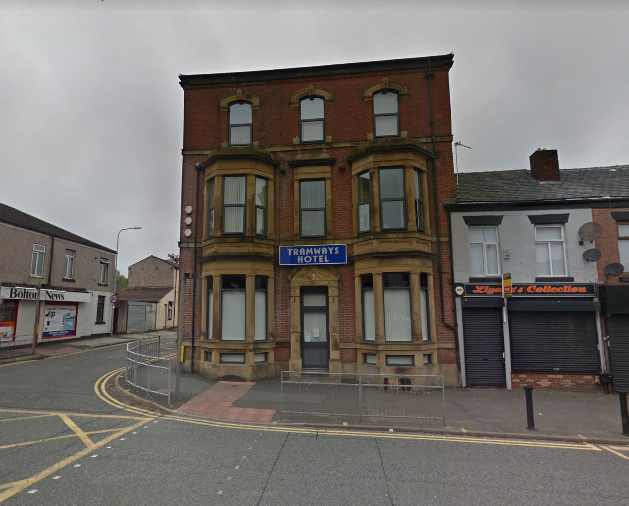
Tramways Hotel, 307 Blackburn Road, Bolton


Tramways Hotel pictured in October 2018. Copyright Google.


On 31 August 1880, Her Majesty's Inspector Of The Board Of Trade, Major-General Hutchinson, joined the Mayor of Bolton, Alderman Richardson, the Town Clerk, Mr Hinnell and the chairman of the Astley Bridge local board, Major-General Hesketh and a number of other local dignitaries on a horse-drawn tramcar driven by a Mr John Metcalf that had pulled up outside the Town Hall. The tram made its way along Newport Street and headed for Moses Gate. It then returned back to Bolton where the three horses at the front of the car were replaced by four for the journey on the remainder of what was Bolton's new tram network. Crowds gathered on all aspects of the route on what was a test run for the town's new transport network.

As the tram made its way towards the border that marked the border with Astley Bridge – then a separate township – it passed a building under construction on the site of an old beerhouse and butcher's shop and which would be named the Tramways Hotel in honour of this new mode of public transport.

Six days earlier on 25 August 1880, Thomas Morris, who had been granted a provisional licence the previous year, agreed to give notice for its confirmation on 30 September. By early November 1880 the Tramways was open. The pub was aimed both at billiards players and at hotel guests who wanted to stay within reasonable distance of Bolton without the bustle of town centre. The full licence of the Red Lion, Deansgate had been transferred to the Tramways and the pub had managed to gain a billiards licence. It employed James Craven, formerly of the Balmoral Hotel, as a marker. Craven marked when, in February 1881, Walter Grundy took on Herbert Wortley in a game billed as the championship of Bolton. Wortley was suffering from a cold and was no match for Grundy who won by 1000 to 397.

While Thomas Morris had applied for the licence of the Tramways he was neither the owner or the licensee. By the time the pub opened James Atkinson was the landlord. Born in Wigan in 1835, Atkinson was a brickmaker by trade and owned the Tanners Hole brickworks in Great Lever close to what is now the junction of Settle Street and Nugent Road. He had also turned his hand to property development and along with Robert Horridge, Barnard Henry and James Holden had formed the Great Lever Building Company. He was living in Sidney Street, off Bridgeman Street, in 1861 and by 1871 he was living with his wife Margaret at Woodside Terrace, Rishton Lane. He was a successful Liberal candidate for the election to the Bolton Board Of Guardians in 1876.

However, all was not well. In an advertisement in the Bolton Evening News of 26 November – little more than a year after the Tramways opened, Atkinson filed for bankruptcy with debts estimated at £4500 – the equivalent of over £500,000 today. This suggests Atkinson, perhaps with some of his partners, built the Tramways but in doing so he perhaps over-stretched himself. In January 1882 the licence of the pub was transferred to one of his business partners, Robert Horridge.

In March 1891, a former self-actor minder named Peter Thompson of no fixed address was found dying in the middle of Blackburn Road outside the Tramways. At his inquest it was heard that the 37-year-old Thompson hadn't worked for some 12 or 13 years but made small sums of money singing or dancing at pubs. When he was found his clothes were saturated with rain and he was helplessly drunk. Any attempts to obtain a name or address out of him elicited the response that he was “the champion singer and clog dancer of Farnworth”. A doctor was called for but Thompson died before medical help arrived [Bolton Evening News, 31 March 1891].

The Tramways remained a sporting pub. Bolton Harriers often started some of their inter-club matches outside the pub. The North End Angling Society were certainly meeting there in 1908 and around that time there is mention of a Tramways in the fixtures for the Bolton Wednesday Football League for 1908 playing against the likes of Market Hall, Farnworth Wednesday and Pawnbrokers. However, this may well have been employees of the local tramways department rather than the pub's customers.

There was unwelcome attention for the Tramways in 1905 when Herbert Taylor, a 22-year-old labourer, was accused of taking bets in the vicinity of the pub and its yard. He was fined £3.

The Tramways became a Magee's house before becoming a Greenalls pub in 1958 on their takeover of Magee's Crown Brewery.

The pub was sold by Greenall's in 1988. It remains licensed premises and there is a bar on site but it is no longer a pub. It has been run for a number of years as a guesthouse/bed-and-breakfast.

Saturday, 9 January 2016

Foresters Arms, 421 Blackburn Road, Bolton


The Foresters Arms was situated at 421 Blackburn Road, Bolton. Its original address was 21 Blackburn Road, but when Astley Bridge was incorporated into the County Borough Of Bolton in 1896 the number of the house was changed along with all those on the other side of the bridge further down Blackburn Road that marked the former boundary between Bolton and Astley Bridge.

The first mention we have as a beerhouse is on the 1876 Post Office Bolton Directory when the landlord was Peter Hardman. Born in Harwood in 1824, Mr Hardman was listed as living in Kelly Row on Blackburn Road in 1851. By 1871 he was listed as a “watchman and beer seler” in what was now the Foresters Arms. He remained at the pub until his death in 1887.

On the 1895 Directory the landlord was given as Richard Thornborough. However, directories were often compiled up to a year in advance. Richard Thornborough (b. Rumworth, 1857) had actually died in February 1894 and his widow Martha was now running the pub. The Thornboroughs had also been at the premises on the 1891 census.

In February 1895 Martha Thornborough married John Wilcock, a shoemaker from Snowden Street close to the town centre. In October of that year the freehold of the pub was put up for auction. [1] It was leased to Magee, Marshall and Co but the lease was due to expire in 1898 and the brewery bought the freehold to secure their interest in the pub.

John and Martha Wilcock remained at the Foresters Arms. The 1901 census shows that they were living at the premises along with three of Martha’s children from her first marriage to Richard Thornborough along with two children she had with John Wilcock.

The Foresters Arms closed in 1913 when the Bolton licensing magistrates referred the pub and six other licensed premises to the Compensation Authority. [2] The authority bought licensed premises in order to cut down on the number of pubs and beerhouses in the town. However, the Wilcock family continued to live there. The 1924 Bolton Directory shows John Wilcock still at 421 Blackburn Road and working as a boot repairer. He died in 1932 at the age of 69. Martha Wilcock moved to Baythorpe Street on the other side of Blackburn Road. She died two years later at the age of 77.

Number 421 Blackburn Road still exists and an August 2015 image can be seen below (copyright Google Street View). Since 1987 it has been the Talking Heads hairdressing salon. According to contributors on Rootsweb, the gate next to the former pub led to an area known as ‘the Hovel’ though the land actually belongs to one of the properties in Viola Street. [3]

[1] Manchester Courier, 12 October 1895.
[2] Manchester Courier, 25 April 2013.
[3] Rootsweb. Accessed 9 January 2016.


Saturday, 31 January 2015

Tippings Arms - Bedrock Cafe - Astley's, Blackburn Road


The site of the Tippings Arms in September 2014. The pub knocked into its neighbouring properties many years ago and part of the premises had already been sold off and converted into a taxi office when this image was taken.

The Tippings Arms opened in the 1820s and was named after the Tipping family, local landowners who owned land in the Little Bolton area north of the River Croal. The pub was one of the last buildings in Bolton, at least until Astley Bridge was incorporated into the County Borough of Bolton in 1896. The bridge itself over Astley Brook was just a few yards away up Blackburn Road.

John Grime was an early landlord of the Tippings and he was followed by Humphrey Nightingale and his son John who ran the pub from around 1836 until 1848.

Mr Nightingale was succeeded by Jesse Langshaw, previously a warehouseman in Little Bolton. Jesse had married a Turton girl, Alice Wood, in February 1848 and once they had settled in at the Tippings the couple took the opportunity of the relative stability of life as pub licensees to start a family. In the space of less than two-and-a-half years, Alice gave birth on no fewer than three separate occasions – a girl followed by two boys.

The Langshaws were gone by 1870 and were running a beerhouse further up Blackburn Road.

Later in the nineteenth century, the Tippings was bought by Eden and Thwaites, who since 1770 had owned the Water’s Meeting bleachworks at the bottom of what was then known as Tippinge’s Road (now Water’s Meeting Road).  The deal made commercial sense to Eden and Thwaites who would see their employees trudge up Tippnge’s Road every night into the pub. Buying the Tippings at least ensured that they reclaimed what was perhaps a fair chunk of their employees’ wages.

There was a more munificent side to Eden and Thwaites. When one of the partners, James Eden, died in 1874 he left money for the establishment of a children’s home. The Eden Orphanage stood on  Thorns Road from 1878 to 1951 when it was taken over by the Isis Independent School. It closed in 1966 and most of the buildings were demolished. Pendle Court now stands on the site. [1]

The Thwaites side of the partnership built The Watermillock in the 1880s. After ending its days as a private residence it was an old people’s home for many years before being converted into a restaurant in the 1990s by Banks’s Brewery. It is now a Toby Carvery

Eden and Thwaites eventually sold the Tippings to Threlfalls brewery of Salford. Threlfalls were bought by Whitbread in 1967.  That led to handpumps being pulled out of the pub and Whitbread’s ubiquitous national brand Trophy Bitter being pushed. Local drinkers reported in 1981 that it did, however, sell two of Whitbread’s real ales from time to time: Special Cask Bitter and Dutton’s Best Bitter. [2]

The pub was taken over in the mid-eighties by the same licensees that ran another Whitbread pub, Scandals (formerly the Painter’s Arms) on Crook Street. They renamed it Astley’s and turned it into a kind of disco pub with regular live acts. It did well – at least for a while.

In January 1999, Astley’s was taken over by Willy Richards, described by the Bolton Evening News as “a larger than life character” who had previously run The Jungle (previously Pink Panther) on St George’s Street. Willy renamed Astley’s as the Bedrock CafĂ©, based on a Flintstone’s theme. Opening-night invitations were sent out on slate. There were three bars, two floors and two DJs. [3] When that didn’t work out the pub reverted back to being the Tippings Arms.

The Tippings closed in 2006 and the premises remained empty for a number of years. A taxi office opened in one part of before work began converting the rest of the premises into houses in 2014.

Bridge Inn Tippings Blackburn Road Bolton


The Tippings can be seen in the distance in this 1970s image of Blackburn Road. In the middle distance people are crossing Astley Bridge itself, which at one time marked the Bolton boundary. But in the near distance is the Bridge Inn which was demolished some time after the turn of the millennium. The site of that pub has remained vacant ever since.

[1] Bolton.org.ukhttp://www.bolton.org.uk/edenhome.html. Retrieved 31 January 2015. 
[2] What’s Doing, the Greater Manchester Beer Drinkers’ monthly magazinie, July 1981 issue. Retrieved from the Bolton Camra website, 31 January 2015. What’s Doing’s Bolton items from 1975 to 1984 have been collated onto two files (the otherfile can be accessed here). 
[3] Bolton Evening News, 22 January 1999. Retrieved from the Bolton News website, 31 January 2015.