Showing posts with label Mill Hill. Show all posts

Tuesday, 8 October 2019

Sunray Hotel, 74 Mill Street, Bolton


Sunray Hotel Mill Street Bolton site of
This motor dealer workshop marks the site of the Sunray Hotel. The original pub was situated between Bare Street and Barlow Street; however, Barlow Street disappeared when the area was redeveloped in the seventies. Image taken June 2018. Copyright Google.


The Sunray Hotel was situated on Mill Street, not far from the Bare Street Mission.

The pub was originally known as the Weavers Arms and was in existence by 1847 although the only evidence we have for that it when it came to a licence renewal in 1869, landlord John Hill claimed to have been at the pub for 22 years. [Bolton Evening News, 17 September 1869]. Police objected to the licence at that hearing with Sergeant Whittle and PC Dearden claiming men had been known to act suspiciously in the vicinity of the pub and had heard them call for beer. There was a suspicion on the part of the police that these men acted as lookout scouts for illegal opening, probably on a Sunday morning. There was also a grate which might afford facilities for the illegal sale of beer. That there were three other beerhouses in the immediate vicinity also counted against the Weavers. While the magistrates initially ruled against Hill he was successful in an appeal and regained his licence later that same year.

The Weavers Arms changed its name to the Sunray Hotel in the 1870s.

In 1880 the pub was one of six raided in a betting scandal. On Sunday 17 October 1880 around 60 officers were despatched to the Oliver Cromwell on Bridgeman Street, the Kay Street Arms  and the Black Horse  both on Kay Street, the Ancient Shepherd on Bold Street and the Turk's Head on Bridge Street. Officers were placed at each entrance of the six pubs to prevent anybody from leaving. Other officers entered the pubs and took away betting books, papers, lists and telegrams. Among the publications found were the Sporting Life and McColl's Turf Calendar. Sixty men were arrested and the Sunray's landlord Thomas Vickers was found with £10 on him – a huge sum in those days. The men were taken to the town hall where a large crowd of people gathered and remained until midnight.

When the came case to court at the end of October, Detective Peter Howcroft related how he went to the Sunray Hotel at just before eight o'clock on the evening of 17 October. He found various betting books on Vickers, while the cash was discovered when he was brought to the town hall. Detective Howcroft claimed Sunday was the settling night for the Cesarewitch, a race that had been run a day or two previously. He stated that when he arrived at the pub and warned Vickers he had a warrant, Vickers sajd: “I hope you'll not be hard with me; it is a hard job and if you go in other houses of the town you would have found more in.” When Vickers was searched at the police station the £10 was found on him. However, no evidence was found on other men arrested at the Sunray. Perhaps none of them had won, but the bench, led by the Mayor Of Bolton, Alderman Richardson, decided that there was no evidence linking Vickers with betting. The case was thrown out to much applause from the public gallery.

The Sunray was owned by the Crown Brewery of Bury. It lasted until 1907 when its licence was objected to on the grounds that it was not required for the wants of the neighbourhood. Six other pubs suffered a similar fate: the Coach and Horses, Deansgate; the Prince Of Wales, Paley Street; the Nailmakers Arms, Folds Road; the Queens Arms, Deansgate and the Sir Colin Campbell, Folds Road. 

The pub remained empty for a while. The following year three men were arrested after being seen entering the building and leaving with a sack filled with 40 pounds of lead flashing, torn off the washing boiler. One of the men, John Kervin of Barlow Street – the next street to the Sunray – claimed he had bought the lead from a woman in Little Lever. The three pleaded guilty and were committed to the Quarter Sessions. [Bolton Evening News 17 February 1908]

The Sunray was converted to a house. An engineer named Walter Thomson occupied the premises in 1924.

The Mill Hill area was cleared in the 1970s. The former Sunray Hotel was demolished along with Barlow Street. A workshop belonging to a local Audi dealership now stands on the site. The Bare Street Mission building still survives although it hasn't been used for some years. In 2017, Henry Lisowski took a number of photos for the I Belong To Bolton Facebook group showing the inside of the abandoned building.


Saturday, 22 April 2017

Mill Hill Tavern, 121-123 Mill Hill Street, Bolton


Mill Hill Tavern Bolton site of Sep 2014
Mill Hill Street and the site of the Mill Hill Tavern (copyright Google Street View) pictured in September 2014.

The Mill Hill Tavern was situated right at the top of Mill Hill Street at its junction with Windley Street and Kestor Street.

The name Windley is significant in the history of the pub as the first recorded landlord of the Mill Hill Tavern was John Windley in the middle of the 19th century. It is thought that Mr Windley was formerly a schoolmaster who gave his name to the street formerly known as Hill Lane that ran alongside the pub.

The Mill Hill Tavern doesn’t appear on the 1849 list of beerhouses in the Little Bolton area, but by 1853 John Windley is listed as being in business at licensed premises that are assumed to be the Mill Hill Tavern.

John Windley left the Mill Hill in the mid-1860s. He died in October 1871 and was described as a retired publican in the census taken earlier that year. He was succeeded by John Wood, a man already in his seventies. He died in 1868 and his wife Ellen took over the running of the pub. She was assisted by her son Thomas who brewed the pub's beer.

The pub was sold by the Woods to Henry Heyes who owned the Fox and Goose on Deansgate. On Heyes' death in 1881 the Mill Hill Tavern was sold again.

The Mill Hill's very existence was under threat in August 1881 when the annual brewster session refused the transfer of its licence to Thomas Pickersgill. The session was presided over by the then Mayor of Bolton, Joseph Musgrave. A factory owner, Conservative and no friend of pubs or their customers, Musgrave refused the licences of 14 pubs and beerhouses at the 1881 session, but Pickersgill appealed and was granted the licence at a later hearing.

Magee Marshall owned the pub for a while at the end of the 19th century. It then became a rare outlet for Grant's Tower Brewery of Ewood, near Blackburn before being sold to William Tong's whose Diamond Brewery was situated just off Deane Road. Tong's was taken over by Walker Cain Ltd in 1923. Walker's merged with Joshua Tetley Ltd to form Tetley Walker.

It was a Tetley Walker pub that the Mill Hill ended its days. It was granted a full licence in 1962 that enabled it to serve wines and spirits as well as beer. But the whole of the Mill Hill area was redeveloped in the 1970s. The pub closed in 1972 and the building remained standing for a few years later but it was demolished along with much of the rest of Mill Street.

The Mill Hill caravan park now stands on the site.


Sunday, 22 February 2015

Mount Pleasant Inn, 44 - 46 Mill Street


The Mount Pleasant Inn was situated on Mill Street. The pub, Mill Street and Mill Hill all took their name from the Mount Pleasant mill which was erected by the industrialist John Lum at the top of a hill leading out of Little Bolton in the early nineteenth century.

Lum was a strict Sabbatarian and moralist who required his employees to join in hymn-singing while at work. [1] However, after his death in 1836 his wife erected six almshouses in his honour on Goodwin Meadow. The row was later renamed Lum Street and while the almshouses have long gone Lum Street remains.

The Mount Pleasant Inn was right outside the mill. The pub was a corner shop that branched out into the sale of beer and the 1871 Census shows that it was occupied by the 46-year-old William Ridings and his 43-year-old wife, Ann. Mr Ridings is described as a ‘provision dealer and beer seller.’

The pub was situated on a row of three buildings close to the junction of Mill Street and Green Street and were right outside Mount Pleasant mill itself. So it must have been a blow the Ridings when the mill burnt down in 1870 causing £20,000 worth of damage.

The mill was rebuilt and by 1884 it was occupied by Bamber and Co Ltd. By then the Rdings had left the Mount Pleasant beerhouse. The couple had worked in the cotton industry prior to their move to the pub and by 1881, they were crofters at  Eagley Bank.  William Riding died in 1891, aged 67. Ann Ridings died in 1897, aged 71.

The Mount Pleasant Inn became a Sharman’s pub. Indeed, it would have been one of the earliest Sharman’s houses given that until he moved to the Mere Hall Brewery in 1872, Joseph Sharman was brewing at the Crompton’s Monument pub just across the road from the Mount Pleasant.

In 1913, the Mount Pleasant saw its license refused though that in itself may have been no huge blow to its customers who still had another four beerhouses to choose from on Mill Street itself.

By 1924, Albert R Parry was a grocer at the former Mount Pleasant with part of the premises given over to his motor repair business.

The whole of the Mill Hill area was redeveloped in the sixties and seventies. The site of the Mount Pleasant pub and Mount Pleasant Mill and is now a motor dealership. (See image below, copyright Google Street View).


[1] Classic Soil: Community, Aspiration, and Debate in the Bolton Region of Lancashire, 1819-1845, by Malcolm Hardman.
[2] Bolton Pubs, 1800 – 2000, by Gordon Readyhough. Published by Neil Richardson (2000).

Tuesday, 9 September 2014

Gasworks Tavern, 91 Mill Hill Street


Mill Hill Street looking towards the town centre with the bridge carrying the former Astley Bridge railway line in the distance. The Gasworks Tavern was situated on the right-hand side. The area has been clear of residential use for many years.

The Gasworks Tavern took its name from the nearby Lum Street gas works that was built by the Bolton Gas Light and Coke Company in 1851. The gasworks, along with a site at Gas Street, off Moor Lane, was purchased by Bolton Council in 1872. At that time it stood on the corner of  Lum Street and Mill Hill Street.

The Gasworks Tavern was situated just a few yards away on the other side of the viaduct carrying the goods railway line to Astley Bridge. It was built not long after the  Lum Street works opened and Worrall’s Directory of 1871 had John Entwistle as landlord.

The pub was an early tied house of Joseph Sharman. Between 1868 and 1874 Sharman brewed at  Crompton’sMonument, a beer-house less than 200 yards away from the Gasworks Tavern. In Pubs Of Bolton 1800-2000, Gordon Readyhough states that the Gasworks was at least tied to Sharman. [1]

The pub was later owned by Wingfield’s Silverwell Brewery, which sold out to the Manchester Brewery Company in 1899.  Walker & Homfray’s of Salford bought the Manchester Brewery Company in 1912 and it was as a Walker & Homfray’s pub that the Gasworks Tavern ended its days in 1935.

The former beerhouse premises were converted to residential use. The whole of the Mill Hill area was redeveloped for industrial use in the sixties and early seventies.

[1] Bolton Pubs 1800-2000, by Gordon Readyhough. Published by Neil Richardson (2000).

Saturday, 10 May 2014

Arrowsmiths Arms, Mill Street


Well Street, Bolton. On the other side of the wall at the end of the street is St Peter’s Way, but it also marks the spot where Well Street met Mill Street. The Arrowsmiths Arms stood on the corner of those two streets.

The Arrowsmith family were early industrialists in Bolton. James Arrowsmith was a counterpane and quilt manufacturer, who had a warehouse built in Craddock Lane in the Mill Hill area. Not far away, on Mill Street, David Morris opened a beer house and shop which was in existence by 1836 and which he named the Arrowsmiths Arms, presumably after the local industrialist.

Soon after it opened Morris obtained a full licence for the pub. The 1843 Bolton Directory shows that Morris was still a ‘beer seller’ – in other words, he hadn’t yet obtained the full licence. However, the 1849 licensing list shows that the Arrowsmiths Arms was a public house licensed to serve wine and spirits as well as beer. [1]

In February 1905 a tragedy occurred at the pub when the landlord, Robert Tonge, fell downstairs and died the following day of his injuries. His widow, Edith, continued to run the pub after his death.

The Arrowsmith’s was owned by Sharman’s brewery and was one of 20 pubs transferred to George Shaw of Leigh when they took over Sharman’s in 1926. Shaw’s was in turn taken over by Walker Cain Ltd of Warrington in 1931.

As we have seen with the Old Robin Hood on Lever Street  when Walker’s reviewed their Bolton estate with the acquisition of Shaw’s and the earlier purchase of another Bolton brewery, William Tong’s, 
they decided that the Arrowsmith’s full licence was more valuable than the pub itself as a going concern. The King William IV beerhouse on Manchester Road opposite Burnden Park could do with a full licence so in 1933 the Arrowsmiths Arms closed down and its licence was transferred to the King Bill.

The location for the Arrowsmiths was on Mill Street the corner of Well St, which means that St Peters Way now runs over the site of the pub.


[1] Four Bolton Directories: 1821/2, 1836, 1843, 1853. Reprinted by Neil Richardson (2000).

Tuesday, 29 April 2014

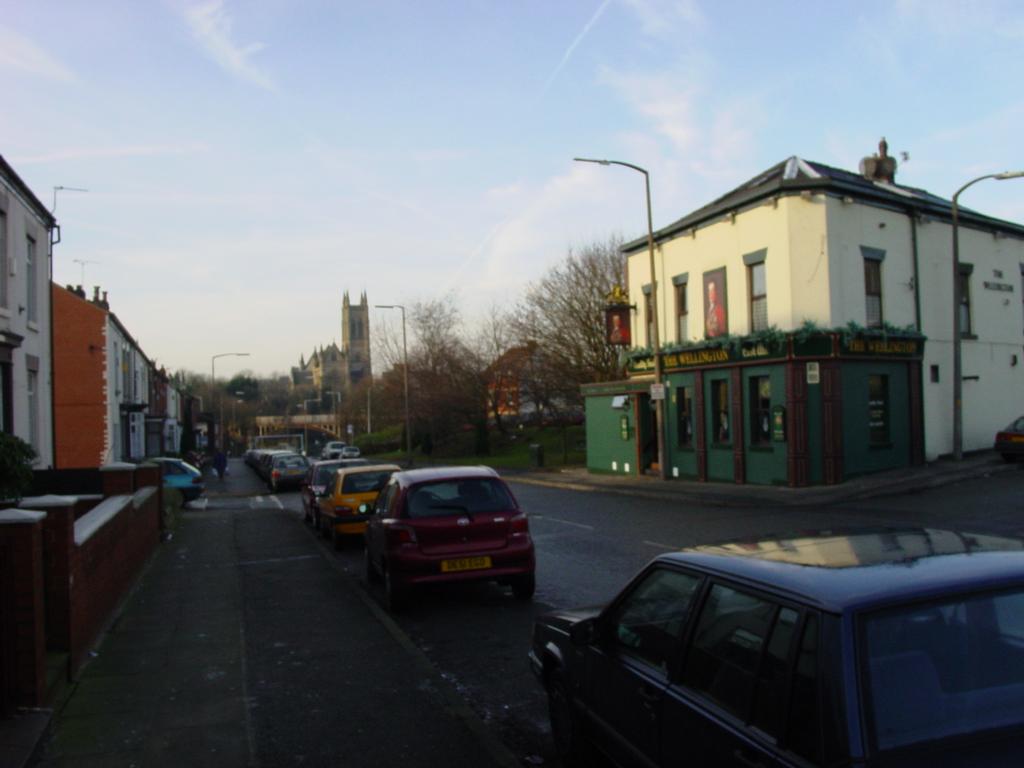
Wellington Inn, Bury New Road

Wellington Bury Road Bolton


The Wellington as seen in 2012.

A 2002 view of the pub can be seen here.  [1]

The Wellington Inn was situated at number 51 Bury New Road, Bolton.

The pub was on the edge of the densely-populated and heavily-pubbed Mill Hill district just a few hundred yards away from the town centre, but in the opposite direction was Castle Street, Dorset Street and rows of more desirable terraced housing. As this area of Bolton was developed in the late-nineteenth century it attracted a better class of punter than the older housing in Mill Hill and it was perhaps with these streets in mind that the Wellington obtained a full licence as opposed to the beer-house licenses that were prevalent in Mill Hill.

The Wellington was certainly in existence by 1871and was probably there some years earlier. Worrall's Directory for that year notes William Stubbs as the brewer there.

It was owned for  much of its existence by the Crown Brewery of Bury. Crown had a number of pubs in Bolton: the Man and Scythe on Churchgate and another Wellington, the one on Market Street in Farnworth, to name but two. Crown and its 127 pubs was taken over by Dutton’s of Blackburn in 1959, but Dutton’s sold out to Whitbread in 1964 and the Wellington spent the next 30 years or so under Whitbread ownership.

In 2010, the Wellington was bought by Pritesh Chauhan who spent £10,000 on re-decorating the pub. A function room was created and a big screen installed in time for the 2010 World Cup. Pritesh’s family helped out on the food side. He got a couple of good write-ups in the Bolton News and on the Best Of Bolton website but sadly the venture failed to take off.

In late-2012 the Wellington was put up for auction but was bought before it went under the hammer by the owner of Nash’s Pharmacy on Castle Street. It appeared on the list of 12 Bolton pubs to close in 2013 although Bolton Council’s spreadsheet of empty properties showed that it was vacated just before Christmas 2012.

Planning permission was lodged in April 2013 for the Wellington to be turned into ground-floor offices and six two-bedroom flats and this was granted in September 2013.

More pictures of the Wellington - while it was still  open - can be seen here and here from 2011

[1] Bolton.org.uk  Retrieved 29 April 2014.

The picture below shows the Wellington during its conversion into flats, April 2014. An extension was being added to the rear of the pub to help accommodate some of its six two-bedroomed flats. 


Tuesday, 29 March 2011

Anchor Inn, Bury Old Road

Anchor Inn Bury Old Road Bolton

The Anchor Inn, March 2011. Image copyright Lost Pubs Of Bolton.

A pub that quietly slipped off the scene in 2008 was the Anchor Inn on the corner of Eagle Street and Bury Old Road, which for the previous 25 years had operated as a free house.

Quite how long it was a pub isn’t known but the building is certainly shown on an 1848 map of Bolton. It may well have been a beer house which generally weren’t marked out on maps of the time.

According to Gordon Readyhough [1] the pub was once known as the Bright View until it became a Magee’s house and changed its name to the Anchor.

The Mill Hill area was a hive of industrial activity and there were numerous pubs between Bury Old Road and Folds Road, particularly along Mill Street and Mill Hill Street, both of which still stand. The Anchor was on the edge of the district and served a mix of industrial buildings and nearby housing in the Bury Road/Castle Street area.

After Magee’s were taken over it became a Greenall’s house and can be seen on this 1976 Bolton Evening News photograph. Note the cobbled streets and the old Bolton Parish Church school in the background (re-built nearby in Kestor Street the eighties).

Although much of the nearby heavy industry largely disappeared in the seventies and eighties there are still a number of offices and industrial units close to the Anchor. But, by the early eighties the Anchor, like a number of other pubs (e.g the Ancient Shepherd and the Alma) was surplus to Greenall’s requirements and it closed and remained empty for some time. However, it reopened in early-1983 [2] after being bought by the Mistry brothers who owned the Bantry club on Derby Street. This time it was run as a free house. Boddington’s beers were sold instead of Greenalls and there was an upturn in the pub’s fortunes. Boddies real ale was now on sale [3] at 53p for a pint of bitter, which was probably average for the time. Cask-conditioned Boddingtons Mild was soon added [4].

The Anchor was quite a pleasant pub, open-plan with a centrally-located bar on the left as you went through the Bury Old Road entrance, and a comfortable lounge ahead of you and to the right.

The pub later bought the adjoining fish and chip shop and opened it as the ‘Anchor Chippy’ serving the nearby industrial units.

The Anchor quietly closed in 2008 and is now known as the Anchor House. The Mistrys have got out of the licensed trade altogether and the old pub is now being run as office premises. Indian Karaoke is one of the businesses based there while the former chippy is now Mandy’s Pantry.

[1] The Pubs Of Bolton 1800-2000, Gordon Readyhough, published by Neil Richardson (2000)
[2] What’s Doing, the Greater Manchester beer drinkers monthly magazine, March 1983
[3] What’s Doing, May 1983
[4] What’s Doing, October 1983

Anchor Inn Bury Old Road Bolton


A side view of the Anchor Inn in 2011 taken from Eagle Street and showing the anchor stone near to the top of the building.

Image copyright Lost Pubs Of Bolton.